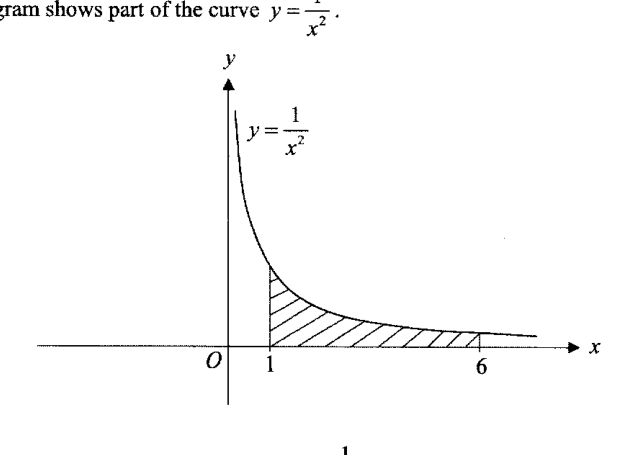
The diagram shows part of the curve y=1x2y = \frac{1}{x^2}.

  1. (i)

    Find the area bounded by the curve y=1x2y = \frac{1}{x^2}, the lines x=1x = 1, x=6x = 6 and the xx-axis.

  2. (ii)

    Show that 122+132+142+152+162<56\frac{1}{2^2} + \frac{1}{3^2} + \frac{1}{4^2} + \frac{1}{5^2} + \frac{1}{6^2} < \frac{5}{6}.

Work through it with AI →

It won't just hand you the answer — it asks where you're stuck.How the checker works

Worked solution

9(i)

1. Set up the definite integral for the area

Area=∫161x2 dx\text{Area} = \int_{1}^{6} \frac{1}{x^2} \, dx

2. Integrate the function

∫16x−2 dx=[x−1−1]16=[−1x]16\int_{1}^{6} x^{-2} \, dx = \left[ \frac{x^{-1}}{-1} \right]_{1}^{6} = \left[ -\frac{1}{x} \right]_{1}^{6}

3. Evaluate the definite integral

(−16)−(−11)=−16+1=56\left( -\frac{1}{6} \right) - \left( -\frac{1}{1} \right) = -\frac{1}{6} + 1 = \frac{5}{6}

Answer

56\frac{5}{6}

9(ii)

1. Calculate the area under the curve from part (i)

Area =∫16x−2 dx=[−1x]16=−16−(−1)=56= \int_{1}^{6} x^{-2} \, dx = \left[ -\frac{1}{x} \right]_{1}^{6} = -\frac{1}{6} - (-1) = \frac{5}{6}

2. Relate the given sum to the area of rectangles under the curve

The sum 122+132+142+152+162\frac{1}{2^2} + \frac{1}{3^2} + \frac{1}{4^2} + \frac{1}{5^2} + \frac{1}{6^2} represents the total area of 5 rectangles, each of width 1, with heights corresponding to the yy-values of the curve at x=2,3,4,5,6x = 2, 3, 4, 5, 6.
Since the curve y=1x2y = \frac{1}{x^2} is decreasing, these rectangles lie entirely below the curve for the interval x=1x=1 to x=6x=6.

3. Conclude the inequality

Therefore, the sum of the areas of these rectangles is strictly less than the area under the curve from x=1x=1 to x=6x=6.
122+132+142+152+162<∫161x2 dx\frac{1}{2^2} + \frac{1}{3^2} + \frac{1}{4^2} + \frac{1}{5^2} + \frac{1}{6^2} < \int_{1}^{6} \frac{1}{x^2} \, dx
122+132+142+152+162<56\frac{1}{2^2} + \frac{1}{3^2} + \frac{1}{4^2} + \frac{1}{5^2} + \frac{1}{6^2} < \frac{5}{6}

Answer

Shown.

AI analysis — may contain mistakes.

Worked this one out on paper? Snap your steps and Gigle's AI math checker will circle the step where it went wrong.

More questions on this topic

  1. 1The figure shows part of the curve y=g(x)y = g(x). (2,8)(2, 8) and (6,1)(6, 1) are two points on the curve. Given that ∫26y dx=32\int_{2}^{6} y \text{ } dx = 32…
  2. 2定积分∫01(2x−x2)dx\int_{0}^{1}(\sqrt{2x{-}x^{2}})dx等于()({ }) A. π4\dfrac{\pi}{4} B. π2\dfrac{\pi}{2} C. π−14\dfrac{\pi{-}1}{4}…
  3. 3The diagram shows part of the curve y=3x+4y = \sqrt{3x + 4}. The line ABAB is tangent to the curve at AA. The points BB an…
  4. 4The diagram shows part of the curve y=(1−x)(x−4)y = (1 - x)(x - 4) and two lines l1l_1 and l2l_2. The lines l1l_1 and l2l_2 are ta…
  5. 5∫−22(sin⁡x+4−x2)dx=()∫_{-2}^{2}(\sin x+\sqrt{4-x^{2}}){\rm d}x=(\quad) A. 44 B. 2π2π C. 4+2π4+2π D. 88