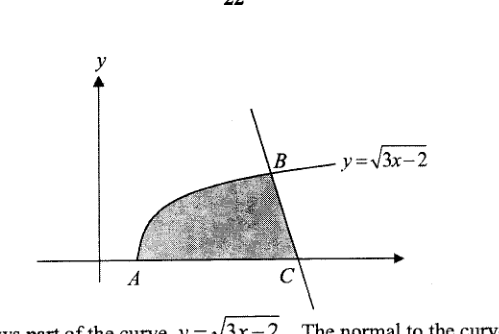
The diagram shows part of the curve . The normal to the curve at meets the -axis at . Given that the -coordinate of is 9, find
- (a)
the coordinates of and of ,
- (b)
the area of the shaded region.
Applications differentiationArea curve and linesCirclesChain ruleDerivative as gradientDefinite integral areaIntegration linear argumentEvaluating definite integralsArea rectilinear中文
It won't just hand you the answer — it asks where you're stuck.How the checker works
Worked solution
14(b)
1. State the coordinates of $A$, $B$, and $C$ found in part (a)
From part (a), we have , , and .
2. Set up the integral for the area under the curve from $A$ to the $x$-coordinate of $B$
Area under curve
3. Evaluate the integral
4. Calculate the area of the triangle formed by the normal and the $x$-axis
The region under the normal from to is a triangle with base and height .
Area of triangle
5. Find the total area of the shaded region
Total area
Answer
or
AI analysis — may contain mistakes.
Worked this one out on paper? Snap your steps and Gigle's AI math checker will circle the step where it went wrong.
More questions on this topic
- 1The diagram shows a greenhouse built on a rectangular base. of polyethene is used to build the curved r…
- 2In the triangle , , and angle . If is increasing…
- 3A curve has the equation , where . The normal to the point on the cur…
- 4Find the gradient function of the curve . The curve touches the positive -axis at point . Fi…
- 5The normal to the curve at point crosses the -axis at point …