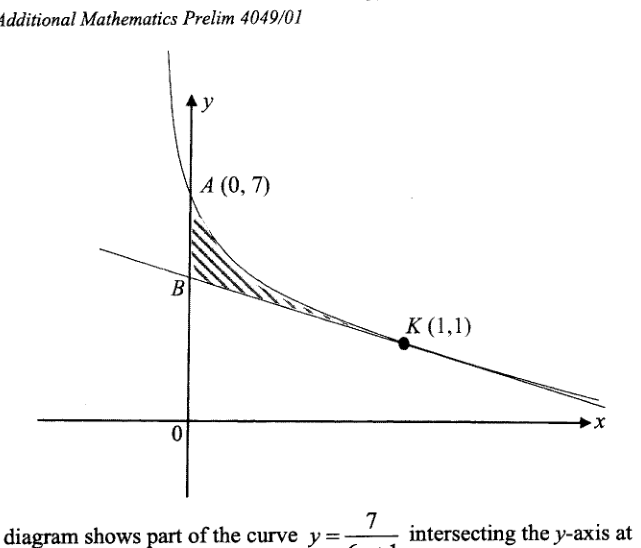
The diagram shows part of the curve intersecting the -axis at .
The tangent to the curve at the point intersects the -axis at .
- (a)
Find the coordinates of .
- (b)
Find the area of the shaded region bounded by the curve, the tangent and the -axis.
It won't just hand you the answer — it asks where you're stuck.How the checker works
Worked solution
12(a)
1. Find the derivative of the curve equation
2. Calculate the gradient of the tangent at $K(1, 1)$
At ,
3. Find the equation of the tangent line and the coordinates of $B$
Equation of tangent at :
Since is the -intercept, substitute :
Coordinates of are .
12(b)
1. Find the equation of the tangent and the coordinates of B from part (a)
At ,
Equation of tangent:
At , . So .
2. Set up the integral for the area under the curve from x = 0 to x = 1
Area under curve
3. Evaluate the integral
4. Calculate the area of the trapezium under the tangent KB
Area of trapezium
5. Find the shaded area by subtracting the trapezium area from the area under the curve
Shaded Area
units
units
AI analysis — may contain mistakes.
Worked this one out on paper? Snap your steps and Gigle's AI math checker will circle the step where it went wrong.
More questions on this topic
- 1The diagram shows a greenhouse built on a rectangular base. of polyethene is used to build the curved r…
- 2In the triangle , , and angle . If is increasing…
- 3A curve has the equation , where . The normal to the point on the cur…
- 4Find the gradient function of the curve . The curve touches the positive -axis at point . Fi…
- 5The normal to the curve at point crosses the -axis at point …