P, Q, R and S are four villages located on an island, where Q is due north of R. PQ = 924 m, QR = 640 m, PR = 1124 m, RS = 583 m. Angle RPS = 26° and angle PSR is obtuse.
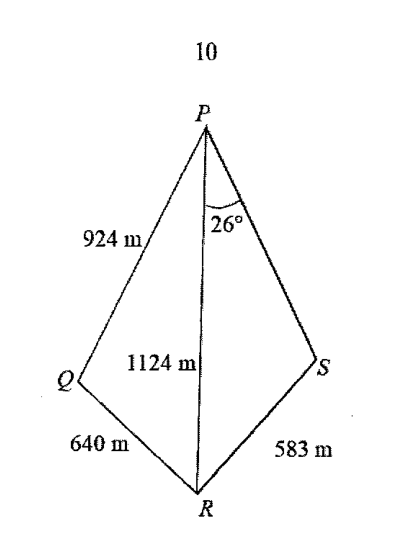
  1. (a)

    Show that P is due east of Q.

  2. (b)

    Find the bearing of S from R.

    Answer ... °

  3. (c)

    A villager took the shortest route to jog from Village Q to Village S at a constant speed of 9.5 km/h. Find the time taken by the villager to jog from Village Q to Village S. Give your answers in minutes and seconds, correct to the nearest ten seconds.

    Answer ... min ... s

Work through it with AI →

It won't just hand you the answer — it asks where you're stuck.How the checker works

Worked solution

4(a)

1. Check whether triangle $PQR$ is right-angled using the three given side lengths.

In △PQR\triangle PQR,
PQ2+QR2=9242+6402PQ^2+QR^2=924^2+640^2
=853 776+409 600=853\,776+409\,600
=1 263 376=1\,263\,376
Also,
PR2=11242=1 263 376PR^2=1124^2=1\,263\,376
Hence,
PQ2+QR2=PR2.PQ^2+QR^2=PR^2.

2. Conclude the right angle is at $Q$.

Since PRPR is the longest side and PQ2+QR2=PR2PQ^2+QR^2=PR^2, PRPR is the hypotenuse.

Therefore,
∠PQR=90∘,\angle PQR=90^\circ,
so PQ⊥QRPQ \perp QR.

3. Use the given north-south direction to justify that $P$ is due east of $Q$.

Since QQ is due north of RR, the line QRQR is a north-south line.

As PQ⊥QRPQ \perp QR, PQPQ is an east-west line.

From the diagram, PP lies to the east of QQ.

Therefore, PP is due east of QQ.

Answer

Since PQ⊥QRPQ \perp QR and QQ is due north of RR, PQPQ is in the east-west direction. From the diagram, PP is to the east of QQ. Hence, PP is due east of QQ.

4(b)

1. Find the bearing of $P$ from $R$ using the right-angled triangle $PQR$.

From part (a), PQperpQRPQ \\perp QR, with QQ due north of RR and PP due east of QQ.\n\nIn right-angled triangle PQRPQR,\ntanangleQRP=fracPQQR=frac924640\\tan \\angle QRP=\\frac{PQ}{QR}=\\frac{924}{640}\nangleQRP=55.3∘textcorrectto1d.p.\\angle QRP=55.3^\circ \\text{ correct to 1 d.p.}\nSo the bearing of PP from RR is 055.3∘055.3^\circ.

2. Use the sine rule in triangle $PRS$ to find the obtuse angle $\\angle PSR$.

In triangle PRSPRS,\nfracsinanglePSRPR=fracsinangleRPSRS\\frac{\\sin \\angle PSR}{PR}=\\frac{\\sin \\angle RPS}{RS}\nfracsinanglePSR1124=fracsin26∘583\\frac{\\sin \\angle PSR}{1124}=\\frac{\\sin 26^\circ}{583}\nsinanglePSR=frac1124sin26∘583=0.844ldots\\sin \\angle PSR=\\frac{1124\\sin 26^\circ}{583}=0.844\\ldots\nHence,\nanglePSR=57.6∘textor122.4∘\\angle PSR=57.6^\circ \\text{ or } 122.4^\circ\nSince anglePSR\\angle PSR is obtuse,\nanglePSR=122.4∘.\\angle PSR=122.4^\circ.

3. Find $\\angle PRS$ and hence the bearing of $S$ from $R$.

Using the angle sum of triangle PRSPRS,\nanglePRS=180∘−26∘−122.4∘=31.6∘.\\angle PRS=180^\circ-26^\circ-122.4^\circ=31.6^\circ.\nFrom the diagram, SS is clockwise from PP about RR. Therefore,\ntextbearingofStextfromR=55.3∘+31.6∘=86.9∘.\\text{bearing of }S\\text{ from }R=55.3^\circ+31.6^\circ=86.9^\circ.\nAs a three-figure bearing, this is\n087∘.087^\circ.

Answer

087∘087^\circ

4(c)

1. Find $\angle PSR$ and hence $\angle PRS$ in triangle $PRS$.

In △PRS\triangle PRS, using the sine rule,
sin⁡∠PSR1124=sin⁡26∘583\frac{\sin \angle PSR}{1124}=\frac{\sin 26^\circ}{583}
sin⁡∠PSR=1124sin⁡26∘583\sin \angle PSR=\frac{1124\sin 26^\circ}{583}
Since ∠PSR\angle PSR is obtuse,
∠PSR≈122.3∘\angle PSR\approx 122.3^\circ
Hence
∠PRS=180∘−26∘−122.3∘≈31.7∘.\angle PRS=180^\circ-26^\circ-122.3^\circ\approx31.7^\circ.

2. Find the length $PS$ using the sine rule.

Using the sine rule again,
PSsin⁡31.7∘=583sin⁡26∘\frac{PS}{\sin 31.7^\circ}=\frac{583}{\sin 26^\circ}
PS=583sin⁡31.7∘sin⁡26∘PS=\frac{583\sin31.7^\circ}{\sin26^\circ}
PS≈698 m.PS\approx698\text{ m}.

3. Find the straight-line distance $QS$.

From part (a), PQ⊥QRPQ\perp QR, so in △PQR\triangle PQR,
tan⁡∠QPR=QRPQ=640924\tan \angle QPR=\frac{QR}{PQ}=\frac{640}{924}
∠QPR≈34.7∘.\angle QPR\approx34.7^\circ.
Therefore
∠QPS=34.7∘+26∘=60.7∘.\angle QPS=34.7^\circ+26^\circ=60.7^\circ.
In △PQS\triangle PQS, using the cosine rule,
QS2=9242+6982−2(924)(698)cos⁡60.7∘QS^2=924^2+698^2-2(924)(698)\cos60.7^\circ
QS≈843 m=0.843 km.QS\approx843\text{ m}=0.843\text{ km}.

4. Use speed to calculate the time and round to the nearest ten seconds.

Speed =9.5 km/h=9.5\text{ km/h}.
Time=0.8439.5 h\text{Time}=\frac{0.843}{9.5}\text{ h}
Time≈0.0887 h\text{Time}\approx0.0887\text{ h}
0.0887×60≈5.32 min0.0887\times60\approx5.32\text{ min}
This is approximately 55 min 1919 s, which rounds to the nearest ten seconds as
5 min 20 s.5\text{ min }20\text{ s}.

Answer

55 min 2020 s

AI analysis — may contain mistakes.

Worked this one out on paper? Snap your steps and Gigle's AI math checker will circle the step where it went wrong.

More questions on this topic

  1. 1如果下列各组数是三角形的三边,那么不能组成直角三角形的一组数是()(\quad) A. 33;44;55 B. 33;44;66 C. 99;1212;1515 D. 44;152\dfrac{15}{2}…
  2. 2下列各组数据,能作为直角三角形三边长的是()() A. 1111,1515,1313 B. 11,44,55 C. 88,1515,1717 D. 44,55,66
  3. 3下列说法正确的是()(\quad) A. y=kx+by=kx+b一定是一次函数 B. 有的实数在数轴上找不到对应的点 C. 长为3\sqrt{3},4\sqrt{4},5\sqrt{5}的三条线段能组成直角三角形 D.…
  4. 4以下列各组数为边长,能构成直角三角形的是()() A. 2 \sqrt {2},3 \sqrt {3},5 \sqrt {5} B. 3 \sqrt {3},4 \sqrt {4},5 \sqrt {5}…
  5. 5以下列各数为边长,不能组成直角三角形的是()(\quad) A. 11,2\sqrt{2},3\sqrt{3} B. 22,232\sqrt{3},44 C. 33,44,55 D.…