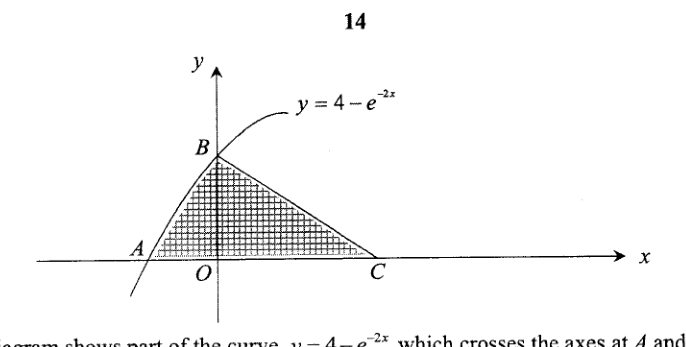
The diagram shows part of the curve y=4−e−2xy = 4 - e^{-2x} which crosses the axes at AA and at BB.

  1. (i)

    Find the coordinates of AA and of BB.

  2. (ii)

    The normal to the curve at BB meets the xx-axis at CC.
    Find the coordinates of CC.

  3. (iii)

    Find the area of the shaded region.

Work through it with AI →

It won't just hand you the answer — it asks where you're stuck.How the checker works

Worked solution

9(i)

1. Find the coordinates of A by setting y = 0

At AA, the curve crosses the xx-axis, so y=0y = 0.
4−e−2x=04 - e^{-2x} = 0
e−2x=4e^{-2x} = 4
−2x=ln⁡4-2x = \ln 4
x=−12ln⁡4x = -\frac{1}{2}\ln 4
So, AA is (−12ln⁡4,0)\left(-\frac{1}{2}\ln 4, 0\right).

2. Find the coordinates of B by setting x = 0

At BB, the curve crosses the yy-axis, so x=0x = 0.
y=4−e−2(0)y = 4 - e^{-2(0)}
y=4−e0y = 4 - e^0
y=4−1=3y = 4 - 1 = 3
So, BB is (0,3)(0, 3).

Answer

A(−12ln⁡4,0)A\left(-\frac{1}{2}\ln 4, 0\right) and B(0,3)B(0, 3)

9(ii)

1. State the coordinates of $B$ from part (i)

At the yy-axis, x=0x = 0.
y=4−e0=4−1=3y = 4 - e^{0} = 4 - 1 = 3
So, BB is (0,3)(0, 3).

2. Find the derivative of the curve to determine the gradient function

y=4−e−2xy = 4 - e^{-2x}
dydx=−(−2)e−2x=2e−2x\frac{dy}{dx} = -(-2)e^{-2x} = 2e^{-2x}

3. Find the gradient of the tangent and the normal at $B$

At x=0x = 0, gradient of tangent mt=2e0=2m_t = 2e^{0} = 2.
Gradient of normal mn=−1mt=−12m_n = -\frac{1}{m_t} = -\frac{1}{2}.

4. Find the equation of the normal at $B$

Equation of the normal:
y−3=−12(x−0)y - 3 = -\frac{1}{2}(x - 0)
y=−12x+3y = -\frac{1}{2}x + 3

5. Find the coordinates of $C$ by setting $y = 0$

The normal meets the xx-axis at CC, so y=0y = 0.
0=−12x+30 = -\frac{1}{2}x + 3
12x=3\frac{1}{2}x = 3
x=6x = 6
Coordinates of CC are (6,0)(6, 0).

Answer

(6,0)(6, 0)

9(iii)

1. Recall or calculate the coordinates of $A$, $B$, and $C$ from earlier parts

From (i), AA is the xx-intercept of the curve: 4−e−2x=0  ⟹  e−2x=4  ⟹  x=−12ln⁡4=−ln⁡24 - e^{-2x} = 0 \implies e^{-2x} = 4 \implies x = -\frac{1}{2}\ln 4 = -\ln 2. So A(−ln⁡2,0)A(-\ln 2, 0).
BB is the yy-intercept: x=0  ⟹  y=4−e0=3x = 0 \implies y = 4 - e^0 = 3. So B(0,3)B(0, 3).
From (ii), the normal at BB has gradient −12-\frac{1}{2} and equation y=−12x+3y = -\frac{1}{2}x + 3. Its xx-intercept is C(6,0)C(6, 0).

2. Set up and evaluate the definite integral for the area under the curve from $A$ to the $y$-axis

Area1=∫−ln⁡20(4−e−2x) dx\text{Area}_1 = \int_{-\ln 2}^{0} (4 - e^{-2x}) \, dx
=[4x+12e−2x]−ln⁡20= \left[ 4x + \frac{1}{2}e^{-2x} \right]_{-\ln 2}^{0}

3. Substitute the limits to find the exact area under the curve

=(0+12e0)−(4(−ln⁡2)+12e−2(−ln⁡2))= \left( 0 + \frac{1}{2}e^0 \right) - \left( 4(-\ln 2) + \frac{1}{2}e^{-2(-\ln 2)} \right)
=12−(−4ln⁡2+12eln⁡4)= \frac{1}{2} - \left( -4\ln 2 + \frac{1}{2}e^{\ln 4} \right)
=12−(−4ln⁡2+12(4))= \frac{1}{2} - \left( -4\ln 2 + \frac{1}{2}(4) \right)
=12+4ln⁡2−2=4ln⁡2−32= \frac{1}{2} + 4\ln 2 - 2 = 4\ln 2 - \frac{3}{2}

4. Calculate the area of the triangle formed by the normal and the axes, and find the total area

The region from x=0x=0 to x=6x=6 is a right-angled triangle OBCOBC.
Area2=12×base×height=12×6×3=9\text{Area}_2 = \frac{1}{2} \times \text{base} \times \text{height} = \frac{1}{2} \times 6 \times 3 = 9
Total Area=Area1+Area2=(4ln⁡2−32)+9=4ln⁡2+152\text{Total Area} = \text{Area}_1 + \text{Area}_2 = \left(4\ln 2 - \frac{3}{2}\right) + 9 = 4\ln 2 + \frac{15}{2}
≈10.3 units2\approx 10.3 \text{ units}^2 (to 3 s.f.)

Answer

4ln⁡2+7.54\ln 2 + 7.5 or 10.310.3 units2^2

AI analysis — may contain mistakes.

Worked this one out on paper? Snap your steps and Gigle's AI math checker will circle the step where it went wrong.

More questions on this topic

  1. 1Answer all questions. Given that a=b2+4ac2aa = \sqrt{\frac{b^2+4ac}{2a}}, find the values of bb when a=4a = 4 and c=−1c = -1. Answ…
  2. 2Mr Phua bought a new car. After tt months, its value VV is given by V=250000e−ptV = 250000e^{-pt}, where pp is a constant. The…
  3. 3The diagram shows part of the curve y=3e−12x−6y = 3e^{-\frac{1}{2}x} - 6 which crosses the xx-axis at PP and the yy-axis at QQ…
  4. 4The decay of a certain radioactive isotope can be modelled by the exponential equation N=N0e−atN = N_0 e^{-at} after tt wee…
  5. 5Given that 125x=51−x25\sqrt{125^x} = \dfrac{5^{1-x}}{25}, find the value of 125x\sqrt{125^x}. Show that log⁡2x−log⁡16x=3lg⁡x4lg⁡2\log_2 x - \log_{16} x = \dfrac{3\lg x}{4\lg 2}…