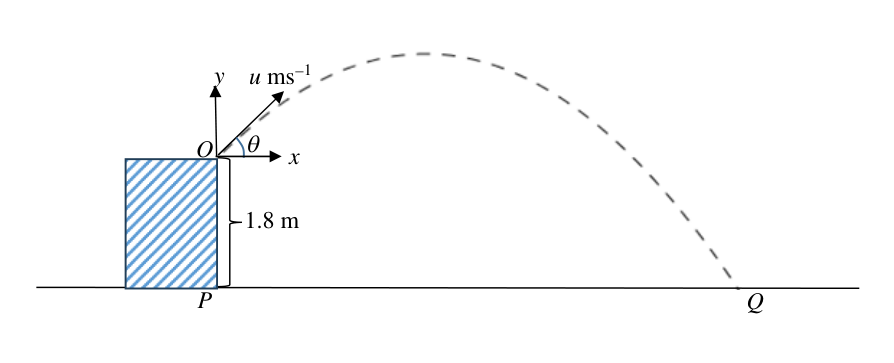
如图所示,一个物体从平台顶部的 OO 点以与水平方向成 θ\theta 的抛射角抛出,其中 0<θ<π20 < \theta < \frac{\pi}{2},初始速度为 u ms−1u\text{ ms}^{-1}。xx-yy 平面包含该物体的运动轨迹,以通过 OO 点的水平轴和竖直轴为参考,该轨迹的方程为 y=xtan⁡θ−10x22u2cos⁡2θ,y = x \tan \theta - \frac{10x^2}{2u^2 \cos^2 \theta}, 其中 x mx\text{ m} 和 y my\text{ m} 分别是如上图所示从 OO 点向右和向上移动的距离。 点 PP 在水平地面上,位于 OO 点正下方 1.8 m1.8\text{ m} 处,而 QQ 是物体落地的点。

  1. (i)

    若物体的投射角为 π4\frac{\pi}{4},且它落在地面上距离 PP 点 15 m15\text{ m} 处,求其初始投射速度。

  2. (ii)

    已知在本题的其余部分中 u=10u = 10。

    证明在 QQ 点,xx 满足方程

    x2−10xsin⁡2θ−18cos⁡2θ−18=0.x^2 - 10x \sin 2\theta - 18 \cos 2\theta - 18 = 0.

  3. (iii)

    通过求导,在 xx 的驻值处用 tan⁡2θ\tan 2\theta 表示 xx。

  4. (iv)

    由此计算 θ\theta(保留两位小数),并求出 xx 的驻值。

先不看答案,让 AI 诊断你卡在哪里?

它不会直接告诉你答案,而是问你卡在哪一步看看 AI 是怎么陪你一步步弄懂这道题的

完整解法

11(i)

1. Determine the coordinates $(x, y)$ of the landing point $Q$.

Since PP is 1.8 m1.8\text{ m} vertically below the origin OO, and QQ is 15 m15\text{ m} horizontally from PP on the ground, the coordinates of QQ are x=15x = 15 and y=−1.8y = -1.8.

2. Substitute the coordinates of $Q$ and the angle of projection into the trajectory equation.

Substitute x=15x = 15, y=−1.8y = -1.8, and θ=π4\theta = \frac{\pi}{4} into the trajectory equation y=xtan⁡θ−10x22u2cos⁡2θy = x \tan \theta - \frac{10x^2}{2u^2 \cos^2 \theta}:
−1.8=15tan⁡(π4)−10(15)22u2cos⁡2(π4)-1.8 = 15 \tan\left(\frac{\pi}{4}\right) - \frac{10(15)^2}{2u^2 \cos^2\left(\frac{\pi}{4}\right)}
Using tan⁡(π4)=1\tan\left(\frac{\pi}{4}\right) = 1 and cos⁡(π4)=12\cos\left(\frac{\pi}{4}\right) = \frac{1}{\sqrt{2}} (so cos⁡2(π4)=12\cos^2\left(\frac{\pi}{4}\right) = \frac{1}{2}):
−1.8=15(1)−22502u2(12)-1.8 = 15(1) - \frac{2250}{2u^2 \left(\frac{1}{2}\right)}
−1.8=15−2250u2-1.8 = 15 - \frac{2250}{u^2}

3. Solve the equation for the initial speed $u$.

Rearrange the equation to make u2u^2 the subject:
2250u2=15+1.8\frac{2250}{u^2} = 15 + 1.8
2250u2=16.8\frac{2250}{u^2} = 16.8
u2=225016.8=187514≈133.93u^2 = \frac{2250}{16.8} = \frac{1875}{14} \approx 133.93
Since speed u>0u > 0, we take the positive square root:
u=187514≈11.5727u = \sqrt{\frac{1875}{14}} \approx 11.5727
u=11.6 m s−1 (to 3 s.f.)u = 11.6\text{ m s}^{-1} \text{ (to 3 s.f.)}

答案

11.6 m s−111.6\text{ m s}^{-1}

11(ii)

1. Substitute $u = 10$ and $y = -1.8$ into the trajectory equation.

At point QQ, the object is on the ground, which is 1.8 m1.8\text{ m} below the origin OO. Thus, the vertical displacement is y=−1.8y = -1.8. We are also given u=10u = 10. Substituting these into the trajectory equation:
−1.8=xtan⁡θ−10x22(10)2cos⁡2θ-1.8 = x \tan \theta - \frac{10x^2}{2(10)^2 \cos^2 \theta}
−1.8=x(sin⁡θcos⁡θ)−10x2200cos⁡2θ-1.8 = x \left(\frac{\sin \theta}{\cos \theta}\right) - \frac{10x^2}{200 \cos^2 \theta}
−1.8=xsin⁡θcos⁡θ−x220cos⁡2θ-1.8 = x \frac{\sin \theta}{\cos \theta} - \frac{x^2}{20 \cos^2 \theta}

2. Multiply by $20 \cos^2 \theta$ and rearrange the equation to form a quadratic in $x$.

Multiply the entire equation by 20cos⁡2θ20 \cos^2 \theta to eliminate the denominators:
−36cos⁡2θ=20xsin⁡θcos⁡θ−x2-36 \cos^2 \theta = 20x \sin \theta \cos \theta - x^2
Rearranging all terms to one side to make the x2x^2 coefficient positive:
x2−20xsin⁡θcos⁡θ−36cos⁡2θ=0x^2 - 20x \sin \theta \cos \theta - 36 \cos^2 \theta = 0

3. Apply double-angle identities for sine and cosine to obtain the final equation.

Using the double-angle identities sin⁡2θ=2sin⁡θcos⁡θ\sin 2\theta = 2 \sin \theta \cos \theta and cos⁡2θ=2cos⁡2θ−1\cos 2\theta = 2 \cos^2 \theta - 1 (which rearranges to 2cos⁡2θ=cos⁡2θ+12\cos^2\theta = \cos 2\theta + 1):
x2−10(2sin⁡θcos⁡θ)−18(2cos⁡2θ)=0x^2 - 10(2 \sin \theta \cos \theta) - 18(2 \cos^2 \theta) = 0
x2−10xsin⁡2θ−18(cos⁡2θ+1)=0x^2 - 10x \sin 2\theta - 18(\cos 2\theta + 1) = 0
x2−10xsin⁡2θ−18cos⁡2θ−18=0(shown)x^2 - 10x \sin 2\theta - 18 \cos 2\theta - 18 = 0 \quad \text{(shown)}

答案

x2−10xsin⁡2θ−18cos⁡2θ−18=0(shown)x^2 - 10x \sin 2\theta - 18 \cos 2\theta - 18 = 0 \quad \text{(shown)}

11(iii)

1. Differentiate the given equation implicitly with respect to $\theta$.

Given the equation from part (ii):
x2−10xsin⁡2θ−18cos⁡2θ−18=0x^2 - 10x \sin 2\theta - 18 \cos 2\theta - 18 = 0

We differentiate each term implicitly with respect to θ\theta, taking care to use the product rule for the −10xsin⁡2θ-10x \sin 2\theta term:
2xdxdθ−(10dxdθsin⁡2θ+10x(2cos⁡2θ))−18(−2sin⁡2θ)−0=02x \frac{dx}{d\theta} - \left(10 \frac{dx}{d\theta} \sin 2\theta + 10x(2 \cos 2\theta)\right) - 18(-2 \sin 2\theta) - 0 = 0
2xdxdθ−10dxdθsin⁡2θ−20xcos⁡2θ+36sin⁡2θ=02x \frac{dx}{d\theta} - 10 \frac{dx}{d\theta} \sin 2\theta - 20x \cos 2\theta + 36 \sin 2\theta = 0

2. Apply the condition for a stationary value of $x$.

At the stationary value of xx, the derivative dxdθ=0\frac{dx}{d\theta} = 0. Substituting this into our differentiated equation:
2x(0)−10(0)sin⁡2θ−20xcos⁡2θ+36sin⁡2θ=02x(0) - 10(0) \sin 2\theta - 20x \cos 2\theta + 36 \sin 2\theta = 0
−20xcos⁡2θ+36sin⁡2θ=0-20x \cos 2\theta + 36 \sin 2\theta = 0

3. Rearrange the equation to express $x$ in terms of $\tan 2\theta$.

Move the terms to opposite sides to isolate xx:
20xcos⁡2θ=36sin⁡2θ20x \cos 2\theta = 36 \sin 2\theta
x=36sin⁡2θ20cos⁡2θx = \frac{36 \sin 2\theta}{20 \cos 2\theta}
x=95tan⁡2θx = \frac{9}{5} \tan 2\theta
x=1.8tan⁡2θx = 1.8 \tan 2\theta

答案

x=1.8tan⁡2θx = 1.8 \tan 2\theta

11(iv)

1. Derive the result of part (iii) by implicitly differentiating the equation to find an expression for the stationary value of $x$.

x2−10xsin⁡2θ−18cos⁡2θ−18=0x^2 - 10x \sin 2\theta - 18 \cos 2\theta - 18 = 0

Differentiating implicitly with respect to θ\theta:
2xdxdθ−(10dxdθsin⁡2θ+20xcos⁡2θ)−18(−2sin⁡2θ)=02x \frac{dx}{d\theta} - \left( 10 \frac{dx}{d\theta} \sin 2\theta + 20x \cos 2\theta \right) - 18(-2 \sin 2\theta) = 0
2xdxdθ−10dxdθsin⁡2θ−20xcos⁡2θ+36sin⁡2θ=02x \frac{dx}{d\theta} - 10 \frac{dx}{d\theta} \sin 2\theta - 20x \cos 2\theta + 36 \sin 2\theta = 0

At the stationary value of xx, dxdθ=0\frac{dx}{d\theta} = 0:
−20xcos⁡2θ+36sin⁡2θ=0  ⟹  20xcos⁡2θ=36sin⁡2θ-20x \cos 2\theta + 36 \sin 2\theta = 0 \implies 20x \cos 2\theta = 36 \sin 2\theta
x=36sin⁡2θ20cos⁡2θ=1.8tan⁡2θx = \frac{36 \sin 2\theta}{20 \cos 2\theta} = 1.8 \tan 2\theta

2. Substitute $x = 1.8 \tan 2\theta$ into the original equation to form a trigonometric equation in terms of $\theta$.

(1.8tan⁡2θ)2−10(1.8tan⁡2θ)sin⁡2θ−18cos⁡2θ−18=0(1.8 \tan 2\theta)^2 - 10(1.8 \tan 2\theta) \sin 2\theta - 18 \cos 2\theta - 18 = 0
3.24sin⁡22θcos⁡22θ−18sin⁡22θcos⁡2θ−18cos⁡2θ−18=03.24 \frac{\sin^2 2\theta}{\cos^2 2\theta} - 18 \frac{\sin^2 2\theta}{\cos 2\theta} - 18 \cos 2\theta - 18 = 0

Divide by 18:
0.18sin⁡22θcos⁡22θ−sin⁡22θcos⁡2θ−cos⁡2θ−1=00.18 \frac{\sin^2 2\theta}{\cos^2 2\theta} - \frac{\sin^2 2\theta}{\cos 2\theta} - \cos 2\theta - 1 = 0

3. Simplify the trigonometric equation into a quadratic in terms of $\cos 2\theta$ and solve for its roots.

Multiply the equation by cos⁡22θ\cos^2 2\theta:
0.18sin⁡22θ−sin⁡22θcos⁡2θ−cos⁡32θ−cos⁡22θ=00.18 \sin^2 2\theta - \sin^2 2\theta \cos 2\theta - \cos^3 2\theta - \cos^2 2\theta = 0

Substitute sin⁡22θ=1−cos⁡22θ\sin^2 2\theta = 1 - \cos^2 2\theta:
0.18(1−cos⁡22θ)−cos⁡2θ(1−cos⁡22θ)−cos⁡32θ−cos⁡22θ=00.18(1 - \cos^2 2\theta) - \cos 2\theta(1 - \cos^2 2\theta) - \cos^3 2\theta - \cos^2 2\theta = 0
0.18−0.18cos⁡22θ−cos⁡2θ+cos⁡32θ−cos⁡32θ−cos⁡22θ=00.18 - 0.18 \cos^2 2\theta - \cos 2\theta + \cos^3 2\theta - \cos^3 2\theta - \cos^2 2\theta = 0
−1.18cos⁡22θ−cos⁡2θ+0.18=0-1.18 \cos^2 2\theta - \cos 2\theta + 0.18 = 0

Multiply by −50-50 to achieve integer coefficients:
59cos⁡22θ+50cos⁡2θ−9=059 \cos^2 2\theta + 50 \cos 2\theta - 9 = 0

Factorising the quadratic equation:
(59cos⁡2θ−9)(cos⁡2θ+1)=0(59 \cos 2\theta - 9)(\cos 2\theta + 1) = 0

Since 0<θ<π20 < \theta < \frac{\pi}{2}, we have 0<2θ<π0 < 2\theta < \pi, which means cos⁡2θ≠−1\cos 2\theta \neq -1. Thus:
cos⁡2θ=959\cos 2\theta = \frac{9}{59}

4. Calculate the angle $\theta$ and find the corresponding stationary value of $x$.

2θ=cos⁡−1(959)≈1.4176 rad2\theta = \cos^{-1}\left(\frac{9}{59}\right) \approx 1.4176 \text{ rad}
θ≈0.7088≈0.71 rad (to 2 d.p.)\theta \approx 0.7088 \approx 0.71 \text{ rad (to 2 d.p.)}

Substitute 2θ≈1.41762\theta \approx 1.4176 back to find xx:
x=1.8tan⁡(1.4176)≈11.6619x = 1.8 \tan(1.4176) \approx 11.6619
x≈11.7 (to 3 s.f.)x \approx 11.7 \text{ (to 3 s.f.)}

答案

θ=0.71\theta = 0.71
x=11.7x = 11.7

AI 分析,可能出错

用 AI 批改,圈出写错的那一步,并自动将你的薄弱点存入错题本,形成你的错因库。

同一知识点的其他题

  1. 1曲线 C 的方程为 x+y=(x−y)2x + y = (x - y)^2。 已知 C 只有一个转向点。 证明 1−dydx=21+2x−2y1 - \frac{dy}{dx} = \frac{2}{1 + 2x - 2y}。 由此,或用其他方法,证明 d2ydx2=(1−dydx)3\displaystyle \frac{d^2 y}{dx^2} = \left(1 - \frac{dy}{dx}\right)^3…
  2. 2曲线 C 的方程为 x+y=(x−y)2.x + y = (x - y)^2. 已知 C 只有一个驻点。 证明 1−dydx=21+2x−2y1 - \dfrac{dy}{dx} = \dfrac{2}{1 + 2x - 2y}。 由此或用其他方法,证明 d2ydx2=(1−dydx)3.\dfrac{d^2y}{dx^2} = \left(1 - \dfrac{dy}{dx}\right)^3.…
  3. 3曲线 C1C_1 的方程为 p2x2−y2=p2p^2x^2 - y^2 = p^2,其中 p>1p > 1。 画出 C1C_1 的草图,用 pp 表示出其与坐标轴的所有交点坐标、所有驻点坐标以及所有渐近线方程。 C1C_1 经过单一变换得到 C2C_2。…
  4. 4曲线 CC 的参数方程为 x=2cos⁡θ+cos⁡2θ,y=2sin⁡θ−sin⁡2θ,x = 2\cos\theta + \cos 2\theta, \quad y = 2\sin\theta - \sin 2\theta, 其中 0<θ<2π0 < \theta < 2\pi 且 θ≠2π3,π,4π3\theta \ne \frac{2\pi}{3}, \pi, \frac{4\pi}{3}…
  5. 5已知 y=1+tan⁡−12xy = \sqrt{1 + \tan^{-1} 2x},其中 −12<x<12-\frac{1}{2} < x < \frac{1}{2}。证明 yd2ydx2+(dydx)2+8x(1+4x2)2=0.y \frac{\mathrm{d}^2 y}{\mathrm{d}x^2} + \left(\frac{\mathrm{d}y}{\mathrm{d}x}\right)^2 + \frac{8x}{(1 + 4x^2)^2} = 0.…