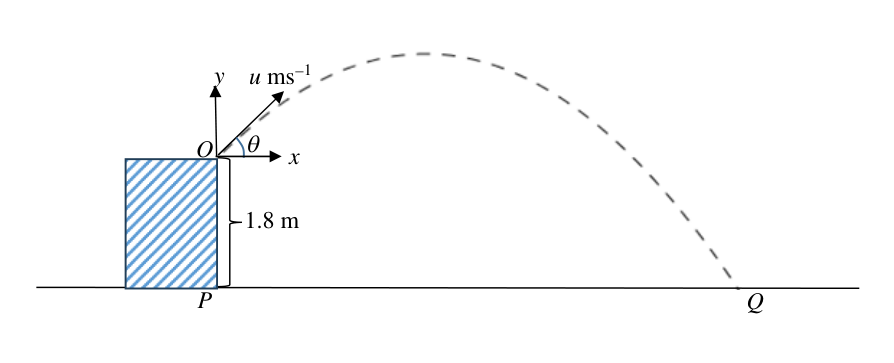
The diagram shows an object being projected from the top of a platform at at an angle of projection made with the horizontal, where , with an initial speed of . The - plane contains the trajectory of the object, with the equation of the trajectory, referred to the horizontal and vertical axes through , given by where and are the distances travelled to the right and upwards from respectively as shown in the diagram above. The point is vertically below on the horizontal ground and is the point where the object lands on the ground.
- (i)
If the angle of projection of the object is and it lands at a distance of on the ground from , find its initial speed of projection.
- (ii)
It is given that for the rest of the question.
Show that at , satisfies the equation
- (iii)
By using differentiation, express in terms of at the stationary value of .
- (iv)
Hence calculate to 2 decimal places and find the stationary value of .
It won't just hand you the answer — it asks where you're stuck.How the checker works
Worked solution
11(i)
1. Determine the coordinates $(x, y)$ of the landing point $Q$.
Since is vertically below the origin , and is horizontally from on the ground, the coordinates of are and .
2. Substitute the coordinates of $Q$ and the angle of projection into the trajectory equation.
Substitute , , and into the trajectory equation :
Using and (so ):
3. Solve the equation for the initial speed $u$.
Rearrange the equation to make the subject:
Since speed , we take the positive square root:
11(ii)
1. Substitute $u = 10$ and $y = -1.8$ into the trajectory equation.
At point , the object is on the ground, which is below the origin . Thus, the vertical displacement is . We are also given . Substituting these into the trajectory equation:
2. Multiply by $20 \cos^2 \theta$ and rearrange the equation to form a quadratic in $x$.
Multiply the entire equation by to eliminate the denominators:
Rearranging all terms to one side to make the coefficient positive:
3. Apply double-angle identities for sine and cosine to obtain the final equation.
Using the double-angle identities and (which rearranges to ):
11(iii)
1. Differentiate the given equation implicitly with respect to $\theta$.
Given the equation from part (ii):
We differentiate each term implicitly with respect to , taking care to use the product rule for the term:
2. Apply the condition for a stationary value of $x$.
At the stationary value of , the derivative . Substituting this into our differentiated equation:
3. Rearrange the equation to express $x$ in terms of $\tan 2\theta$.
Move the terms to opposite sides to isolate :
11(iv)
1. Derive the result of part (iii) by implicitly differentiating the equation to find an expression for the stationary value of $x$.
Differentiating implicitly with respect to :
At the stationary value of , :
2. Substitute $x = 1.8 \tan 2\theta$ into the original equation to form a trigonometric equation in terms of $\theta$.
Divide by 18:
3. Simplify the trigonometric equation into a quadratic in terms of $\cos 2\theta$ and solve for its roots.
Multiply the equation by :
Substitute :
Multiply by to achieve integer coefficients:
Factorising the quadratic equation:
Since , we have , which means . Thus:
4. Calculate the angle $\theta$ and find the corresponding stationary value of $x$.
Substitute back to find :
AI analysis — may contain mistakes.
Worked this one out on paper? Snap your steps and Gigle's AI math checker will circle the step where it went wrong.
More questions on this topic
- 1The curve C has equation . It is given that C has only one turning point. Show that …
- 2The curve C has equation It is given that C has only one turning point. Show that …
- 3A curve has the equation where . Sketch , stating the coordinates of any points o…
- 4A curve has parametric equations where …
- 5It is given that where . Show that …