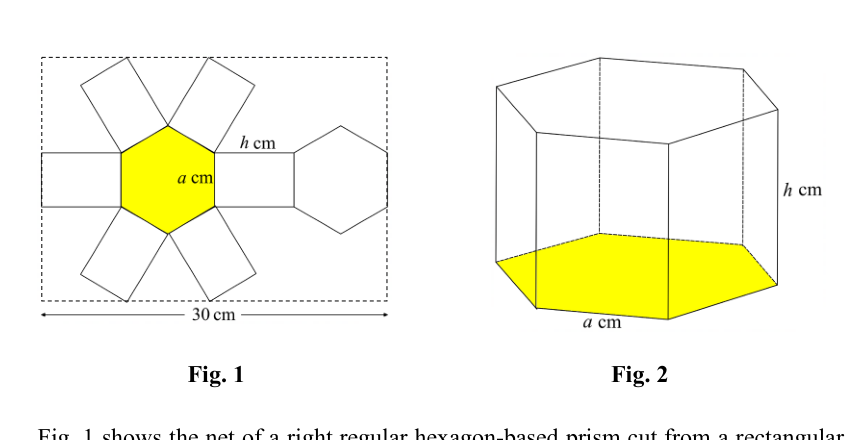
图 1 展示了一个直正六棱柱的展开图,它是从一张边长为 30 cm 的矩形纸板上裁剪下来的。该展开图由两个边长为 aa cm 的正六边形和六个边长分别为 aa cm 和 hh cm 的矩形组成。将展开图折叠后形成一个直六棱柱,其底面为边长 aa cm 的正六边形,直高为 hh cm,如图 2 所示。

  1. (a)

    证明 h+a3=15h + a \sqrt{3} = 15。

  2. (b)

    证明正六边形底面的面积为 332a2 cm2\frac{3\sqrt{3}}{2} a^2\text{ cm}^2。

  3. (c)

    利用求导求出该棱柱可能的最大体积的精确值,并证明该值确实为最大值。

  4. (d)

    求出取得该最大体积时 hh 与 aa 的比值。

  5. (e)

    画出展示棱柱体积随 aa 的值变化而变化的函数图像草图。

先不看答案,让 AI 诊断你卡在哪里?

它不会直接告诉你答案,而是问你卡在哪一步看看 AI 是怎么陪你一步步弄懂这道题的

完整解法

12(a)

1. Find the distance across opposite parallel sides of the regular hexagon.

A regular hexagon of side aa can be divided into 6 equilateral triangles of side length aa.
The perpendicular height of one such equilateral triangle is:
asin⁡60∘=a(32)=32aa \sin 60^\circ = a \left(\frac{\sqrt{3}}{2}\right) = \frac{\sqrt{3}}{2}a
The horizontal distance between opposite parallel sides of the hexagon is twice this height:
Distance=2(32a)=a3\text{Distance} = 2 \left( \frac{\sqrt{3}}{2}a \right) = a\sqrt{3}

2. Formulate the equation for the width of the cardboard and simplify to obtain the required result.

Based on the layout of the net, the maximum span across the rectangular boundary consists of the length of two rectangles (each hh) and the width of two hexagons (each a3a\sqrt{3}).
Total width=h+a3+h+a3\text{Total width} = h + a\sqrt{3} + h + a\sqrt{3}
Total width=2h+2a3\text{Total width} = 2h + 2a\sqrt{3}
Given that this total width corresponds to the cardboard side length of 30 cm:
2h+2a3=302h + 2a\sqrt{3} = 30
Dividing the entire equation by 2 gives:
h+a3=15(shown)h + a\sqrt{3} = 15 \quad \text{(shown)}

答案

h+a3=15h + a\sqrt{3} = 15

12(b)

1. Find the area of one of the 6 equilateral triangles that make up the regular hexagon.

A regular hexagon of side length aa can be divided into 6 congruent equilateral triangles with side length aa.
Area of one equilateral triangle=12(a)(a)sin⁡60∘\text{Area of one equilateral triangle} = \frac{1}{2}(a)(a)\sin 60^\circ
=12a2(32)=34a2= \frac{1}{2}a^2\left(\frac{\sqrt{3}}{2}\right) = \frac{\sqrt{3}}{4}a^2

2. Calculate the total area of the regular hexagon.

Area of hexagon=6×34a2\text{Area of hexagon} = 6 \times \frac{\sqrt{3}}{4}a^2
=332a2 cm2(Shown)= \frac{3\sqrt{3}}{2}a^2\text{ cm}^2 \quad \text{(Shown)}

答案

332a2 cm2\frac{3\sqrt{3}}{2} a^2\text{ cm}^2 (Shown)

12(c)

1. Express the volume of the prism, $V$, in terms of a single variable $a$.

V=Base Area×hV = \text{Base Area} \times h
V=(332a2)hV = \left( \frac{3\sqrt{3}}{2}a^2 \right) h
From part (a), h=15−a3h = 15 - a\sqrt{3}. Substitute this into the volume equation:
V=332a2(15−a3)V = \frac{3\sqrt{3}}{2}a^2 (15 - a\sqrt{3})
V=4532a2−92a3V = \frac{45\sqrt{3}}{2}a^2 - \frac{9}{2}a^3

2. Differentiate $V$ with respect to $a$.

dVda=453a−272a2\frac{\text{d}V}{\text{d}a} = 45\sqrt{3}a - \frac{27}{2}a^2

3. Find the critical value of $a$ by setting the derivative to zero.

Set dVda=0\frac{\text{d}V}{\text{d}a} = 0 for stationary points:
a(453−272a)=0a \left( 45\sqrt{3} - \frac{27}{2}a \right) = 0
Since a>0a > 0 for a valid physical length, we reject a=0a=0:
453−272a=045\sqrt{3} - \frac{27}{2}a = 0
a=90327=1033a = \frac{90\sqrt{3}}{27} = \frac{10\sqrt{3}}{3}

4. Use the second derivative test to prove that the volume is a maximum.

d2Vda2=453−27a\frac{\text{d}^2V}{\text{d}a^2} = 45\sqrt{3} - 27a
Substitute a=1033a = \frac{10\sqrt{3}}{3}:
d2Vda2=453−27(1033)\frac{\text{d}^2V}{\text{d}a^2} = 45\sqrt{3} - 27\left(\frac{10\sqrt{3}}{3}\right)
d2Vda2=453−903=−453\frac{\text{d}^2V}{\text{d}a^2} = 45\sqrt{3} - 90\sqrt{3} = -45\sqrt{3}
Since d2Vda2<0\frac{\text{d}^2V}{\text{d}a^2} < 0, the volume VV is a maximum.

5. Calculate the exact maximum volume.

When a=1033a = \frac{10\sqrt{3}}{3}, we first find hh:
h=15−(1033)3=15−10=5h = 15 - \left(\frac{10\sqrt{3}}{3}\right)\sqrt{3} = 15 - 10 = 5
Substitute into V=Base Area×hV = \text{Base Area} \times h:
Vmax=332(1033)2(5)V_{\text{max}} = \frac{3\sqrt{3}}{2} \left(\frac{10\sqrt{3}}{3}\right)^2 (5)
Vmax=1532(100×39)V_{\text{max}} = \frac{15\sqrt{3}}{2} \left(\frac{100 \times 3}{9}\right)
Vmax=1532(1003)=2503 cm3V_{\text{max}} = \frac{15\sqrt{3}}{2} \left(\frac{100}{3}\right) = 250\sqrt{3} \text{ cm}^3

答案

2503 cm3250\sqrt{3} \text{ cm}^3

12(d)

1. Find the corresponding value of $h$ for the maximum volume

From part (c), the maximum volume occurs when dVda=0\frac{\mathrm{d}V}{\mathrm{d}a} = 0, which gives a=1033a = \frac{10\sqrt{3}}{3}.

Substituting this into the equation relating hh and aa from part (a):
h=15−a3h = 15 - a\sqrt{3}
h=15−(1033)3h = 15 - \left(\frac{10\sqrt{3}}{3}\right)\sqrt{3}
h=15−10(3)3=15−10=5h = 15 - \frac{10(3)}{3} = 15 - 10 = 5

2. Calculate and simplify the ratio of $h$ to $a$

Ratio ha=51033\frac{h}{a} = \frac{5}{\frac{10\sqrt{3}}{3}}
ha=15103\frac{h}{a} = \frac{15}{10\sqrt{3}}
ha=323=32\frac{h}{a} = \frac{3}{2\sqrt{3}} = \frac{\sqrt{3}}{2}

The ratio of hh to aa is 3:2\sqrt{3} : 2.

答案

3:2\sqrt{3} : 2

12(e)

1. Identify the equation for the volume and the practical domain for $a$.

From earlier parts, the volume is V=332a2(15−a3)V = \frac{3\sqrt{3}}{2} a^2 (15 - a\sqrt{3}).
For a physical prism, the side length a>0a > 0 and the height h>0h > 0.
Since h=15−a3>0h = 15 - a\sqrt{3} > 0, we have a<153=53a < \frac{15}{\sqrt{3}} = 5\sqrt{3}.
Thus, the meaningful domain for the graph is 0<a<530 < a < 5\sqrt{3}.

2. Determine the coordinates of the intercepts and the turning point.

The aa-intercepts occur where V=0V = 0, which gives a=0a = 0 and a=53a = 5\sqrt{3}.
From part (c), the maximum volume occurs at a=1033a = \frac{10\sqrt{3}}{3}.
Substituting this into VV yields the maximum volume:
V=332(1033)2(15−10333)=332(1003)(15−10)=2503V = \frac{3\sqrt{3}}{2} \left(\frac{10\sqrt{3}}{3}\right)^2 \left(15 - \frac{10\sqrt{3}}{3}\sqrt{3}\right) = \frac{3\sqrt{3}}{2} \left(\frac{100}{3}\right)(15 - 10) = 250\sqrt{3}.
So the maximum point is (1033,2503)\left(\frac{10\sqrt{3}}{3}, 250\sqrt{3}\right).

3. Describe the features of the sketched curve.

The graph is a smooth cubic curve. Since dVda=0\frac{dV}{da} = 0 at a=0a = 0, the curve starts tangent to the horizontal axis at (0,0)(0,0), increases to the maximum turning point at (1033,2503)\left(\frac{10\sqrt{3}}{3}, 250\sqrt{3}\right), and then decreases until it hits the aa-axis at (53,0)(5\sqrt{3}, 0).

答案

A smooth curve plotted on VV (vertical) and aa (horizontal) axes. The curve starts at the origin (0,0)(0,0) where it is horizontal, rises to a maximum turning point labelled (1033,2503)\left(\frac{10\sqrt{3}}{3}, 250\sqrt{3}\right), and falls to intersect the aa-axis at (53,0)(5\sqrt{3}, 0). The sketch is restricted to the domain 0≤a≤530 \le a \le 5\sqrt{3}.

AI 分析,可能出错

用 AI 批改,圈出写错的那一步,并自动将你的薄弱点存入错题本,形成你的错因库。

同一知识点的其他题

  1. 1[底面半径为 rr、高为 hh 的圆锥体积由 V=13πr2hV = \frac{1}{3}\pi r^2 h 给出。] 某制造商用同一种材料制作了一个漏斗状的装饰品,它由两部分组成,如图 1所示。 * 一个半径为 rr cm、高为 hh…
  2. 2一个圆心角为 θ\theta 弧度、半径为 4π cm4\pi\text{ cm} 的扇形被用来围成一个直圆锥的侧面,且没有重叠。证明该圆锥的体积为 8π34π2θ4−θ6 cm3.\hfill[3]\frac{8\pi}{3}\sqrt{4\pi^2\theta^4 - \theta^6}\text{ cm}^3. \hfill [3]…
  3. 3作为艺术项目的一部分,一个学生设计了一个如图所示的八面体灯笼。灯笼的框架由十二根直铁丝组成,端点相连,形成两个相同的正四棱锥(其底面为边长为 4x m4x\text{ m} 的正方形,侧棱长为 y my\text{ m})。铁丝框架用彩色纸紧紧包…
  4. 4下图显示了一个体积固定为 4k34k\sqrt{3} 单位3^{3} 的梯形柱体的尺寸,其中变量为 xx 和 yy。 该柱体的顶面 ABCDABCD 是一个等腰梯形,其中 ABAB 的长度为 5x5x 单位,DCDC 的长度为 3x3x 单…
  5. 5[半径为 rr、高为 hh 的直圆锥的体积为 13πr2h\frac{1}{3}\pi r^2 h。] 一名学生为他自制的3D打印机制作了一个打印机喷嘴。该打印机喷嘴由一个厚度可忽略的空心倒置直圆锥(其半径为 rr mm,其中 0<r<20 < r < 2…