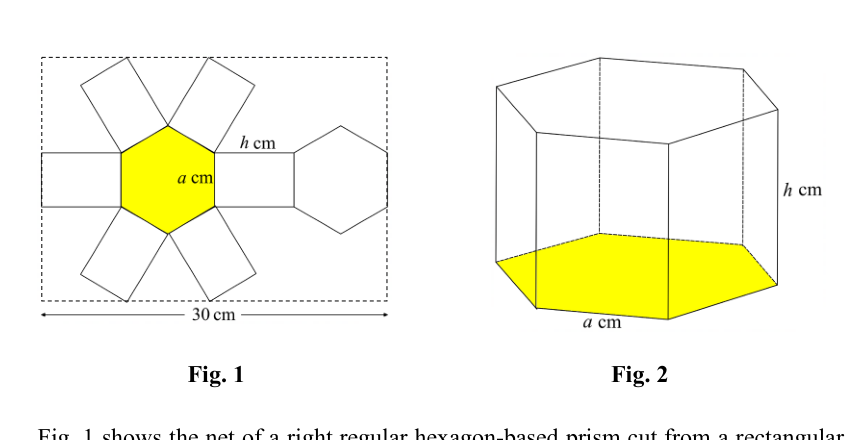
Fig. 1 shows the net of a right regular hexagon-based prism cut from a rectangular cardboard of one side length 30 cm. The net consists of two regular hexagons of side length cm and six rectangles, each with sides of length cm and cm. The net is folded to form a prism which has a hexagonal base of side length cm and vertical height cm, as shown in Fig. 2.
- (a)
Show that .
- (b)
Show that the area of the hexagonal base is .
- (c)
Use differentiation to find the exact value of the maximum possible volume of the prism and prove that this value is a maximum.
- (d)
Find the ratio of to that gives this maximum volume.
- (e)
Sketch the graph showing the volume of the prism as the value of varies.
It won't just hand you the answer — it asks where you're stuck.How the checker works
Worked solution
12(a)
1. Find the distance across opposite parallel sides of the regular hexagon.
A regular hexagon of side can be divided into 6 equilateral triangles of side length .
The perpendicular height of one such equilateral triangle is:
The horizontal distance between opposite parallel sides of the hexagon is twice this height:
2. Formulate the equation for the width of the cardboard and simplify to obtain the required result.
Based on the layout of the net, the maximum span across the rectangular boundary consists of the length of two rectangles (each ) and the width of two hexagons (each ).
Given that this total width corresponds to the cardboard side length of 30 cm:
Dividing the entire equation by 2 gives:
12(b)
1. Find the area of one of the 6 equilateral triangles that make up the regular hexagon.
A regular hexagon of side length can be divided into 6 congruent equilateral triangles with side length .
2. Calculate the total area of the regular hexagon.
(Shown)
12(c)
1. Express the volume of the prism, $V$, in terms of a single variable $a$.
From part (a), . Substitute this into the volume equation:
2. Differentiate $V$ with respect to $a$.
3. Find the critical value of $a$ by setting the derivative to zero.
Set for stationary points:
Since for a valid physical length, we reject :
4. Use the second derivative test to prove that the volume is a maximum.
Substitute :
Since , the volume is a maximum.
5. Calculate the exact maximum volume.
When , we first find :
Substitute into :
12(d)
1. Find the corresponding value of $h$ for the maximum volume
From part (c), the maximum volume occurs when , which gives .
Substituting this into the equation relating and from part (a):
2. Calculate and simplify the ratio of $h$ to $a$
Ratio
The ratio of to is .
12(e)
1. Identify the equation for the volume and the practical domain for $a$.
From earlier parts, the volume is .
For a physical prism, the side length and the height .
Since , we have .
Thus, the meaningful domain for the graph is .
2. Determine the coordinates of the intercepts and the turning point.
The -intercepts occur where , which gives and .
From part (c), the maximum volume occurs at .
Substituting this into yields the maximum volume:
.
So the maximum point is .
3. Describe the features of the sketched curve.
The graph is a smooth cubic curve. Since at , the curve starts tangent to the horizontal axis at , increases to the maximum turning point at , and then decreases until it hits the -axis at .
A smooth curve plotted on (vertical) and (horizontal) axes. The curve starts at the origin where it is horizontal, rises to a maximum turning point labelled , and falls to intersect the -axis at . The sketch is restricted to the domain .
AI analysis — may contain mistakes.
Worked this one out on paper? Snap your steps and Gigle's AI math checker will circle the step where it went wrong.
More questions on this topic
- 1[The volume of a cone of base radius and height is given by .] A manufacturer makes a…
- 2A sector of angle radians and radius is used to form the curved surface of a right circular co…
- 3As part of an Art Project, a student designed a lantern in the shape of an octahedron as shown in the diagram. The frame…
- 4The following diagram shows the dimensions of a trapezoidal prism with fixed volume units, with varia…
- 5[The volume of a right circular cone of radius and height is .] A student makes a printer…