ξ={integers x:1≤x≤12}\xi = \{\text{integers } x: 1 \le x \le 12\} A={integers x:1−2x>−9}A = \{\text{integers } x: 1-2x > -9\} B={prime numbers}B = \{\text{prime numbers}\}

  1. (a)

    列出 A∩B′A \cap B' 中的元素。

    答案 ...

  2. (b)

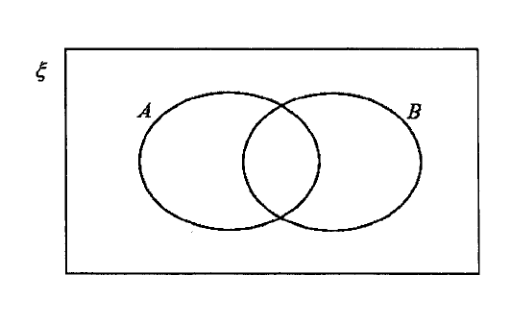
    在韦恩图中,给表示 A′∪BA' \cup B 的区域涂上阴影。

    答案

先不看答案,让 AI 诊断你卡在哪里?

它不会直接告诉你答案,而是问你卡在哪一步看看 AI 是怎么陪你一步步弄懂这道题的

完整解法

7(a)

1. Identify the universal set and find the elements of set $A$.

ξ={1,2,3,4,5,6,7,8,9,10,11,12}\xi=\{1,2,3,4,5,6,7,8,9,10,11,12\}

For AA:
1−2x>−91-2x>-9
−2x>−10-2x>-10
x<5x<5
So, within ξ\xi,
A={1,2,3,4}.A=\{1,2,3,4\}.

2. Identify $B'$ and list the elements in $A\cap B'$.

The prime numbers in ξ\xi are
B={2,3,5,7,11}.B=\{2,3,5,7,11\}.
Hence
B′={1,4,6,8,9,10,12}.B'=\{1,4,6,8,9,10,12\}.
Therefore
A∩B′={1,4}.A\cap B'=\{1,4\}.

答案

{1,4}\{1, 4\}

7(b)

1. Interpret the set expression and identify the required shaded regions.

A′∪BA' \cup B means all elements which are not in AA, or are in BB.

On the Venn diagram, shade:

  • the whole of circle BB, including A∩BA \cap B,
  • all the region outside circle AA.

Therefore the only region not shaded is A∩B′A \cap B', the part inside AA but outside BB.

答案

Shade the whole rectangle except the part of AA only, i.e. leave only A∩B′A \cap B' unshaded.

AI 分析,可能出错

用 AI 批改,圈出写错的那一步,并自动将你的薄弱点存入错题本,形成你的错因库。

同一知识点的其他题

  1. 1在韦恩图上,给表示 A′∪BA' \cup B 的区域涂上阴影。 用集合符号描述阴影区域。
  2. 2已知 ξ={x:x is polygon},\xi = \{x: x \text{ is polygon}\}, p={x:x is a parallelogram},p = \{x: x \text{ is a parallelogram}\}, q={x:x is a quadrilateral},q = \{x: x \text{ is a quadrilateral}\},…
  3. 3ξ={integers x:2<x≤12}\xi = \{\text{integers } x: 2 < x \le 12\} A={prime numbers}A = \{\text{prime numbers}\} B={factors of 12}B = \{\text{factors of 12}\} C={greater than 100}C = \{\text{greater than } \sqrt{100}\}…
  4. 4在答题区给出的韦恩图中,用阴影表示集合 A∩B′A \cap B'。 ε=x:x is an integer and 1≤x≤100ε = {x: x \text{ is an integer and } 1 \le x \le 100} P=x:x is a perfect squareP = {x: x \text{ is a perfect square}}…
  5. 5ε={integer x:0<x≤12}\varepsilon = \{\text{integer } x : 0 < x \le 12\} A={prime numbers}A = \{\text{prime numbers}\} B={numbers that have at least 2 distinct factors}B = \{\text{numbers that have at least 2 distinct factors}\}…