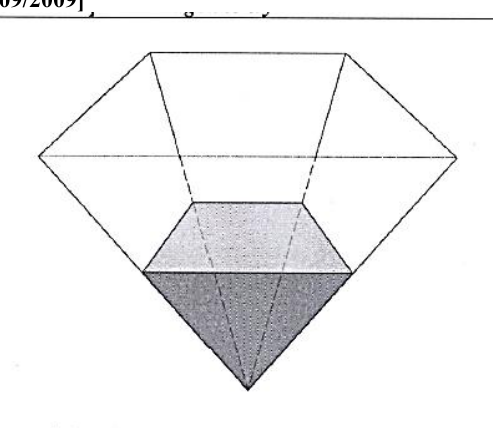
[剑桥/9709/2009] 一个地下储水罐正在被注满液体(如图所示)。初始时储水罐是空的。在开始注水后 tt 小时,液体的体积为 V m3V\text{ m}^3,液体的深度为 h mh\text{ m}。已知 V=43h3V = \frac{4}{3}h^3。 液体以每小时 20 m320\text{ m}^3 的速率注入,但由于泄漏,液体流失的速率与 h2h^2 成正比。当 h=1h = 1 时,dhdt=4.95\frac{\text{d}h}{\text{d}t} = 4.95。

  1. (i)

    证明 hh 满足微分方程
    dhdt=5h2−120.\frac{\text{d}h}{\text{d}t} = \frac{5}{h^2} - \frac{1}{20}.

  2. (ii)

    验证 20h2100−h2≡−20+2000(10−h)(10+h)\frac{20h^2}{100 - h^2} \equiv -20 + \frac{2000}{(10 - h)(10 + h)}。

  3. (iii)

    由此求解第 (i) 部分中的微分方程,得到用 hh 表示 tt 的表达式。

先不看答案,让 AI 诊断你卡在哪里?

它不会直接告诉你答案,而是问你卡在哪一步看看 AI 是怎么陪你一步步弄懂这道题的

完整解法

Q4(i)

1. Express the rate of change of volume $\frac{\text{d}V}{\text{d}t}$ in terms of $h$ and an unknown constant of proportionality $k$.

The net rate of change of volume is the rate at which liquid is poured in minus the rate of leakage.
dVdt=20−kh2\frac{\text{d}V}{\text{d}t} = 20 - kh^2 where kk is a constant of proportionality.

2. Find $\frac{\text{d}V}{\text{d}h}$ from the given volume formula.

Given V=43h3V = \frac{4}{3}h^3, differentiating with respect to hh gives:
dVdh=4h2\frac{\text{d}V}{\text{d}h} = 4h^2

3. Relate $\frac{\text{d}h}{\text{d}t}$ to $\frac{\text{d}V}{\text{d}t}$ using the chain rule.

By the chain rule for connected rates of change:
dVdt=dVdh⋅dhdt\frac{\text{d}V}{\text{d}t} = \frac{\text{d}V}{\text{d}h} \cdot \frac{\text{d}h}{\text{d}t}
Substituting our expressions:
20−kh2=4h2dhdt20 - kh^2 = 4h^2 \frac{\text{d}h}{\text{d}t}
Dividing both sides by 4h24h^2:
dhdt=20−kh24h2=5h2−k4\frac{\text{d}h}{\text{d}t} = \frac{20 - kh^2}{4h^2} = \frac{5}{h^2} - \frac{k}{4}

4. Use the initial conditions to find the value of the constant term and obtain the required differential equation.

We are given that when h=1h = 1, dhdt=4.95\frac{\text{d}h}{\text{d}t} = 4.95. Substituting these values into the equation gives:
4.95=512−k44.95 = \frac{5}{1^2} - \frac{k}{4}
4.95=5−k44.95 = 5 - \frac{k}{4}
k4=5−4.95=0.05=120\frac{k}{4} = 5 - 4.95 = 0.05 = \frac{1}{20}
Substituting k4=120\frac{k}{4} = \frac{1}{20} back into the differential equation gives:
dhdt=5h2−120(shown)\frac{\text{d}h}{\text{d}t} = \frac{5}{h^2} - \frac{1}{20} \quad \text{(shown)}

答案

dhdt=5h2−120\frac{\text{d}h}{\text{d}t} = \frac{5}{h^2} - \frac{1}{20}

Q4(ii)

1. Express the right-hand side over a common denominator and simplify to match the left-hand side.

RHS=−20+2000(10−h)(10+h)\text{RHS} = -20 + \frac{2000}{(10 - h)(10 + h)}
=−20+2000100−h2= -20 + \frac{2000}{100 - h^2}
=−20(100−h2)+2000100−h2= \frac{-20(100 - h^2) + 2000}{100 - h^2}
=−2000+20h2+2000100−h2= \frac{-2000 + 20h^2 + 2000}{100 - h^2}
=20h2100−h2= \frac{20h^2}{100 - h^2}
=LHS= \text{LHS}

答案

RHS=LHS\text{RHS} = \text{LHS} (Verified)

Q4(iii)

1. Separate the variables in the differential equation.

From part (i), we have the differential equation:
dhdt=5h2−120\frac{\text{d}h}{\text{d}t} = \frac{5}{h^2} - \frac{1}{20}
Combine the terms on the right-hand side over a common denominator:
dhdt=100−h220h2\frac{\text{d}h}{\text{d}t} = \frac{100 - h^2}{20h^2}
Separate the variables hh and tt:
∫20h2100−h2 dh=∫1 dt\int \frac{20h^2}{100 - h^2} \,\text{d}h = \int 1 \,\text{d}t

2. Substitute the identity from part (ii) and integrate both sides.

Substitute the algebraic identity given in part (ii):
∫(−20+2000(10−h)(10+h)) dh=∫1 dt\int \left( -20 + \frac{2000}{(10 - h)(10 + h)} \right) \,\text{d}h = \int 1 \,\text{d}t
∫(−20+2000100−h2) dh=∫1 dt\int \left( -20 + \frac{2000}{100 - h^2} \right) \,\text{d}h = \int 1 \,\text{d}t
Integrate using the standard result ∫1a2−x2 dx=12aln⁡∣a+xa−x∣\int \frac{1}{a^2-x^2}\,\text{d}x = \frac{1}{2a}\ln\left|\frac{a+x}{a-x}\right|:
−20h+2000(12(10)ln⁡∣10+h10−h∣)=t+C-20h + 2000 \left( \frac{1}{2(10)} \ln\left|\frac{10+h}{10-h}\right| \right) = t + C
−20h+100ln⁡∣10+h10−h∣=t+C-20h + 100 \ln\left|\frac{10+h}{10-h}\right| = t + C
(Note: This can equivalently be integrated by expanding 2000(10−h)(10+h)\frac{2000}{(10-h)(10+h)} into partial fractions 10010−h+10010+h\frac{100}{10-h} + \frac{100}{10+h}).

3. Use the initial condition to find the constant of integration.

The problem states that the tank is initially empty. Therefore, when t=0t = 0, the depth h=0h = 0.
Substitute these values into the integrated equation to find CC:
−20(0)+100ln⁡∣10+010−0∣=0+C-20(0) + 100 \ln\left|\frac{10+0}{10-0}\right| = 0 + C
100ln⁡(1)=C100 \ln(1) = C
C=0C = 0

4. Express $t$ in terms of $h$.

Substitute C=0C = 0 back into the equation:
t=100ln⁡∣10+h10−h∣−20ht = 100 \ln\left|\frac{10+h}{10-h}\right| - 20h
Since the tank is filling starting from h=0h = 0, we have 0≤h<100 \le h < 10. This ensures that 10+h10−h>0\frac{10+h}{10-h} > 0, so the absolute value signs can be dropped.
t=100ln⁡(10+h10−h)−20ht = 100 \ln\left(\frac{10+h}{10-h}\right) - 20h

答案

t=100ln⁡(10+h10−h)−20ht = 100 \ln\left(\frac{10+h}{10-h}\right) - 20h

AI 分析,可能出错

用 AI 批改,圈出写错的那一步,并自动将你的薄弱点存入错题本,形成你的错因库。

同一知识点的其他题

  1. 1曲线上的点 (x,y)(x,y) 满足方程 x=12t2−2tx = \tfrac{1}{2}t^2 - 2t 和 dydx=12t−1\dfrac{dy}{dx} = \dfrac{1}{2t - 1} 其中 tt 为参数,t>2t > 2。 已知当 t=4t = 4…
  2. 2在一个大城镇中,首次发现某种病毒 tt 天后感染该病毒的人数为 xx。假设感染率与 xx 成正比。起初有 5 人感染该病毒,而在首次发现病毒 30 天后,有 5120 人感染该病毒。 在发现病毒 30 天后,人们发现了该病毒的治疗方法…
  3. 3考虑二阶微分方程 d2xdt2+adxdt=b,\frac{d^{2}x}{dt^{2}} + a\frac{dx}{dt} = b, where aa and bb are non-zero constants and dxdt≠ba\frac{dx}{dt} \ne \dfrac{b}{a}…
  4. 4一杯刚泡好的茶,初始温度为 85∘C85^\circ\text{C},被放在一间室温为 25∘C25^\circ\text{C} 的房间里冷却。20分钟后,茶的温度为 55∘C55^\circ\text{C}。已知茶温的变化率与茶温与室温之差成正比。…
  5. 5在一个大城镇中,在首次发现某种病毒 tt 天后,感染该病毒的人数为 xx。假设感染率与 xx 成正比。起初有 5 人感染该病毒,在首次发现该病毒 30 天后,有 5120 人感染。 证明 x=5(2)t3x = 5(2)^{\frac{t}{3}}…