[Cambridge/9709/2009] An underground storage tank is being filled with liquid as shown in the diagram. Initially the tank is empty. At time hours after filling begins, the volume of liquid is and the depth of liquid is . It is given that . The liquid is poured in at a rate of per hour, but owing to leakage, liquid is lost at a rate proportional to . When , .
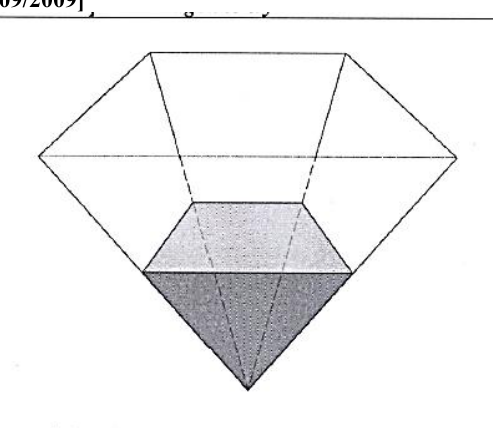
- (i)
Show that satisfies the differential equation
- (ii)
Verify that .
- (iii)
Hence solve the differential equation in part (i), obtaining an expression for in terms of .
It won't just hand you the answer — it asks where you're stuck.How the checker works
Worked solution
Q4(i)
1. Express the rate of change of volume $\frac{\text{d}V}{\text{d}t}$ in terms of $h$ and an unknown constant of proportionality $k$.
The net rate of change of volume is the rate at which liquid is poured in minus the rate of leakage.
where is a constant of proportionality.
2. Find $\frac{\text{d}V}{\text{d}h}$ from the given volume formula.
Given , differentiating with respect to gives:
3. Relate $\frac{\text{d}h}{\text{d}t}$ to $\frac{\text{d}V}{\text{d}t}$ using the chain rule.
By the chain rule for connected rates of change:
Substituting our expressions:
Dividing both sides by :
4. Use the initial conditions to find the value of the constant term and obtain the required differential equation.
We are given that when , . Substituting these values into the equation gives:
Substituting back into the differential equation gives:
Q4(ii)
1. Express the right-hand side over a common denominator and simplify to match the left-hand side.
(Verified)
Q4(iii)
1. Separate the variables in the differential equation.
From part (i), we have the differential equation:
Combine the terms on the right-hand side over a common denominator:
Separate the variables and :
2. Substitute the identity from part (ii) and integrate both sides.
Substitute the algebraic identity given in part (ii):
Integrate using the standard result :
(Note: This can equivalently be integrated by expanding into partial fractions ).
3. Use the initial condition to find the constant of integration.
The problem states that the tank is initially empty. Therefore, when , the depth .
Substitute these values into the integrated equation to find :
4. Express $t$ in terms of $h$.
Substitute back into the equation:
Since the tank is filling starting from , we have . This ensures that , so the absolute value signs can be dropped.
AI analysis — may contain mistakes.
Worked this one out on paper? Snap your steps and Gigle's AI math checker will circle the step where it went wrong.
More questions on this topic
- 1The points on a curve satisfy the equations and …
- 2In a large town, the number of people infected by a particular virus days after the virus was first discovered is …
- 3Consider the second order differential equation where and are no…
- 4A freshly brewed cup of tea, initially at a temperature of , is left out to cool in a room with a room…
- 5In a large town, the number of people infected by a particular virus days after the virus was first discovered is …