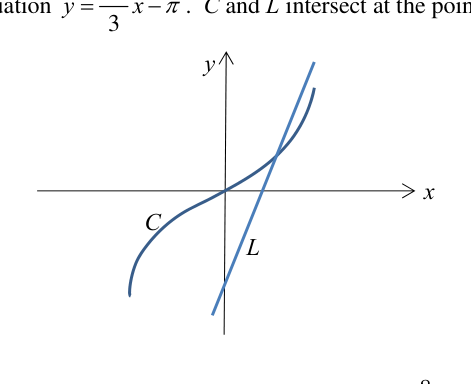
1. Determine the $y$-coordinates of the intersection points and the intercepts.
When x=21, y=2sin−1(21)=2(6π)=3π
For curve C, when x=0, y=2sin−1(0)=0.
For line L, when x=0, y=−π.
2. Express $x$ in terms of $y$ for both $C$ and $L$ to prepare for integration with respect to $y$.
For curve C: y=2sin−1x⟹sin−1x=2y⟹x=sin(2y)
For line L: y=38πx−π⟹x=8π3(y+π)
3. Set up the integral for the volume generated by rotating the region about the $y$-axis.
The region is bounded by L on the right, and by C (for y≥0) and the y-axis (for y<0) on the left.
The volume can be found by calculating the volume of the solid cone generated by L and subtracting the solid volume generated by C: V=π∫−π3π[8π3(y+π)]2dy−π∫03πsin2(2y)dy
4. Calculate the volume generated by rotating the line $L$ (which forms a cone).
V1=π∫−π3π64π29(y+π)2dy =64π9[3(y+π)3]−π3π =64π3(34π)3=64π3(2764π3)=9π2 (Alternatively, using the cone formula: V1=31πr2h=31π(21)2(3π−(−π))=9π2)
5. Calculate the volume generated by rotating the curve $C$, using the double angle formula.
V2=π∫03πsin2(2y)dy
Using the identity sin2(2y)=21(1−cosy): V2=π∫03π21(1−cosy)dy =2π[y−siny]03π =2π(3π−sin3π) =2π(3π−23)=6π2−43π
6. Subtract the volumes to find the exact final volume.