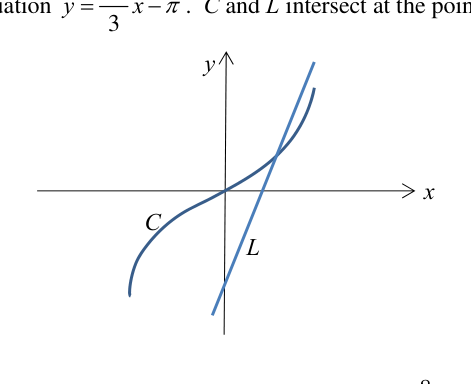
The diagram shows the curve CC with equation y=2sin⁡−1xy = 2\sin^{-1}x and the line LL with equation y=8π3x−πy = \frac{8\pi}{3}x - \pi. CC and LL intersect at the point where x=12x = \frac{1}{2}. The region SS is defined by y≤2sin⁡−1xy \le 2\sin^{-1}x, y≥8π3x−πy \ge \frac{8\pi}{3}x - \pi and x≥0x \ge 0. Find the exact volume of the solid obtained when SS is rotated through 2π2\pi radians about the yy-axis.

Work through it with AI →

It won't just hand you the answer — it asks where you're stuck.How the checker works

Worked solution

4

1. Determine the $y$-coordinates of the intersection points and the intercepts.

When x=12x = \frac{1}{2},
y=2sin⁡−1(12)=2(π6)=π3y = 2\sin^{-1}\left(\frac{1}{2}\right) = 2\left(\frac{\pi}{6}\right) = \frac{\pi}{3}
For curve CC, when x=0x = 0, y=2sin⁡−1(0)=0y = 2\sin^{-1}(0) = 0.
For line LL, when x=0x = 0, y=−πy = -\pi.

2. Express $x$ in terms of $y$ for both $C$ and $L$ to prepare for integration with respect to $y$.

For curve CC:
y=2sin⁡−1x  ⟹  sin⁡−1x=y2  ⟹  x=sin⁡(y2)y = 2\sin^{-1}x \implies \sin^{-1}x = \frac{y}{2} \implies x = \sin\left(\frac{y}{2}\right)
For line LL:
y=8π3x−π  ⟹  x=38π(y+π)y = \frac{8\pi}{3}x - \pi \implies x = \frac{3}{8\pi}(y + \pi)

3. Set up the integral for the volume generated by rotating the region about the $y$-axis.

The region is bounded by LL on the right, and by CC (for y≥0y \ge 0) and the yy-axis (for y<0y < 0) on the left.
The volume can be found by calculating the volume of the solid cone generated by LL and subtracting the solid volume generated by CC:
V=π∫−ππ3[38π(y+π)]2dy−π∫0π3sin⁡2(y2)dyV = \pi \int_{-\pi}^{\frac{\pi}{3}} \left[ \frac{3}{8\pi}(y + \pi) \right]^2 \text{d}y - \pi \int_{0}^{\frac{\pi}{3}} \sin^2\left(\frac{y}{2}\right) \text{d}y

4. Calculate the volume generated by rotating the line $L$ (which forms a cone).

V1=π∫−ππ3964π2(y+π)2dyV_1 = \pi \int_{-\pi}^{\frac{\pi}{3}} \frac{9}{64\pi^2}(y + \pi)^2 \text{d}y
=964π[(y+π)33]−ππ3= \frac{9}{64\pi} \left[ \frac{(y + \pi)^3}{3} \right]_{-\pi}^{\frac{\pi}{3}}
=364π(4π3)3=364π(64π327)=π29= \frac{3}{64\pi} \left( \frac{4\pi}{3} \right)^3 = \frac{3}{64\pi} \left( \frac{64\pi^3}{27} \right) = \frac{\pi^2}{9}
(Alternatively, using the cone formula: V1=13πr2h=13π(12)2(π3−(−π))=π29V_1 = \frac{1}{3}\pi r^2 h = \frac{1}{3}\pi\left(\frac{1}{2}\right)^2\left(\frac{\pi}{3} - (-\pi)\right) = \frac{\pi^2}{9})

5. Calculate the volume generated by rotating the curve $C$, using the double angle formula.

V2=π∫0π3sin⁡2(y2)dyV_2 = \pi \int_{0}^{\frac{\pi}{3}} \sin^2\left(\frac{y}{2}\right) \text{d}y
Using the identity sin⁡2(y2)=12(1−cos⁡y)\sin^2\left(\frac{y}{2}\right) = \frac{1}{2}(1 - \cos y):
V2=π∫0π312(1−cos⁡y)dyV_2 = \pi \int_{0}^{\frac{\pi}{3}} \frac{1}{2}(1 - \cos y) \text{d}y
=π2[y−sin⁡y]0π3= \frac{\pi}{2} \left[ y - \sin y \right]_{0}^{\frac{\pi}{3}}
=π2(π3−sin⁡π3)= \frac{\pi}{2} \left( \frac{\pi}{3} - \sin\frac{\pi}{3} \right)
=π2(π3−32)=π26−3π4= \frac{\pi}{2} \left( \frac{\pi}{3} - \frac{\sqrt{3}}{2} \right) = \frac{\pi^2}{6} - \frac{\sqrt{3}\pi}{4}

6. Subtract the volumes to find the exact final volume.

V=V1−V2=π29−(π26−3π4)V = V_1 - V_2 = \frac{\pi^2}{9} - \left( \frac{\pi^2}{6} - \frac{\sqrt{3}\pi}{4} \right)
=2π218−3π218+3π4= \frac{2\pi^2}{18} - \frac{3\pi^2}{18} + \frac{\sqrt{3}\pi}{4}
=3π4−π218= \frac{\sqrt{3}\pi}{4} - \frac{\pi^2}{18}

Answer

3π4−π218\frac{\sqrt{3}\pi}{4} - \frac{\pi^2}{18}

AI analysis — may contain mistakes.

Worked this one out on paper? Snap your steps and Gigle's AI math checker will circle the step where it went wrong.

More questions on this topic

  1. 1The curve CC is defined by the parametric equations x=t−sin⁡tx = t - \sin t, y=sin⁡2ty = \sin^{2} t,   0≤t≤π\;0 \le t \le \pi. The point…
  2. 2The diagram shows the graph of y=f(x)y = f(x). The curve has a turning point at (0,a)(0,a) and the lines y=±kxy = \pm kx are asymp…
  3. 3You are given that C=∫0πe−2xcos⁡x  dxC = \int_{0}^{\pi} \mathrm{e}^{-2x} \cos x \; \mathrm{d}x and S=∫0πe−2xsin⁡x  dxS = \int_{0}^{\pi} \mathrm{e}^{-2x} \sin x \; \mathrm{d}x…
  4. 4A function f is defined as f(x)=ln⁡(5−x),  x<5.f(x)=\ln(5-x),\; x<5. Find the volume of revolution when the region bounded by the curve of…
  5. 5By using the substitution u=x+1u = \sqrt{x+1}, find ∫x+1x−1 dx\displaystyle \int \frac{\sqrt{x+1}}{x-1}\,dx. The region RR is boun…