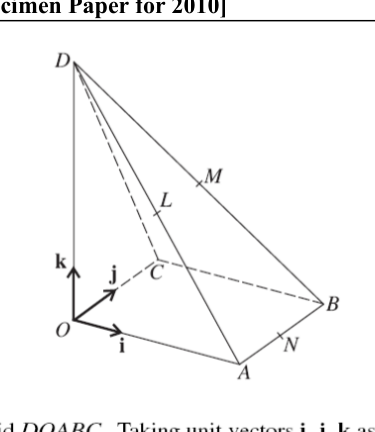
图中显示了一个棱锥 DOABC。取如图所示的单位向量 i, j, k,A, B, C, D 的位置向量分别为 OA→=4i,OB→=4i+2j,OC→=2j,OD→=6k。\overrightarrow{OA} = 4i,\quad \overrightarrow{OB} = 4i + 2j,\quad \overrightarrow{OC} = 2j,\quad \overrightarrow{OD} = 6k。 AD, BD 和 AB 的中点分别为 L, M 和 N。

  1. (i)

    求向量 MN→\overrightarrow{MN},以及 MN→\overrightarrow{MN} 与 OB→\overrightarrow{OB} 方向之间的夹角。

  2. (ii)

    位于 ODOD 上的点 PP 的位置向量为 p kp\,k。确定 pp 的值,使得通过 PP 和 BB 的直线与通过 CC 和 LL 的直线相交。

先不看答案,让 AI 诊断你卡在哪里?

它不会直接告诉你答案,而是问你卡在哪一步看看 AI 是怎么陪你一步步弄懂这道题的

完整解法

Q4(i)

1. Find the position vectors of the mid-points $M$ and $N$.

Since MM is the mid-point of BDBD:
OM→=12(OB→+OD→)=12(4i+2j+6k)=2i+j+3k\overrightarrow{OM} = \frac{1}{2}(\overrightarrow{OB} + \overrightarrow{OD}) = \frac{1}{2}(4\mathbf{i} + 2\mathbf{j} + 6\mathbf{k}) = 2\mathbf{i} + \mathbf{j} + 3\mathbf{k}
Since NN is the mid-point of ABAB:
ON→=12(OA→+OB→)=12(4i+(4i+2j))=4i+j\overrightarrow{ON} = \frac{1}{2}(\overrightarrow{OA} + \overrightarrow{OB}) = \frac{1}{2}(4\mathbf{i} + (4\mathbf{i} + 2\mathbf{j})) = 4\mathbf{i} + \mathbf{j}

2. Find the displacement vector $\overrightarrow{MN}$.

MN→=ON→−OM→\overrightarrow{MN} = \overrightarrow{ON} - \overrightarrow{OM}
MN→=(4i+j)−(2i+j+3k)=2i−3k\overrightarrow{MN} = (4\mathbf{i} + \mathbf{j}) - (2\mathbf{i} + \mathbf{j} + 3\mathbf{k}) = 2\mathbf{i} - 3\mathbf{k}

3. Calculate the scalar product and the magnitudes of $\overrightarrow{MN}$ and $\overrightarrow{OB}$.

MN→⋅OB→=(2i−3k)⋅(4i+2j)=(2)(4)+(0)(2)+(−3)(0)=8\overrightarrow{MN} \cdot \overrightarrow{OB} = (2\mathbf{i} - 3\mathbf{k}) \cdot (4\mathbf{i} + 2\mathbf{j}) = (2)(4) + (0)(2) + (-3)(0) = 8
∣MN→∣=22+02+(−3)2=13|\overrightarrow{MN}| = \sqrt{2^2 + 0^2 + (-3)^2} = \sqrt{13}
∣OB→∣=42+22+02=20|\overrightarrow{OB}| = \sqrt{4^2 + 2^2 + 0^2} = \sqrt{20}

4. Determine the angle between the two vectors using the scalar product formula.

Let θ\theta be the required angle.
cos⁡θ=MN→⋅OB→∣MN→∣∣OB→∣\cos \theta = \frac{\overrightarrow{MN} \cdot \overrightarrow{OB}}{|\overrightarrow{MN}| |\overrightarrow{OB}|}
cos⁡θ=81320=8260=465\cos \theta = \frac{8}{\sqrt{13}\sqrt{20}} = \frac{8}{\sqrt{260}} = \frac{4}{\sqrt{65}}
θ=cos⁡−1(465)≈60.255∘\theta = \cos^{-1}\left(\frac{4}{\sqrt{65}}\right) \approx 60.255^\circ
θ≈60.3∘ (to 1 d.p.)\theta \approx 60.3^\circ \text{ (to 1 d.p.)}

答案

MN→=2i−3k\overrightarrow{MN} = 2\mathbf{i} - 3\mathbf{k}
Angle=60.3∘ (or 1.05 radians)\text{Angle} = 60.3^\circ \text{ (or } 1.05 \text{ radians)}

Q4(ii)

1. Find the position vector of the point $L$.

LL is the mid-point of ADAD. Using the ratio theorem:
OL→=12(OA→+OD→)\overrightarrow{OL} = \frac{1}{2}(\overrightarrow{OA} + \overrightarrow{OD})
OL→=12(4i+6k)=2i+3k\overrightarrow{OL} = \frac{1}{2}(4\mathbf{i} + 6\mathbf{k}) = 2\mathbf{i} + 3\mathbf{k}

2. Determine the vector equation of the line passing through $C$ and $L$.

The direction vector of line CLCL is:
CL→=OL→−OC→=(2i+3k)−2j=2i−2j+3k\overrightarrow{CL} = \overrightarrow{OL} - \overrightarrow{OC} = (2\mathbf{i} + 3\mathbf{k}) - 2\mathbf{j} = 2\mathbf{i} - 2\mathbf{j} + 3\mathbf{k}
Let μ\mu be a scalar parameter. The vector equation of line CLCL is:
r=2j+μ(2i−2j+3k)\mathbf{r} = 2\mathbf{j} + \mu(2\mathbf{i} - 2\mathbf{j} + 3\mathbf{k})

3. Determine the vector equation of the line passing through $P$ and $B$.

The direction vector of line PBPB is:
PB→=OB→−OP→=(4i+2j)−pk=4i+2j−pk\overrightarrow{PB} = \overrightarrow{OB} - \overrightarrow{OP} = (4\mathbf{i} + 2\mathbf{j}) - p\mathbf{k} = 4\mathbf{i} + 2\mathbf{j} - p\mathbf{k}
Let λ\lambda be a scalar parameter. The vector equation of line PBPB is:
r=pk+λ(4i+2j−pk)\mathbf{r} = p\mathbf{k} + \lambda(4\mathbf{i} + 2\mathbf{j} - p\mathbf{k})

4. Form a system of equations by equating the components of the two lines at their point of intersection.

At the point of intersection, the position vectors from both lines must be identical:
2μi+(2−2μ)j+3μk=4λi+2λj+(p−pλ)k2\mu\mathbf{i} + (2 - 2\mu)\mathbf{j} + 3\mu\mathbf{k} = 4\lambda\mathbf{i} + 2\lambda\mathbf{j} + (p - p\lambda)\mathbf{k}
Comparing the i\mathbf{i}, j\mathbf{j}, and k\mathbf{k} coefficients respectively:
2μ=4λ  ⟹  μ=2λ— (1)2\mu = 4\lambda \implies \mu = 2\lambda \quad \text{--- (1)}
2−2μ=2λ— (2)2 - 2\mu = 2\lambda \quad \text{--- (2)}
3μ=p(1−λ)— (3)3\mu = p(1 - \lambda) \quad \text{--- (3)}

5. Solve for the scalar parameters $\lambda$ and $\mu$.

Substitute equation (1) into equation (2):
2−2(2λ)=2λ2 - 2(2\lambda) = 2\lambda
2−4λ=2λ2 - 4\lambda = 2\lambda
6λ=2  ⟹  λ=136\lambda = 2 \implies \lambda = \frac{1}{3}
Using equation (1) to find μ\mu:
μ=2(13)=23\mu = 2\left(\frac{1}{3}\right) = \frac{2}{3}

6. Find the value of $p$ using the $\mathbf{k}$ component equation.

Substitute λ=13\lambda = \frac{1}{3} and μ=23\mu = \frac{2}{3} into equation (3):
3(23)=p(1−13)3\left(\frac{2}{3}\right) = p\left(1 - \frac{1}{3}\right)
2=p(23)2 = p\left(\frac{2}{3}\right)
p=3p = 3

答案

p=3p = 3

AI 分析,可能出错

用 AI 批改,圈出写错的那一步,并自动将你的薄弱点存入错题本,形成你的错因库。

同一知识点的其他题

  1. 1直线 l1l_1 和 l2l_2 的方程分别为 r=(4110)+λ(1−1−6),λ∈R\mathbf{r} = \begin{pmatrix} 4 \\ 1 \\ 10 \end{pmatrix} + \lambda \begin{pmatrix} 1 \\ -1 \\ -6 \end{pmatrix}, \lambda \in \mathbb{R}…
  2. 2已知向量 a\mathbf{a} 和 b\mathbf{b} 为 a=i+(sin⁡θ)j+(cos⁡θ)k\mathbf{a}=\mathbf{i}+(\sin\theta)\mathbf{j}+(\cos\theta)\mathbf{k}\quad 且 b=i+(sin⁡ϕ)j+(cos⁡ϕ)k\quad\mathbf{b}=\mathbf{i}+(\sin\phi)\mathbf{j}+(\cos\phi)\mathbf{k}…
  3. 3平面 p1p_1 和 p2p_2 的方程由下式给出: p1:r⋅(α72)=α+20,  α∈R,p_1: \mathbf{r} \cdot \begin{pmatrix} \alpha \\ 7 \\ 2 \end{pmatrix} = \alpha + 20, \; \alpha \in \mathbb{R},…
  4. 4以原点 OO 为基准,点 AA、BB 和 CC 的位置向量分别为 a\mathbf{a}、b\mathbf{b} 和 c\mathbf{c}。已知 a+b−c\mathbf{a} + \mathbf{b} - \mathbf{c}…
  5. 5三个非零向量 p\mathbf{p}、q\mathbf{q} 和 r\mathbf{r} 满足 3p×q=r×p3\mathbf{p} \times \mathbf{q} = \mathbf{r} \times \mathbf{p}。求 p\mathbf{p}…