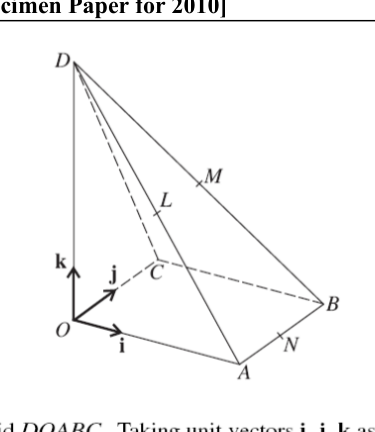
The diagram shows a pyramid DOABC. Taking unit vectors i, j, k as shown, the position vectors of A, B, C, D are given by OA→=4i,OB→=4i+2j,OC→=2j,OD→=6k.\overrightarrow{OA} = 4i,\quad \overrightarrow{OB} = 4i + 2j,\quad \overrightarrow{OC} = 2j,\quad \overrightarrow{OD} = 6k. The mid-points of AD, BD and AB are L, M and N respectively.
  1. (i)

    Find the vector MN→\overrightarrow{MN} and the angle between the directions of MN→\overrightarrow{MN} and OB→\overrightarrow{OB}.

  2. (ii)

    The point PP lying on ODOD has position vector p kp\,k. Determine the value of pp for which the line through PP and BB intersects the line through CC and LL.

Work through it with AI →

It won't just hand you the answer — it asks where you're stuck.How the checker works

Worked solution

Q4(i)

1. Find the position vectors of the mid-points $M$ and $N$.

Since MM is the mid-point of BDBD:
OM→=12(OB→+OD→)=12(4i+2j+6k)=2i+j+3k\overrightarrow{OM} = \frac{1}{2}(\overrightarrow{OB} + \overrightarrow{OD}) = \frac{1}{2}(4\mathbf{i} + 2\mathbf{j} + 6\mathbf{k}) = 2\mathbf{i} + \mathbf{j} + 3\mathbf{k}
Since NN is the mid-point of ABAB:
ON→=12(OA→+OB→)=12(4i+(4i+2j))=4i+j\overrightarrow{ON} = \frac{1}{2}(\overrightarrow{OA} + \overrightarrow{OB}) = \frac{1}{2}(4\mathbf{i} + (4\mathbf{i} + 2\mathbf{j})) = 4\mathbf{i} + \mathbf{j}

2. Find the displacement vector $\overrightarrow{MN}$.

MN→=ON→−OM→\overrightarrow{MN} = \overrightarrow{ON} - \overrightarrow{OM}
MN→=(4i+j)−(2i+j+3k)=2i−3k\overrightarrow{MN} = (4\mathbf{i} + \mathbf{j}) - (2\mathbf{i} + \mathbf{j} + 3\mathbf{k}) = 2\mathbf{i} - 3\mathbf{k}

3. Calculate the scalar product and the magnitudes of $\overrightarrow{MN}$ and $\overrightarrow{OB}$.

MN→⋅OB→=(2i−3k)⋅(4i+2j)=(2)(4)+(0)(2)+(−3)(0)=8\overrightarrow{MN} \cdot \overrightarrow{OB} = (2\mathbf{i} - 3\mathbf{k}) \cdot (4\mathbf{i} + 2\mathbf{j}) = (2)(4) + (0)(2) + (-3)(0) = 8
∣MN→∣=22+02+(−3)2=13|\overrightarrow{MN}| = \sqrt{2^2 + 0^2 + (-3)^2} = \sqrt{13}
∣OB→∣=42+22+02=20|\overrightarrow{OB}| = \sqrt{4^2 + 2^2 + 0^2} = \sqrt{20}

4. Determine the angle between the two vectors using the scalar product formula.

Let θ\theta be the required angle.
cos⁡θ=MN→⋅OB→∣MN→∣∣OB→∣\cos \theta = \frac{\overrightarrow{MN} \cdot \overrightarrow{OB}}{|\overrightarrow{MN}| |\overrightarrow{OB}|}
cos⁡θ=81320=8260=465\cos \theta = \frac{8}{\sqrt{13}\sqrt{20}} = \frac{8}{\sqrt{260}} = \frac{4}{\sqrt{65}}
θ=cos⁡−1(465)≈60.255∘\theta = \cos^{-1}\left(\frac{4}{\sqrt{65}}\right) \approx 60.255^\circ
θ≈60.3∘ (to 1 d.p.)\theta \approx 60.3^\circ \text{ (to 1 d.p.)}

Answer

MN→=2i−3k\overrightarrow{MN} = 2\mathbf{i} - 3\mathbf{k}
Angle=60.3∘ (or 1.05 radians)\text{Angle} = 60.3^\circ \text{ (or } 1.05 \text{ radians)}

Q4(ii)

1. Find the position vector of the point $L$.

LL is the mid-point of ADAD. Using the ratio theorem:
OL→=12(OA→+OD→)\overrightarrow{OL} = \frac{1}{2}(\overrightarrow{OA} + \overrightarrow{OD})
OL→=12(4i+6k)=2i+3k\overrightarrow{OL} = \frac{1}{2}(4\mathbf{i} + 6\mathbf{k}) = 2\mathbf{i} + 3\mathbf{k}

2. Determine the vector equation of the line passing through $C$ and $L$.

The direction vector of line CLCL is:
CL→=OL→−OC→=(2i+3k)−2j=2i−2j+3k\overrightarrow{CL} = \overrightarrow{OL} - \overrightarrow{OC} = (2\mathbf{i} + 3\mathbf{k}) - 2\mathbf{j} = 2\mathbf{i} - 2\mathbf{j} + 3\mathbf{k}
Let μ\mu be a scalar parameter. The vector equation of line CLCL is:
r=2j+μ(2i−2j+3k)\mathbf{r} = 2\mathbf{j} + \mu(2\mathbf{i} - 2\mathbf{j} + 3\mathbf{k})

3. Determine the vector equation of the line passing through $P$ and $B$.

The direction vector of line PBPB is:
PB→=OB→−OP→=(4i+2j)−pk=4i+2j−pk\overrightarrow{PB} = \overrightarrow{OB} - \overrightarrow{OP} = (4\mathbf{i} + 2\mathbf{j}) - p\mathbf{k} = 4\mathbf{i} + 2\mathbf{j} - p\mathbf{k}
Let λ\lambda be a scalar parameter. The vector equation of line PBPB is:
r=pk+λ(4i+2j−pk)\mathbf{r} = p\mathbf{k} + \lambda(4\mathbf{i} + 2\mathbf{j} - p\mathbf{k})

4. Form a system of equations by equating the components of the two lines at their point of intersection.

At the point of intersection, the position vectors from both lines must be identical:
2μi+(2−2μ)j+3μk=4λi+2λj+(p−pλ)k2\mu\mathbf{i} + (2 - 2\mu)\mathbf{j} + 3\mu\mathbf{k} = 4\lambda\mathbf{i} + 2\lambda\mathbf{j} + (p - p\lambda)\mathbf{k}
Comparing the i\mathbf{i}, j\mathbf{j}, and k\mathbf{k} coefficients respectively:
2μ=4λ  ⟹  μ=2λ— (1)2\mu = 4\lambda \implies \mu = 2\lambda \quad \text{--- (1)}
2−2μ=2λ— (2)2 - 2\mu = 2\lambda \quad \text{--- (2)}
3μ=p(1−λ)— (3)3\mu = p(1 - \lambda) \quad \text{--- (3)}

5. Solve for the scalar parameters $\lambda$ and $\mu$.

Substitute equation (1) into equation (2):
2−2(2λ)=2λ2 - 2(2\lambda) = 2\lambda
2−4λ=2λ2 - 4\lambda = 2\lambda
6λ=2  ⟹  λ=136\lambda = 2 \implies \lambda = \frac{1}{3}
Using equation (1) to find μ\mu:
μ=2(13)=23\mu = 2\left(\frac{1}{3}\right) = \frac{2}{3}

6. Find the value of $p$ using the $\mathbf{k}$ component equation.

Substitute λ=13\lambda = \frac{1}{3} and μ=23\mu = \frac{2}{3} into equation (3):
3(23)=p(1−13)3\left(\frac{2}{3}\right) = p\left(1 - \frac{1}{3}\right)
2=p(23)2 = p\left(\frac{2}{3}\right)
p=3p = 3

Answer

p=3p = 3

AI analysis — may contain mistakes.

Worked this one out on paper? Snap your steps and Gigle's AI math checker will circle the step where it went wrong.

More questions on this topic

  1. 1The lines l1l_1 and l2l_2 have equations r=(4110)+λ(1−1−6),λ∈R\mathbf{r} = \begin{pmatrix} 4 \\ 1 \\ 10 \end{pmatrix} + \lambda \begin{pmatrix} 1 \\ -1 \\ -6 \end{pmatrix}, \lambda \in \mathbb{R}…
  2. 2The vectors a\mathbf{a} and b\mathbf{b} are given by a=i+(sin⁡θ)j+(cos⁡θ)k\mathbf{a}=\mathbf{i}+(\sin\theta)\mathbf{j}+(\cos\theta)\mathbf{k}\quad…
  3. 3The equations of planes p1p_1 and p2p_2 are given by p1:r⋅(α72)=α+20,  α∈R,p_1: \mathbf{r} \cdot \begin{pmatrix} \alpha \\ 7 \\ 2 \end{pmatrix} = \alpha + 20, \; \alpha \in \mathbb{R},…
  4. 4Referred to the origin OO, points AA, BB and CC have position vectors a\mathbf{a}, b\mathbf{b} and c\mathbf{c} re…
  5. 5Three non-zero vectors p\mathbf{p}, q\mathbf{q} and r\mathbf{r} are such that 3p×q=r×p3\mathbf{p} \times \mathbf{q} = \mathbf{r} \times \mathbf{p}…