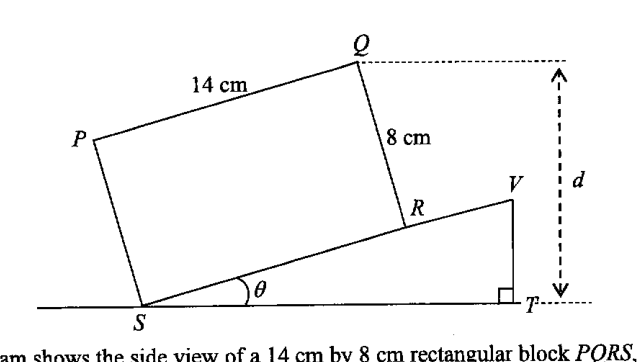
如图所示为一个尺寸为 14 cm ×\times 8 cm 的矩形块 PQRSPQRS 的侧视图,它放置在一个倾角为 θ∘\theta^\circ 的锐角斜面 VSVS 上。
斜面放置在水平面 STST 上,dd 是点 QQ 到 STST 的垂直距离。∠VTS=90∘\angle VTS = 90^\circ。

  1. (a)

    证明 d=8cos⁡θ+14sin⁡θd = 8\cos\theta + 14\sin\theta。

  2. (b)

    将 dd 表示为 Rcos⁡(θ−α)R\cos(\theta - \alpha) 的形式,其中 R>0R > 0 且 0∘<α<90∘0^\circ < \alpha < 90^\circ。

  3. (c)

    求使 d=102d = 10\sqrt{2} 的最小 θ\theta 值。

先不看答案,让 AI 诊断你卡在哪里?

它不会直接告诉你答案,而是问你卡在哪一步看看 AI 是怎么陪你一步步弄懂这道题的

完整解法

10(a)

1. Construct horizontal and vertical lines to form right-angled triangles

Let R′R' be the projection of RR onto the horizontal line STST. Let Q′Q' be the projection of QQ onto the horizontal line passing through RR. Then d=RR′+QQ′d = RR' + QQ'.

2. Express the vertical components in terms of $\theta$

In △SRR′\triangle SRR', ∠RSR′=θ\angle RSR' = \theta. Since SR=14SR = 14 cm, RR′=14sin⁡θRR' = 14\sin\theta.
In △RQQ′\triangle RQQ', ∠QRQ′=θ\angle QRQ' = \theta (since RQRQ is perpendicular to RSRS and RQ′RQ' is parallel to STST). Since QR=8QR = 8 cm, QQ′=8cos⁡θQQ' = 8\cos\theta.
Therefore, d=RR′+QQ′=14sin⁡θ+8cos⁡θ=8cos⁡θ+14sin⁡θd = RR' + QQ' = 14\sin\theta + 8\cos\theta = 8\cos\theta + 14\sin\theta.

答案

Shown

10(b)

1. Expand the target form $R\cos(\theta - \alpha)$

Rcos⁡(θ−α)=R(cos⁡θcos⁡α+sin⁡θsin⁡α)=(Rcos⁡α)cos⁡θ+(Rsin⁡α)sin⁡θR\cos(\theta - \alpha) = R(\cos\theta\cos\alpha + \sin\theta\sin\alpha) = (R\cos\alpha)\cos\theta + (R\sin\alpha)\sin\theta

2. Equate coefficients with the expression for $d$

From part (a), d=8cos⁡θ+14sin⁡θd = 8\cos\theta + 14\sin\theta.
Comparing coefficients:
Rcos⁡α=8R\cos\alpha = 8
Rsin⁡α=14R\sin\alpha = 14

3. Calculate the value of $R$

R=82+142=64+196=260=265R = \sqrt{8^2 + 14^2} = \sqrt{64 + 196} = \sqrt{260} = 2\sqrt{65}

4. Calculate the value of $\alpha$

tan⁡α=148=74\tan\alpha = \frac{14}{8} = \frac{7}{4}
α=tan⁡−1(74)≈60.255∘≈60.3∘\alpha = \tan^{-1}\left(\frac{7}{4}\right) \approx 60.255^\circ \approx 60.3^\circ (to 1 d.p.)
So, d=265cos⁡(θ−60.3∘)d = 2\sqrt{65}\cos(\theta - 60.3^\circ)

答案

265cos⁡(θ−60.3∘)2\sqrt{65}\cos(\theta - 60.3^\circ)

10(c)

1. Recall the result from part (b) and set up the equation

From part (b), d=260cos⁡(θ−60.255∘)d = \sqrt{260}\cos(\theta - 60.255^\circ).
Equating this to 10210\sqrt{2}:
260cos⁡(θ−60.255∘)=102\sqrt{260}\cos(\theta - 60.255^\circ) = 10\sqrt{2}

2. Isolate the cosine term

cos⁡(θ−60.255∘)=102260\cos(\theta - 60.255^\circ) = \frac{10\sqrt{2}}{\sqrt{260}}
cos⁡(θ−60.255∘)=200260=1013\cos(\theta - 60.255^\circ) = \sqrt{\frac{200}{260}} = \sqrt{\frac{10}{13}}

3. Find the possible values for the angle

θ−60.255∘=±cos⁡−1(1013)\theta - 60.255^\circ = \pm \cos^{-1}\left(\sqrt{\frac{10}{13}}\right)
θ−60.255∘=±27.696∘\theta - 60.255^\circ = \pm 27.696^\circ

4. Solve for the smallest positive value of theta

For the smallest θ\theta, we take the negative value:
θ=60.255∘−27.696∘\theta = 60.255^\circ - 27.696^\circ
θ=32.559∘≈32.6∘ (to 1 d.p.)\theta = 32.559^\circ \approx 32.6^\circ \text{ (to 1 d.p.)}

答案

32.6∘32.6^\circ

AI 分析,可能出错

用 AI 批改,圈出写错的那一步,并自动将你的薄弱点存入错题本,形成你的错因库。

同一知识点的其他题

  1. 1解方程 2cot⁡22x=1−5sin⁡2x2 \cot^2 2x = 1 - \frac{5}{\sin 2x},其中 −180∘≤x≤180∘-180^\circ \le x \le 180^\circ。
  2. 2已知sin⁡(α+π12)=55\sin (α+ \dfrac {π}{12} )= \dfrac { \sqrt {5}}{5},则sin⁡(π3−2α)=(    )\sin ( \dfrac {π}{3} -2α)= (\:\:\:\:) A. 45 \dfrac {4}{5}…
  3. 38.8.设△ABC\triangle ABC的内角AA,BB,CC所对的边分别为aa,bb,cc,若bcos⁡C+ccos⁡B=asin⁡Ab\cos C+c\cos B=a\sin A,则△ABC\triangle ABC的形状为…
  4. 4证明 sin⁡3xsec⁡2x+sin⁡x=tan⁡xsec⁡x\sin^{3} x\sec^{2} x + \sin x = \tan x\sec x。 解方程 sin⁡3xsec⁡2x+sin⁡x=5\sin^{3} x\sec^{2} x + \sin x = 5,其中 0≤x≤360∘0 \le x \le 360^\circ。
  5. 5已知 cos⁡x=−45\cos x = -\frac{4}{5} 且 tan⁡x>0\tan x > 0,求 sin⁡2x\sin 2x, cos⁡x2\cos \frac{x}{2}。