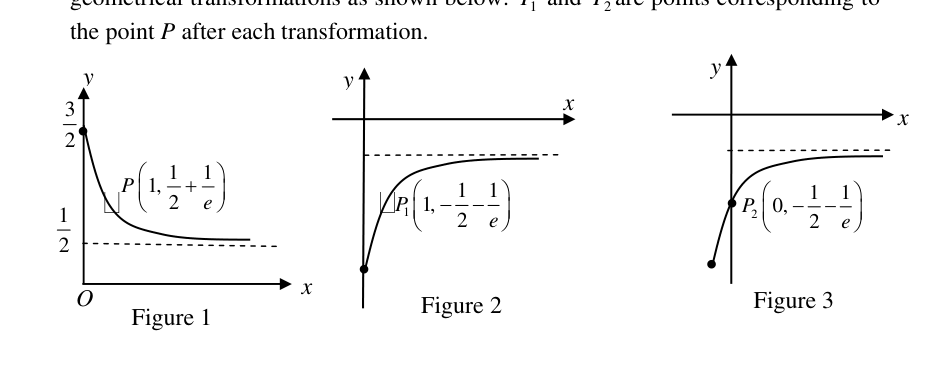
函数 f 定义为 f:x↦11−x2f: x \mapsto \dfrac{1}{1 - x^2},−1<x≤0-1 < x \le 0。 (i) 定义 f−1f^{-1}。 (ii) 在同一坐标系中画出 y=ff−1(x)y = ff^{-1}(x) 和 y=f−1f(x)y = f^{-1}f(x) 的图像简图。由此解方程 ff−1(x)=f−1f(x)。ff^{-1}(x) = f^{-1}f(x)。 图 1 显示了图像 y=12+e−xy = \tfrac{1}{2} + e^{-x},x≥0x \ge 0,该图像经历了如下所示的一系列两次几何变换。P1P_1 和 P2P_2 是点 PP 在每次变换后对应的点。

  1. ((iii))

    图 3 中得到的图像显示了函数 hh 的图像。

    求 h(x)h(x)。

  2. ((iv))

    清楚地解释为什么复合函数 fhfh 不存在。

  3. ((v))

    求 hh 的最大定义域以使 fhfh 存在,并由此求出 fhfh 的值域。

先不看答案,让 AI 诊断你卡在哪里?

它不会直接告诉你答案,而是问你卡在哪一步看看 AI 是怎么陪你一步步弄懂这道题的

完整解法

5((iii))

1. Find the equation of the curve in Figure 2

The curve in Figure 2 has horizontal asymptote y=−12y = -\tfrac{1}{2} and approaches it from below, so it has the form y=−12−Ae−xy = -\tfrac{1}{2} - A e^{-x} (the x≥0x\ge 0 part is preserved by a vertical transformation).

Using P1(1, −12−12e)P_1\left(1,\ -\tfrac{1}{2}-\tfrac{1}{2e}\right):
−12−Ae−1=−12−12e ⇒ A=12.-\tfrac{1}{2} - A e^{-1} = -\tfrac{1}{2} - \tfrac{1}{2e} \ \Rightarrow\ A = \tfrac{1}{2}.
So the Figure 2 curve is y=−12−12e−xy = -\tfrac{1}{2} - \tfrac{1}{2}e^{-x}, x≥0x \ge 0.

2. Apply the horizontal translation (Figure 2 to Figure 3) to get h(x)

From P1(1,⋅)P_1(1,\cdot) to P2(0,⋅)P_2(0,\cdot) the xx-coordinate decreases by 11 with the yy-value unchanged, so Figure 3 is Figure 2 translated 11 unit in the negative xx-direction. Replace xx by x+1x+1:
h(x)=−12−12e−(x+1).h(x) = -\tfrac{1}{2} - \tfrac{1}{2}e^{-(x+1)}.
The domain x≥0x \ge 0 shifts to x≥−1x \ge -1.

Check: h(0)=−12−12e−1=−12−12eh(0) = -\tfrac{1}{2} - \tfrac{1}{2}e^{-1} = -\tfrac{1}{2} - \tfrac{1}{2e}, matching P2P_2.

答案

h(x)=−12−12e−(x+1),x≥−1h(x) = -\tfrac{1}{2} - \tfrac{1}{2}e^{-(x+1)}, \quad x \ge -1

5((iv))

1. State the range of $h$ and the domain of $f$.

From part (iii), the function is h(x)=−12−12e−(x+1)h(x) = -\frac{1}{2} - \frac{1}{2} e^{-(x+1)} for x≥−1x \ge -1.
The minimum value occurs at x=−1x = -1 where h(−1)=−1h(-1) = -1, and the horizontal asymptote is y=−12y = -\frac{1}{2}.
Thus, the range of hh is Rh=[−1,−12)\mathrm{R}_h = \left[-1, -\frac{1}{2}\right).
From the question, the domain of ff is Df=(−1,0]\mathrm{D}_f = (-1, 0].

2. Check the condition for the existence of $fh$ and conclude.

For the composite function fhfh to exist, we must have Rh⊆Df\mathrm{R}_h \subseteq \mathrm{D}_f.
Notice that −1∈Rh-1 \in \mathrm{R}_h (since h(−1)=−1h(-1) = -1), but −1∉Df-1 \notin \mathrm{D}_f because the interval is strictly greater than −1-1.
Since Rh⊈Df\mathrm{R}_h \not\subseteq \mathrm{D}_f, the composite function fhfh does not exist.

答案

The range of hh is Rh=[−1,−12)\mathrm{R}_h = \left[-1, -\frac{1}{2}\right) and the domain of ff is Df=(−1,0]\mathrm{D}_f = (-1, 0].
For fhfh to exist, we require Rh⊆Df\mathrm{R}_h \subseteq \mathrm{D}_f. However, −1∈Rh-1 \in \mathrm{R}_h but −1∉Df-1 \notin \mathrm{D}_f.
Since Rh⊈Df\mathrm{R}_h \not\subseteq \mathrm{D}_f, the composite function fhfh does not exist.

5((v))

1. State the condition for the existence of the composite function $\mathrm{fh}$.

For the composite function fh\mathrm{fh} to exist, the range of the inner function hh must be a subset of the domain of the outer function ff.
We are given Df=(−1,0]D_f = (-1, 0].
Thus, we require h(x)∈(−1,0]h(x) \in (-1, 0], which means −1<h(x)≤0-1 < h(x) \le 0.

2. Solve the inequality to find the maximal domain of $h$.

From part (iii), the function is h(x)=−12−12e−(x+1)h(x) = -\frac{1}{2} - \frac{1}{2}e^{-(x+1)}.
Substitute h(x)h(x) into the inequality:
−1<−12−12e−(x+1)≤0-1 < -\frac{1}{2} - \frac{1}{2}e^{-(x+1)} \le 0
Multiply throughout by −2-2 (which flips the inequalities):
2>1+e−(x+1)≥02 > 1 + e^{-(x+1)} \ge 0
Subtract 1:
1>e−(x+1)≥−11 > e^{-(x+1)} \ge -1
Since e−(x+1)>0e^{-(x+1)} > 0 for all real xx, the right side of the inequality (e−(x+1)≥−1e^{-(x+1)} \ge -1) is always satisfied.
Solving the left inequality:
e−(x+1)<1e^{-(x+1)} < 1
−(x+1)<0-(x+1) < 0
x>−1x > -1
Thus, the maximal domain of hh for fh\mathrm{fh} to exist is x>−1x > -1.

3. Find the restricted range of $h$ using the maximal domain.

We evaluate the range of h(x)=−12(1+e−(x+1))h(x) = -\frac{1}{2}\left(1 + e^{-(x+1)}\right) for x>−1x > -1.
As xx increases from −1-1 to ∞\infty, the term e−(x+1)e^{-(x+1)} strictly decreases from 11 to 00.
Therefore, h(x)h(x) strictly increases over this interval.
Lower limit (as x→−1+x \to -1^+): h(x)→−12(1+e0)=−1h(x) \to -\frac{1}{2}(1 + e^0) = -1.
Upper limit (as x→∞x \to \infty): h(x)→−12(1+0)=−12h(x) \to -\frac{1}{2}(1 + 0) = -\frac{1}{2}.
Hence, the new restricted range of hh is Rh=(−1,−12)R_h = \left(-1, -\frac{1}{2}\right).

4. Determine the range of the composite function $\mathrm{fh}$.

The range of fh\mathrm{fh} is the set of values f(y)f(y) where y∈Rh=(−1,−12)y \in R_h = \left(-1, -\frac{1}{2}\right).
Given f(y)=11−y2f(y) = \frac{1}{1 - y^2}:
As y→−1+y \to -1^+, y2→1−y^2 \to 1^-, so 1−y2→0+1 - y^2 \to 0^+, which gives f(y)→∞f(y) \to \infty.
At the upper bound y→−12−y \to -\frac{1}{2}^-, y2→14+y^2 \to \frac{1}{4}^+, so 1−y2→34−1 - y^2 \to \frac{3}{4}^-.
Thus, f(y)→13/4=43f(y) \to \frac{1}{3/4} = \frac{4}{3}.
Since ff is strictly decreasing for negative values of xx (as y2y^2 is strictly decreasing), f(y)f(y) takes all values between 43\frac{4}{3} and ∞\infty.
The range of fh\mathrm{fh} is therefore (43,∞)\left(\frac{4}{3}, \infty \right).

答案

Maximal domain of hh: x>−1x > -1 (or (−1,∞)(-1, \infty))

Range of fh\mathrm{fh}: (43,∞)\left(\frac{4}{3}, \infty\right)

AI 分析,可能出错

用 AI 批改,圈出写错的那一步,并自动将你的薄弱点存入错题本,形成你的错因库。

同一知识点的其他题

  1. 1将函数f(x)=sin⁡2xf(x)=\sin 2x的图象保持纵坐标不变,先将横坐标缩短为原来的12\dfrac{1}{2},再向右平移π6\dfrac{π}{6}个单位长度后得到g(x)g(x),则g(x)g(x)的解析式为()(\quad)…
  2. 2通过将曲线方程 y=12x+112x+1y = \frac{12x + 11}{2x + 1} 表示为 y=A+B2x+1y = A + \frac{B}{2x + 1} 的形式(其中 AA 和 BB 是常数),描述一个由三个变换组成的序列,该序列将 y=12x−3y = \frac{1}{2x - 3}…
  3. 3曲线 C1C_1 的方程为 p2x2−y2=p2p^2x^2 - y^2 = p^2,其中 p>1p > 1。 画出 C1C_1 的草图,用 pp 表示出其与坐标轴的所有交点坐标、所有驻点坐标以及所有渐近线方程。 C1C_1 经过单一变换得到 C2C_2。…
  4. 4图中给出了 y=f(∣x∣)y = \mathrm{f}(|x|) 和 y=f′(x)y = \mathrm{f}'(x) 的图像。 y=f(∣x∣)y = \mathrm{f}(|x|) 的图像在 (−3,4)(-3, 4) 和 (3,4)(3, 4) 处有转折点,交 xx 轴于 (−2,0)(-2, 0)…
  5. 5方程为 x2a2+y24a2=1\frac{x^2}{a^2}+\frac{y^2}{4a^2}=1 的曲线 C1C_1 经以下变换得到曲线 C2C_2:先沿 xx 轴正方向平移 aa 个单位,然后沿平行于 xx 轴的方向以比例因子 22 进行拉伸,最…