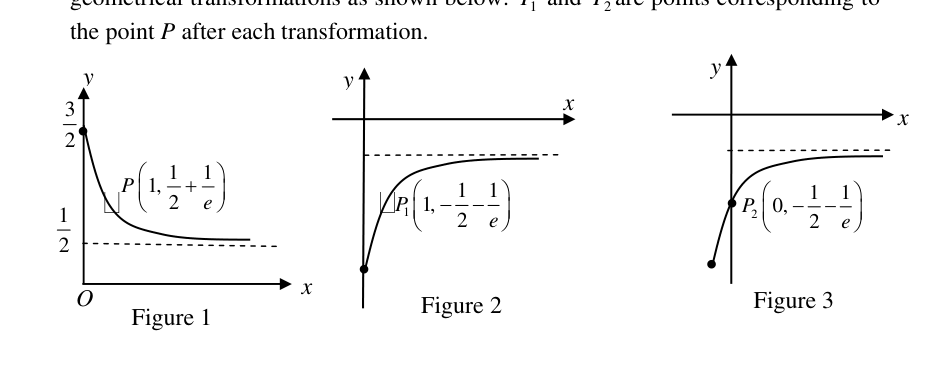
The function f is defined by , . (i) Define . (ii) Sketch the graphs of and on the same diagram. Hence, solve the equation Figure 1 shows the graph , , which undergoes a sequence of two geometrical transformations as shown below. and are points corresponding to the point after each transformation.
- ((iii))
The resulting graph in Figure 3 shows the graph of the function .
Find .
- ((iv))
Explain clearly why the composite function does not exist.
- ((v))
Find the maximal domain of for to exist and hence find the range of .
It won't just hand you the answer — it asks where you're stuck.How the checker works
Worked solution
5((iii))
1. Find the equation of the curve in Figure 2
The curve in Figure 2 has horizontal asymptote and approaches it from below, so it has the form (the part is preserved by a vertical transformation).
Using :
So the Figure 2 curve is , .
2. Apply the horizontal translation (Figure 2 to Figure 3) to get h(x)
From to the -coordinate decreases by with the -value unchanged, so Figure 3 is Figure 2 translated unit in the negative -direction. Replace by :
The domain shifts to .
Check: , matching .
5((iv))
1. State the range of $h$ and the domain of $f$.
From part (iii), the function is for .
The minimum value occurs at where , and the horizontal asymptote is .
Thus, the range of is .
From the question, the domain of is .
2. Check the condition for the existence of $fh$ and conclude.
For the composite function to exist, we must have .
Notice that (since ), but because the interval is strictly greater than .
Since , the composite function does not exist.
The range of is and the domain of is .
For to exist, we require . However, but .
Since , the composite function does not exist.
5((v))
1. State the condition for the existence of the composite function $\mathrm{fh}$.
For the composite function to exist, the range of the inner function must be a subset of the domain of the outer function .
We are given .
Thus, we require , which means .
2. Solve the inequality to find the maximal domain of $h$.
From part (iii), the function is .
Substitute into the inequality:
Multiply throughout by (which flips the inequalities):
Subtract 1:
Since for all real , the right side of the inequality () is always satisfied.
Solving the left inequality:
Thus, the maximal domain of for to exist is .
3. Find the restricted range of $h$ using the maximal domain.
We evaluate the range of for .
As increases from to , the term strictly decreases from to .
Therefore, strictly increases over this interval.
Lower limit (as ): .
Upper limit (as ): .
Hence, the new restricted range of is .
4. Determine the range of the composite function $\mathrm{fh}$.
The range of is the set of values where .
Given :
As , , so , which gives .
At the upper bound , , so .
Thus, .
Since is strictly decreasing for negative values of (as is strictly decreasing), takes all values between and .
The range of is therefore .
Maximal domain of : (or )
Range of :
AI analysis — may contain mistakes.
Worked this one out on paper? Snap your steps and Gigle's AI math checker will circle the step where it went wrong.
More questions on this topic
- 1将函数的图象保持纵坐标不变,先将横坐标缩短为原来的,再向右平移个单位长度后得到,则的解析式为…
- 2By expressing the equation of the curve in the form , where …
- 3A curve has the equation where . Sketch , stating the coordinates of any points o…
- 4The diagram shows the graphs of and . The graph of has t…
- 5The curve with equation is transformed to curve by a translation of …