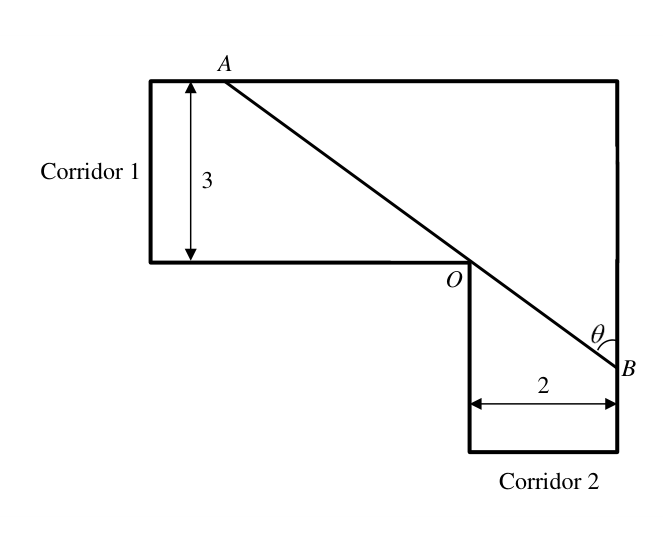
在某栋建筑中,有一个 LL 形通道(见下图)。通道 1 的固定宽度为 3 米,与通道 1 垂直的通道 2 的固定宽度为 2 米。点 AA 和点 BB 分别位于通道 1 和通道 2 的一侧墙壁上,使得线段 ABAB 接触转角 OO,且与其中一面墙壁成 θ\theta 弧度的角(如图所示),其中 0≤θ≤π20 \le \theta \le \frac{\pi}{2}。

  1. (a)

    证明 AB=αcos⁡θ+βsin⁡θAB = \frac{\alpha}{\cos \theta} + \frac{\beta}{\sin \theta},其中 α\alpha 和 β\beta 是待确定的常数。

  2. (b)

    如果 θ\theta 以每秒 0.1 弧度的速度减小,求在 OB=4OB = 4 米的瞬间,ABAB 的增加速率。

  3. (c)

    一根长度为 pp 米的杆平行于地面通过这个 LL 形通道。利用求导法,证明 pp 的最大可能值为 [(2)k+(3)k]1k\left[ (2)^k + (3)^k \right]^{\frac{1}{k}},其中 kk 为一个需要确定精确值的常数。

先不看答案,让 AI 诊断你卡在哪里?

它不会直接告诉你答案,而是问你卡在哪一步看看 AI 是怎么陪你一步步弄懂这道题的

完整解法

13(a)

1. Express the length of $OB$ in terms of $\theta$.

Let PP be the foot of the perpendicular from OO to the right wall of Corridor 2.
In △OPB\triangle OPB, ∠OPB=π2\angle OPB = \frac{\pi}{2} radians and OP=2OP = 2 m (the width of Corridor 2).
Given that the angle between OBOB and the vertical right wall is θ\theta, we have ∠OBP=θ\angle OBP = \theta.
Using trigonometric ratios:
sin⁡θ=OppositeHypotenuse=OPOB=2OB\sin \theta = \frac{\text{Opposite}}{\text{Hypotenuse}} = \frac{OP}{OB} = \frac{2}{OB}
OB=2sin⁡θOB = \frac{2}{\sin \theta}

2. Express the length of $OA$ in terms of $\theta$.

Let QQ be the foot of the perpendicular from OO to the top wall of Corridor 1.
In △OQA\triangle OQA, ∠OQA=π2\angle OQA = \frac{\pi}{2} radians and OQ=3OQ = 3 m (the width of Corridor 1).
Draw a vertical line passing through OO. The angle between OBOB and the downward vertical is θ\theta. Since ABAB is a straight line segment, the vertically opposite angle between OAOA and the upward vertical (OQOQ) is also θ\theta. Thus, ∠AOQ=θ\angle AOQ = \theta.
Using trigonometric ratios:
cos⁡θ=AdjacentHypotenuse=OQOA=3OA\cos \theta = \frac{\text{Adjacent}}{\text{Hypotenuse}} = \frac{OQ}{OA} = \frac{3}{OA}
OA=3cos⁡θOA = \frac{3}{\cos \theta}

3. Combine the lengths to show the required expression for $AB$ and determine the constants.

Since AA, OO, and BB are collinear, the total length ABAB is the sum of OAOA and OBOB:
AB=OA+OBAB = OA + OB
AB=3cos⁡θ+2sin⁡θAB = \frac{3}{\cos \theta} + \frac{2}{\sin \theta}
Comparing this with the given expression AB=αcos⁡θ+βsin⁡θAB = \frac{\alpha}{\cos \theta} + \frac{\beta}{\sin \theta}, we determine that:
α=3andβ=2\alpha = 3 \quad \text{and} \quad \beta = 2

答案

AB=3cos⁡θ+2sin⁡θAB = \frac{3}{\cos \theta} + \frac{2}{\sin \theta}, with α=3\alpha = 3 and β=2\beta = 2

13(b)

1. Deduce the constants $\alpha$ and $\beta$ for the expression of $AB$ as required from part (a).

From the problem description, OBOB forms a right triangle with the vertical right wall (horizontal width 2 m2\text{ m}) with angle θ\theta at OO. Thus,
sin⁡θ=2OB  ⟹  OB=2sin⁡θ\sin \theta = \frac{2}{OB} \implies OB = \frac{2}{\sin \theta}
Similarly, OAOA makes an angle θ\theta with the vertical, forming a right triangle with the horizontal top wall (vertical width 3 m3\text{ m}). Thus,
cos⁡θ=3OA  ⟹  OA=3cos⁡θ\cos \theta = \frac{3}{OA} \implies OA = \frac{3}{\cos \theta}
Hence, AB=3cos⁡θ+2sin⁡θ=3sec⁡θ+2csc⁡θAB = \frac{3}{\cos \theta} + \frac{2}{\sin \theta} = 3\sec \theta + 2\csc \theta, which confirms α=3\alpha = 3 and β=2\beta = 2 from part (a).

2. Find the exact value of $\theta$ at the instant when $OB = 4\text{ m}$.

At the instant when OB=4 mOB = 4\text{ m}:
2sin⁡θ=4  ⟹  sin⁡θ=12\frac{2}{\sin \theta} = 4 \implies \sin \theta = \frac{1}{2}
Given 0≤θ≤π20 \le \theta \le \frac{\pi}{2}, we have:
θ=π6\theta = \frac{\pi}{6}

3. Differentiate $AB$ with respect to $\theta$.

d(AB)dθ=ddθ(3sec⁡θ+2csc⁡θ)\frac{\mathrm{d}(AB)}{\mathrm{d}\theta} = \frac{\mathrm{d}}{\mathrm{d}\theta} (3\sec \theta + 2\csc \theta)
d(AB)dθ=3sec⁡θtan⁡θ−2csc⁡θcot⁡θ\frac{\mathrm{d}(AB)}{\mathrm{d}\theta} = 3\sec \theta \tan \theta - 2\csc \theta \cot \theta

4. Evaluate the derivative at $\theta = \frac{\pi}{6}$ and apply the chain rule to find the rate of change of $AB$.

Evaluate the trigonometric ratios at θ=π6\theta = \frac{\pi}{6}:
sec⁡(π6)=23,tan⁡(π6)=13,csc⁡(π6)=2,cot⁡(π6)=3\sec\left(\frac{\pi}{6}\right) = \frac{2}{\sqrt{3}}, \quad \tan\left(\frac{\pi}{6}\right) = \frac{1}{\sqrt{3}}, \quad \csc\left(\frac{\pi}{6}\right) = 2, \quad \cot\left(\frac{\pi}{6}\right) = \sqrt{3}
d(AB)dθ=3(23)(13)−2(2)(3)=2−43\frac{\mathrm{d}(AB)}{\mathrm{d}\theta} = 3\left(\frac{2}{\sqrt{3}}\right)\left(\frac{1}{\sqrt{3}}\right) - 2(2)(\sqrt{3}) = 2 - 4\sqrt{3}
Given that θ\theta is decreasing at 0.1 rad/s0.1\text{ rad/s}, dθdt=−0.1\frac{\mathrm{d}\theta}{\mathrm{d}t} = -0.1.
By the chain rule:
d(AB)dt=d(AB)dθ×dθdt\frac{\mathrm{d}(AB)}{\mathrm{d}t} = \frac{\mathrm{d}(AB)}{\mathrm{d}\theta} \times \frac{\mathrm{d}\theta}{\mathrm{d}t}
d(AB)dt=(2−43)×(−0.1)=0.43−0.2\frac{\mathrm{d}(AB)}{\mathrm{d}t} = (2 - 4\sqrt{3}) \times (-0.1) = 0.4\sqrt{3} - 0.2
Thus, the rate of increase of ABAB is 0.43−0.2≈0.493 m/s0.4\sqrt{3} - 0.2 \approx 0.493\text{ m/s}.

答案

0.43−0.2 m/s0.4\sqrt{3} - 0.2\text{ m/s} (or 0.493 m/s0.493\text{ m/s} to 3 s.f.)

13(c)

1. Relate the maximum length of the pole $p$ to the length of the line segment $AB$ and set up the expression to minimize.

For the pole to successfully negotiate the corner horizontally, its maximum length pp must not exceed the minimum possible length of the line segment ABAB as it turns.
Using α=3\alpha = 3 and β=2\beta = 2 derived from part (a), the length is:
L=3cos⁡θ+2sin⁡θ=3(cos⁡θ)−1+2(sin⁡θ)−1L = \frac{3}{\cos \theta} + \frac{2}{\sin \theta} = 3(\cos \theta)^{-1} + 2(\sin \theta)^{-1}

2. Differentiate $L$ with respect to $\theta$ and set it to zero to find the stationary point.

dLdθ=3(−1)(cos⁡θ)−2(−sin⁡θ)+2(−1)(sin⁡θ)−2(cos⁡θ)\frac{dL}{d\theta} = 3(-1)(\cos \theta)^{-2}(-\sin \theta) + 2(-1)(\sin \theta)^{-2}(\cos \theta)
dLdθ=3sin⁡θcos⁡2θ−2cos⁡θsin⁡2θ\frac{dL}{d\theta} = \frac{3\sin \theta}{\cos^2 \theta} - \frac{2\cos \theta}{\sin^2 \theta}
For a stationary point, we set dLdθ=0\frac{dL}{d\theta} = 0:
3sin⁡θcos⁡2θ=2cos⁡θsin⁡2θ\frac{3\sin \theta}{\cos^2 \theta} = \frac{2\cos \theta}{\sin^2 \theta}

3. Solve for $\tan \theta$.

3sin⁡3θ=2cos⁡3θ3\sin^3 \theta = 2\cos^3 \theta
sin⁡3θcos⁡3θ=23\frac{\sin^3 \theta}{\cos^3 \theta} = \frac{2}{3}
tan⁡3θ=23  ⟹  tan⁡θ=(23)13\tan^3 \theta = \frac{2}{3} \implies \tan \theta = \left(\frac{2}{3}\right)^{\frac{1}{3}}

4. Use the value of $\tan \theta$ to find exact expressions for $\sin \theta$ and $\cos \theta$.

We can construct a right-angled triangle where the opposite side to θ\theta is 2132^{\frac{1}{3}} and the adjacent side is 3133^{\frac{1}{3}}.
The hypotenuse HH is:
H=(213)2+(313)2=223+323H = \sqrt{\left(2^{\frac{1}{3}}\right)^2 + \left(3^{\frac{1}{3}}\right)^2} = \sqrt{2^{\frac{2}{3}} + 3^{\frac{2}{3}}}
From this triangle:
sin⁡θ=213223+323,cos⁡θ=313223+323\sin \theta = \frac{2^{\frac{1}{3}}}{\sqrt{2^{\frac{2}{3}} + 3^{\frac{2}{3}}}}, \quad \cos \theta = \frac{3^{\frac{1}{3}}}{\sqrt{2^{\frac{2}{3}} + 3^{\frac{2}{3}}}}

5. Substitute $\sin \theta$ and $\cos \theta$ back into the expression for $L$ and simplify using fractional indices.

L=3313223+323+2213223+323L = \frac{3}{\frac{3^{\frac{1}{3}}}{\sqrt{2^{\frac{2}{3}} + 3^{\frac{2}{3}}}}} + \frac{2}{\frac{2^{\frac{1}{3}}}{\sqrt{2^{\frac{2}{3}} + 3^{\frac{2}{3}}}}}
L=31−13223+323+21−13223+323L = 3^{1 - \frac{1}{3}}\sqrt{2^{\frac{2}{3}} + 3^{\frac{2}{3}}} + 2^{1 - \frac{1}{3}}\sqrt{2^{\frac{2}{3}} + 3^{\frac{2}{3}}}
L=323223+323+223223+323L = 3^{\frac{2}{3}}\sqrt{2^{\frac{2}{3}} + 3^{\frac{2}{3}}} + 2^{\frac{2}{3}}\sqrt{2^{\frac{2}{3}} + 3^{\frac{2}{3}}}

6. Factorise and simplify the expression to the required form to determine $k$.

L=(323+223)(223+323)12L = \left(3^{\frac{2}{3}} + 2^{\frac{2}{3}}\right)\left(2^{\frac{2}{3}} + 3^{\frac{2}{3}}\right)^{\frac{1}{2}}
L=[(2)23+(3)23]32L = \left[ (2)^{\frac{2}{3}} + (3)^{\frac{2}{3}} \right]^{\frac{3}{2}}
Comparing this to p=[(2)k+(3)k]1kp = \left[ (2)^k + (3)^k \right]^{\frac{1}{k}}, we obtain exactly k=23k = \frac{2}{3}.

7. Perform the first derivative test to formally verify that this value minimizes $AB$.

Consider the sign of dLdθ\frac{dL}{d\theta} around the stationary point where tan⁡θ=(23)13\tan \theta = \left(\frac{2}{3}\right)^{\frac{1}{3}}.

  • For θ<tan⁡−1((23)13)\theta < \tan^{-1}\left(\left(\frac{2}{3}\right)^{\frac{1}{3}}\right), tan⁡3θ<23  ⟹  3sin⁡3θ<2cos⁡3θ\tan^3 \theta < \frac{2}{3} \implies 3\sin^3 \theta < 2\cos^3 \theta, making dLdθ<0\frac{dL}{d\theta} < 0.
  • For θ>tan⁡−1((23)13)\theta > \tan^{-1}\left(\left(\frac{2}{3}\right)^{\frac{1}{3}}\right), tan⁡3θ>23  ⟹  3sin⁡3θ>2cos⁡3θ\tan^3 \theta > \frac{2}{3} \implies 3\sin^3 \theta > 2\cos^3 \theta, making dLdθ>0\frac{dL}{d\theta} > 0.
    Since dLdθ\frac{dL}{d\theta} changes from negative to positive, LL represents a minimum. Hence, the pole's maximum possible length pp is strictly this minimum value of ABAB.
答案

k=23k = \frac{2}{3}

AI 分析,可能出错

用 AI 批改,圈出写错的那一步,并自动将你的薄弱点存入错题本,形成你的错因库。

同一知识点的其他题

  1. 1[底面半径为 rr、高为 hh 的圆锥体积由 V=13πr2hV = \frac{1}{3}\pi r^2 h 给出。] 某制造商用同一种材料制作了一个漏斗状的装饰品,它由两部分组成,如图 1所示。 * 一个半径为 rr cm、高为 hh…
  2. 2一个圆心角为 θ\theta 弧度、半径为 4π cm4\pi\text{ cm} 的扇形被用来围成一个直圆锥的侧面,且没有重叠。证明该圆锥的体积为 8π34π2θ4−θ6 cm3.\hfill[3]\frac{8\pi}{3}\sqrt{4\pi^2\theta^4 - \theta^6}\text{ cm}^3. \hfill [3]…
  3. 3作为艺术项目的一部分,一个学生设计了一个如图所示的八面体灯笼。灯笼的框架由十二根直铁丝组成,端点相连,形成两个相同的正四棱锥(其底面为边长为 4x m4x\text{ m} 的正方形,侧棱长为 y my\text{ m})。铁丝框架用彩色纸紧紧包…
  4. 4下图显示了一个体积固定为 4k34k\sqrt{3} 单位3^{3} 的梯形柱体的尺寸,其中变量为 xx 和 yy。 该柱体的顶面 ABCDABCD 是一个等腰梯形,其中 ABAB 的长度为 5x5x 单位,DCDC 的长度为 3x3x 单…
  5. 5[半径为 rr、高为 hh 的直圆锥的体积为 13πr2h\frac{1}{3}\pi r^2 h。] 一名学生为他自制的3D打印机制作了一个打印机喷嘴。该打印机喷嘴由一个厚度可忽略的空心倒置直圆锥(其半径为 rr mm,其中 0<r<20 < r < 2…