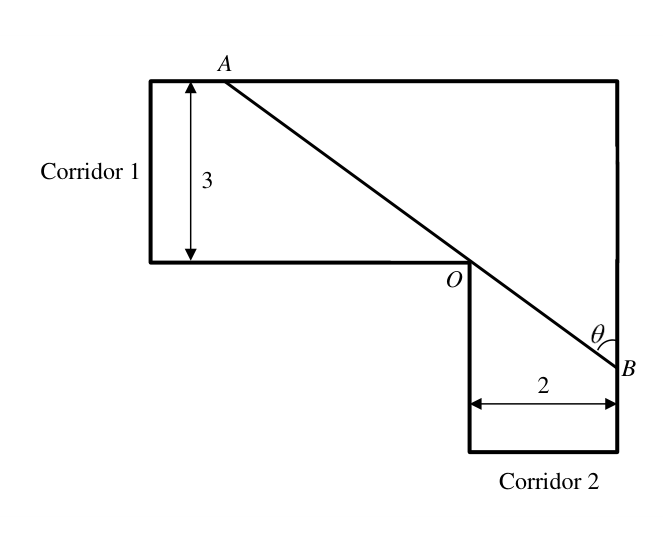
In a particular building, there is an -shaped corridor (see diagram below). Corridor 1 has a fixed width of 3 m and Corridor 2, which is perpendicular to the first corridor, has a fixed width of 2 m. The points and are on one side of the wall along Corridor 1 and Corridor 2 respectively, such that line touches the corner and makes an angle of radians with one of the walls as shown where .
- (a)
Show that , where and are constants to be determined.
- (b)
If is decreasing at 0.1 radians per second, find the rate at which is increasing at the instant when m.
- (c)
A pole of length m is carried through this -shaped corridor parallel to the ground. By using differentiation, show that the maximum possible value of is , where is a constant to be determined exactly.
It won't just hand you the answer — it asks where you're stuck.How the checker works
Worked solution
13(a)
1. Express the length of $OB$ in terms of $\theta$.
Let be the foot of the perpendicular from to the right wall of Corridor 2.
In , radians and m (the width of Corridor 2).
Given that the angle between and the vertical right wall is , we have .
Using trigonometric ratios:
2. Express the length of $OA$ in terms of $\theta$.
Let be the foot of the perpendicular from to the top wall of Corridor 1.
In , radians and m (the width of Corridor 1).
Draw a vertical line passing through . The angle between and the downward vertical is . Since is a straight line segment, the vertically opposite angle between and the upward vertical () is also . Thus, .
Using trigonometric ratios:
3. Combine the lengths to show the required expression for $AB$ and determine the constants.
Since , , and are collinear, the total length is the sum of and :
Comparing this with the given expression , we determine that:
, with and
13(b)
1. Deduce the constants $\alpha$ and $\beta$ for the expression of $AB$ as required from part (a).
From the problem description, forms a right triangle with the vertical right wall (horizontal width ) with angle at . Thus,
Similarly, makes an angle with the vertical, forming a right triangle with the horizontal top wall (vertical width ). Thus,
Hence, , which confirms and from part (a).
2. Find the exact value of $\theta$ at the instant when $OB = 4\text{ m}$.
At the instant when :
Given , we have:
3. Differentiate $AB$ with respect to $\theta$.
4. Evaluate the derivative at $\theta = \frac{\pi}{6}$ and apply the chain rule to find the rate of change of $AB$.
Evaluate the trigonometric ratios at :
Given that is decreasing at , .
By the chain rule:
Thus, the rate of increase of is .
(or to 3 s.f.)
13(c)
1. Relate the maximum length of the pole $p$ to the length of the line segment $AB$ and set up the expression to minimize.
For the pole to successfully negotiate the corner horizontally, its maximum length must not exceed the minimum possible length of the line segment as it turns.
Using and derived from part (a), the length is:
2. Differentiate $L$ with respect to $\theta$ and set it to zero to find the stationary point.
For a stationary point, we set :
3. Solve for $\tan \theta$.
4. Use the value of $\tan \theta$ to find exact expressions for $\sin \theta$ and $\cos \theta$.
We can construct a right-angled triangle where the opposite side to is and the adjacent side is .
The hypotenuse is:
From this triangle:
5. Substitute $\sin \theta$ and $\cos \theta$ back into the expression for $L$ and simplify using fractional indices.
6. Factorise and simplify the expression to the required form to determine $k$.
Comparing this to , we obtain exactly .
7. Perform the first derivative test to formally verify that this value minimizes $AB$.
Consider the sign of around the stationary point where .
- For , , making .
- For , , making .
Since changes from negative to positive, represents a minimum. Hence, the pole's maximum possible length is strictly this minimum value of .
AI analysis — may contain mistakes.
Worked this one out on paper? Snap your steps and Gigle's AI math checker will circle the step where it went wrong.
More questions on this topic
- 1[The volume of a cone of base radius and height is given by .] A manufacturer makes a…
- 2A sector of angle radians and radius is used to form the curved surface of a right circular co…
- 3As part of an Art Project, a student designed a lantern in the shape of an octahedron as shown in the diagram. The frame…
- 4The following diagram shows the dimensions of a trapezoidal prism with fixed volume units, with varia…
- 5[The volume of a right circular cone of radius and height is .] A student makes a printer…