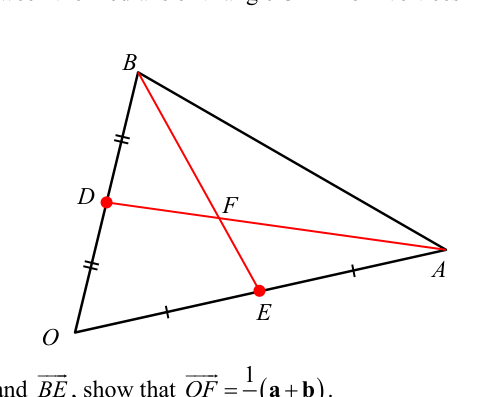
在下图所示的三角形中,一个顶点为原点 O,另外两个顶点为 A 和 B,其中 OA→=a\overrightarrow{OA}=\mathbf{a},OB→=b\overrightarrow{OB}=\mathbf{b}。三角形的中线是连接顶点(O、A 或 B)与对边中点的线段(例如,AD 是三角形 OAB 从顶点 A 出发的中线)。已知 F 是三角形 OAB 从顶点 A 和 B 出发的中线的交点。
  1. (i)

    通过求 AD→\overrightarrow{AD} 和 BE→\overrightarrow{BE},证明 OF→=13(a+b)\overrightarrow{OF}=\tfrac{1}{3}(\mathbf{a}+\mathbf{b})。

  2. (ii)

    证明 F 也落在从顶点 O 出发的三角形 OAB 的中线 OC 上。

先不看答案,让 AI 诊断你卡在哪里?

它不会直接告诉你答案,而是问你卡在哪一步看看 AI 是怎么陪你一步步弄懂这道题的

完整解法

5(i)

1. Find $\overrightarrow{AD}$ and $\overrightarrow{BE}$ using vector addition and the given midpoints.

Given D and E are the midpoints of OB and OA respectively:
OD→=12bandOE→=12a\overrightarrow{OD} = \frac{1}{2}\mathbf{b} \quad \text{and} \quad \overrightarrow{OE} = \frac{1}{2}\mathbf{a}
Using vector subtraction:
AD→=OD→−OA→=12b−a\overrightarrow{AD} = \overrightarrow{OD} - \overrightarrow{OA} = \frac{1}{2}\mathbf{b} - \mathbf{a}
BE→=OE→−OB→=12a−b\overrightarrow{BE} = \overrightarrow{OE} - \overrightarrow{OB} = \frac{1}{2}\mathbf{a} - \mathbf{b}

2. Express $\overrightarrow{OF}$ in two different ways using unknown scalars, as F lies on both AD and BE.

Since F lies on the line segment AD, points A, F, and D are collinear. Hence, AF→=λAD→\overrightarrow{AF} = \lambda\overrightarrow{AD} for some scalar λ\lambda.
OF→=OA→+AF→=a+λ(12b−a)\overrightarrow{OF} = \overrightarrow{OA} + \overrightarrow{AF} = \mathbf{a} + \lambda\left(\frac{1}{2}\mathbf{b} - \mathbf{a}\right)
OF→=(1−λ)a+12λb\overrightarrow{OF} = (1 - \lambda)\mathbf{a} + \frac{1}{2}\lambda\mathbf{b}

Similarly, F lies on BE, so points B, F, and E are collinear. Thus, BF→=μBE→\overrightarrow{BF} = \mu\overrightarrow{BE} for some scalar μ\mu.
OF→=OB→+BF→=b+μ(12a−b)\overrightarrow{OF} = \overrightarrow{OB} + \overrightarrow{BF} = \mathbf{b} + \mu\left(\frac{1}{2}\mathbf{a} - \mathbf{b}\right)
OF→=12μa+(1−μ)b\overrightarrow{OF} = \frac{1}{2}\mu\mathbf{a} + (1 - \mu)\mathbf{b}

3. Equate the coefficients of $\mathbf{a}$ and $\mathbf{b}$ from the two expressions to form linear equations.

Since a\mathbf{a} and b\mathbf{b} are non-zero, non-parallel vectors, we can equate their respective coefficients from the two expressions for OF→\overrightarrow{OF}:
For a\mathbf{a}: 1−λ=12μ1 - \lambda = \frac{1}{2}\mu
For b\mathbf{b}: 12λ=1−μ\frac{1}{2}\lambda = 1 - \mu

4. Solve for the scalar and substitute it back to show the final expression for $\overrightarrow{OF}$.

From the second equation, we get μ=1−12λ\mu = 1 - \frac{1}{2}\lambda.
Substitute this into the first equation:
1−λ=12(1−12λ)1 - \lambda = \frac{1}{2}\left(1 - \frac{1}{2}\lambda\right)
1−λ=12−14λ1 - \lambda = \frac{1}{2} - \frac{1}{4}\lambda
12=34λ  ⟹  λ=23\frac{1}{2} = \frac{3}{4}\lambda \implies \lambda = \frac{2}{3}
Substitute λ=23\lambda = \frac{2}{3} back into the expression for OF→\overrightarrow{OF}:
OF→=(1−23)a+12(23)b\overrightarrow{OF} = \left(1 - \frac{2}{3}\right)\mathbf{a} + \frac{1}{2}\left(\frac{2}{3}\right)\mathbf{b}
OF→=13a+13b=13(a+b)(shown)\overrightarrow{OF} = \frac{1}{3}\mathbf{a} + \frac{1}{3}\mathbf{b} = \frac{1}{3}(\mathbf{a} + \mathbf{b}) \quad \text{(shown)}

答案

\text{Shown}

5(ii)

1. Find the position vector of C, the midpoint of AB.

Since OCOC is the median from vertex OO, CC must be the midpoint of the opposite side ABAB.
OC→=OA→+OB→2\overrightarrow{OC} = \frac{\overrightarrow{OA} + \overrightarrow{OB}}{2}
OC→=12(a+b)\overrightarrow{OC} = \frac{1}{2}(\mathbf{a} + \mathbf{b})

2. Show that $\overrightarrow{OF}$ is a scalar multiple of $\overrightarrow{OC}$ to prove collinearity.

From part (i), we have OF→=13(a+b)\overrightarrow{OF} = \frac{1}{3}(\mathbf{a} + \mathbf{b}).
Expressing OF→\overrightarrow{OF} in terms of OC→\overrightarrow{OC}:
OF→=23[12(a+b)]\overrightarrow{OF} = \frac{2}{3} \left[ \frac{1}{2}(\mathbf{a} + \mathbf{b}) \right]
OF→=23OC→\overrightarrow{OF} = \frac{2}{3} \overrightarrow{OC}
Since OF→\overrightarrow{OF} is a scalar multiple of OC→\overrightarrow{OC} and they share the common point OO, the points OO, FF, and CC are collinear. Thus, FF lies on the line segment OCOC.

答案

As OF→=23OC→\overrightarrow{OF} = \frac{2}{3} \overrightarrow{OC} and they share the common point O, points O, F, and C are collinear, hence F lies on OC.

AI 分析,可能出错

用 AI 批改,圈出写错的那一步,并自动将你的薄弱点存入错题本,形成你的错因库。

同一知识点的其他题

  1. 1以原点 OO 为基准,点 AA、PP 和 QQ 的位置向量分别为 a\mathbf{a}、p\mathbf{p} 和 q\mathbf{q}。一条穿过点 AA 的直线 ll 平行于单位向量 e\mathbf{e}。 点…
  2. 2以原点 OO 为基准,点 AA 和点 BB 满足 OA→=a\overrightarrow{OA}=\mathbf{a} 且 OB→=b\overrightarrow{OB}=\mathbf{b}。点 CC 在 OBOB 上,使得 OC→=pOB→\overrightarrow{OC}=p\overrightarrow{OB}…
  3. 3设点 AA 和点 BB 相对于原点 OO 的位置向量分别为 a\mathbf{a} 和 b\mathbf{b}。 线段 ABAB 上的点 MM 满足 AM:MB=1:2AM : MB = 1 : 2。用 a\mathbf{a} 和 b\mathbf{b}…
  4. 4以原点 OO 为基准,点 AA 和 BB 满足 OA→=a\overrightarrow{OA} = a 且 OB→=b\overrightarrow{OB} = b,其中 aa 不平行于 bb。点 PP 在 ABAB 的延长线上,且满足…
  5. 5相对于原点 OO,点 AA、BB 和 CC 的位置向量分别为 a\mathbf{a}、b\mathbf{b} 和 c\mathbf{c},其中 a\mathbf{a}、b\mathbf{b} 和 c\mathbf{c}…