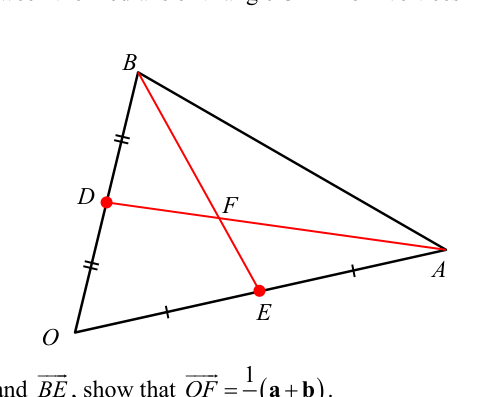
In the triangle shown below, one vertex is origin O, and the two other vertices are A and B where OA→=a\overrightarrow{OA}=\mathbf{a}, OB→=b\overrightarrow{OB}=\mathbf{b}. A median of a triangle is a line segment joining a vertex (O, A or B) to the midpoint of the opposite side (e.g. AD is a median of triangle OAB from vertex A). It is given that F is the point of intersection between the medians of triangle OAB from vertices A and B.
  1. (i)

    By finding AD→\overrightarrow{AD} and BE→\overrightarrow{BE}, show that OF→=13(a+b)\overrightarrow{OF}=\tfrac{1}{3}(\mathbf{a}+\mathbf{b}).

  2. (ii)

    Prove that F also lies on OC, the median of triangle OAB from vertex O.

Work through it with AI →

It won't just hand you the answer — it asks where you're stuck.How the checker works

Worked solution

5(i)

1. Find $\overrightarrow{AD}$ and $\overrightarrow{BE}$ using vector addition and the given midpoints.

Given D and E are the midpoints of OB and OA respectively:
OD→=12bandOE→=12a\overrightarrow{OD} = \frac{1}{2}\mathbf{b} \quad \text{and} \quad \overrightarrow{OE} = \frac{1}{2}\mathbf{a}
Using vector subtraction:
AD→=OD→−OA→=12b−a\overrightarrow{AD} = \overrightarrow{OD} - \overrightarrow{OA} = \frac{1}{2}\mathbf{b} - \mathbf{a}
BE→=OE→−OB→=12a−b\overrightarrow{BE} = \overrightarrow{OE} - \overrightarrow{OB} = \frac{1}{2}\mathbf{a} - \mathbf{b}

2. Express $\overrightarrow{OF}$ in two different ways using unknown scalars, as F lies on both AD and BE.

Since F lies on the line segment AD, points A, F, and D are collinear. Hence, AF→=λAD→\overrightarrow{AF} = \lambda\overrightarrow{AD} for some scalar λ\lambda.
OF→=OA→+AF→=a+λ(12b−a)\overrightarrow{OF} = \overrightarrow{OA} + \overrightarrow{AF} = \mathbf{a} + \lambda\left(\frac{1}{2}\mathbf{b} - \mathbf{a}\right)
OF→=(1−λ)a+12λb\overrightarrow{OF} = (1 - \lambda)\mathbf{a} + \frac{1}{2}\lambda\mathbf{b}

Similarly, F lies on BE, so points B, F, and E are collinear. Thus, BF→=μBE→\overrightarrow{BF} = \mu\overrightarrow{BE} for some scalar μ\mu.
OF→=OB→+BF→=b+μ(12a−b)\overrightarrow{OF} = \overrightarrow{OB} + \overrightarrow{BF} = \mathbf{b} + \mu\left(\frac{1}{2}\mathbf{a} - \mathbf{b}\right)
OF→=12μa+(1−μ)b\overrightarrow{OF} = \frac{1}{2}\mu\mathbf{a} + (1 - \mu)\mathbf{b}

3. Equate the coefficients of $\mathbf{a}$ and $\mathbf{b}$ from the two expressions to form linear equations.

Since a\mathbf{a} and b\mathbf{b} are non-zero, non-parallel vectors, we can equate their respective coefficients from the two expressions for OF→\overrightarrow{OF}:
For a\mathbf{a}: 1−λ=12μ1 - \lambda = \frac{1}{2}\mu
For b\mathbf{b}: 12λ=1−μ\frac{1}{2}\lambda = 1 - \mu

4. Solve for the scalar and substitute it back to show the final expression for $\overrightarrow{OF}$.

From the second equation, we get μ=1−12λ\mu = 1 - \frac{1}{2}\lambda.
Substitute this into the first equation:
1−λ=12(1−12λ)1 - \lambda = \frac{1}{2}\left(1 - \frac{1}{2}\lambda\right)
1−λ=12−14λ1 - \lambda = \frac{1}{2} - \frac{1}{4}\lambda
12=34λ  ⟹  λ=23\frac{1}{2} = \frac{3}{4}\lambda \implies \lambda = \frac{2}{3}
Substitute λ=23\lambda = \frac{2}{3} back into the expression for OF→\overrightarrow{OF}:
OF→=(1−23)a+12(23)b\overrightarrow{OF} = \left(1 - \frac{2}{3}\right)\mathbf{a} + \frac{1}{2}\left(\frac{2}{3}\right)\mathbf{b}
OF→=13a+13b=13(a+b)(shown)\overrightarrow{OF} = \frac{1}{3}\mathbf{a} + \frac{1}{3}\mathbf{b} = \frac{1}{3}(\mathbf{a} + \mathbf{b}) \quad \text{(shown)}

Answer

\text{Shown}

5(ii)

1. Find the position vector of C, the midpoint of AB.

Since OCOC is the median from vertex OO, CC must be the midpoint of the opposite side ABAB.
OC→=OA→+OB→2\overrightarrow{OC} = \frac{\overrightarrow{OA} + \overrightarrow{OB}}{2}
OC→=12(a+b)\overrightarrow{OC} = \frac{1}{2}(\mathbf{a} + \mathbf{b})

2. Show that $\overrightarrow{OF}$ is a scalar multiple of $\overrightarrow{OC}$ to prove collinearity.

From part (i), we have OF→=13(a+b)\overrightarrow{OF} = \frac{1}{3}(\mathbf{a} + \mathbf{b}).
Expressing OF→\overrightarrow{OF} in terms of OC→\overrightarrow{OC}:
OF→=23[12(a+b)]\overrightarrow{OF} = \frac{2}{3} \left[ \frac{1}{2}(\mathbf{a} + \mathbf{b}) \right]
OF→=23OC→\overrightarrow{OF} = \frac{2}{3} \overrightarrow{OC}
Since OF→\overrightarrow{OF} is a scalar multiple of OC→\overrightarrow{OC} and they share the common point OO, the points OO, FF, and CC are collinear. Thus, FF lies on the line segment OCOC.

Answer

As OF→=23OC→\overrightarrow{OF} = \frac{2}{3} \overrightarrow{OC} and they share the common point O, points O, F, and C are collinear, hence F lies on OC.

AI analysis — may contain mistakes.

Worked this one out on paper? Snap your steps and Gigle's AI math checker will circle the step where it went wrong.

More questions on this topic

  1. 1With reference to the origin OO, the points AA, PP and QQ have position vectors a\mathbf{a}, p\mathbf{p} and q\mathbf{q}…
  2. 2Referred to the origin OO, the points AA and BB are such that OA→=a\overrightarrow{OA}=\mathbf{a} and OB→=b\overrightarrow{OB}=\mathbf{b}…
  3. 3The position vectors of the points AA and BB relative to the origin OO are a\mathbf{a} and b\mathbf{b} respectively…
  4. 4Referred to the origin OO, the points AA and BB are such that OA→=a\overrightarrow{OA} = a and OB→=b\overrightarrow{OB} = b…
  5. 5Relative to the origin OO, points AA, BB and CC have position vectors a\mathbf{a}, b\mathbf{b} and c\mathbf{c} re…