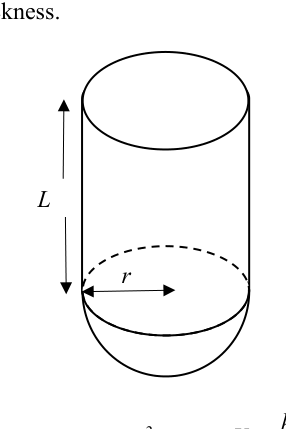
[球体的表面积和体积分别由 4πr24\pi r^2 和 43πr3\dfrac{4}{3}\pi r^3 给出。] 一位预算固定为 $k 的水族爱好者想要建造一个金鱼避难所(鱼缸)。他设计的鱼缸包括一个圆形顶盖、一个长度为 LL cm 的圆柱体和一个半径为 rr cm 的半球形底座,它们紧密地贴合在一起。用于顶盖、圆柱面和半球形底座的材料每 cm2^2 的成本分别为 $20、$10 和 $30。假设制作鱼缸的材料厚度可以忽略不计。
  1. (a)

    证明该鱼缸的体积为 VV cm3^3,其中 V=k20r−103πr3V = \dfrac{k}{20}r - \dfrac{10}{3}\pi r^3。

  2. (b)

    随着 rr 的变化,求当 VV 达到最大值时,用于制作半球形底座的材料成本(用 kk 表示)。你需要证明此时 VV 取得最大值。

  3. (c)

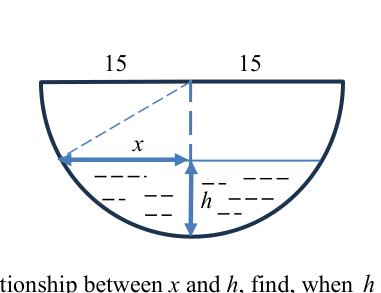
    该水族爱好者已将圆柱体的半径固定为 1515 cm。最初,鱼缸的半球形部分有一些水。然而,由于鱼缸存在缺陷,水正以每分钟 2020 cm3^3 的恒定速率泄漏。半球形底部的深度记为 hh cm,水面的半径为 xx cm。半球形底部的水体积由下式给出:W=πh(3x2+h2)6.W = \dfrac{\pi h\left(3x^2 + h^2\right)}{6}.

    1. (i)

      通过构建 xx 与 hh 之间的关系,求当 h=3h = 3 时水深的变化率。

    2. (ii)

      通过构建 xx 与 hh 之间的关系,求当 h=3h = 3 时水面半径的变化率。

先不看答案,让 AI 诊断你卡在哪里?

它不会直接告诉你答案,而是问你卡在哪一步看看 AI 是怎么陪你一步步弄懂这道题的

完整解法

11(a)

1. Express the total material cost in terms of $r$ and $L$ and equate it to $k$.

Calculate the cost of each part of the tank using the given cost rates and surface area formulas:
Cost of circular cover =20×(πr2)=20πr2= 20 \times (\pi r^2) = 20\pi r^2
Cost of cylindrical surface =10×(2πrL)=20πrL= 10 \times (2\pi r L) = 20\pi r L
Cost of hemispherical base =30×(12×4πr2)=60πr2= 30 \times \left(\frac{1}{2} \times 4\pi r^2\right) = 60\pi r^2

Total cost of material =20πr2+20πrL+60πr2=80πr2+20πrL= 20\pi r^2 + 20\pi r L + 60\pi r^2 = 80\pi r^2 + 20\pi r L

Given the fixed budget is $k\char36{}k:
80πr2+20πrL=k80\pi r^2 + 20\pi r L = k

2. Make $L$ the subject of the equation.

20πrL=k−80πr220\pi r L = k - 80\pi r^2
L=k−80πr220πrL = \frac{k - 80\pi r^2}{20\pi r}
L=k20πr−80πr220πrL = \frac{k}{20\pi r} - \frac{80\pi r^2}{20\pi r}
L=k20πr−4rL = \frac{k}{20\pi r} - 4r

3. Set up the equation for the total volume and substitute $L$ to show the target expression.

Total volume VV is the sum of the volume of the cylinder and the hemisphere:
V=πr2L+23πr3V = \pi r^2 L + \frac{2}{3}\pi r^3

Substitute L=k20πr−4rL = \frac{k}{20\pi r} - 4r into the volume equation:
V=πr2(k20πr−4r)+23πr3V = \pi r^2 \left( \frac{k}{20\pi r} - 4r \right) + \frac{2}{3}\pi r^3
V=k20r−4πr3+23πr3V = \frac{k}{20}r - 4\pi r^3 + \frac{2}{3}\pi r^3
V=k20r−103πr3(Shown)V = \frac{k}{20}r - \frac{10}{3}\pi r^3 \quad \text{(Shown)}

答案

V=k20r−103πr3V = \dfrac{k}{20}r - \dfrac{10}{3}\pi r^3 (Shown)

11(b)

1. Find the first derivative of $V$ with respect to $r$.

dVdr=k20−103π(3r2)=k20−10πr2\frac{\mathrm{d}V}{\mathrm{d}r} = \frac{k}{20} - \frac{10}{3}\pi (3r^2) = \frac{k}{20} - 10\pi r^2

2. Equate the first derivative to zero to find the stationary value of $r^2$.

k20−10πr2=0\frac{k}{20} - 10\pi r^2 = 0
10πr2=k2010\pi r^2 = \frac{k}{20}
r2=k200πr^2 = \frac{k}{200\pi}

3. Use the second derivative to verify that this value of $r$ gives a maximum volume.

d2Vdr2=−20πr\frac{\mathrm{d}^2V}{\mathrm{d}r^2} = -20\pi r
Since the radius r>0r > 0, we have d2Vdr2<0\frac{\mathrm{d}^2V}{\mathrm{d}r^2} < 0.
Therefore, VV is at a maximum.

4. Formulate the cost of the hemispherical base and evaluate it using the stationary value of $r^2$.

The surface area of the hemispherical base is 12×4πr2=2πr2\frac{1}{2} \times 4\pi r^2 = 2\pi r^2.

Cost=$30×2πr2=60πr2\text{Cost} = \$30 \times 2\pi r^2 = 60\pi r^2
Substitute r2=k200πr^2 = \frac{k}{200\pi} into the cost equation:
Cost=60π(k200π)=60200k=310k\text{Cost} = 60\pi \left(\frac{k}{200\pi}\right) = \frac{60}{200}k = \frac{3}{10}k

答案

$\frac{3}{10}k

11(c)(i)

1. Formulate a relationship between the radius of the water surface $x$ and the depth $h$.

Let OO be the centre of the hemispherical base. Since the radius of the cylinder is 15 cm15\text{ cm}, the radius of the hemisphere is also 15 cm15\text{ cm}.

The vertical distance from OO to the water surface is 15−h15 - h.
By Pythagoras' theorem on the vertical cross-section:
x2+(15−h)2=152x^2 + (15 - h)^2 = 15^2
x2+225−30h+h2=225x^2 + 225 - 30h + h^2 = 225
x2=30h−h2x^2 = 30h - h^2

2. Express the volume of the water $W$ solely in terms of $h$.

Substitute x2=30h−h2x^2 = 30h - h^2 into the given volume formula W=πh(3x2+h2)6W = \frac{\pi h(3x^2 + h^2)}{6}:
W=πh(3(30h−h2)+h2)6W = \frac{\pi h(3(30h - h^2) + h^2)}{6}
W=πh(90h−3h2+h2)6W = \frac{\pi h(90h - 3h^2 + h^2)}{6}
W=πh(90h−2h2)6W = \frac{\pi h(90h - 2h^2)}{6}
W=π(15h2−13h3)W = \pi\left(15h^2 - \frac{1}{3}h^3\right)

3. Differentiate $W$ with respect to $h$ and evaluate at $h=3$.

dWdh=π(30h−h2)\frac{dW}{dh} = \pi\left(30h - h^2\right)
When h=3h = 3:
dWdh=π(30(3)−32)=π(90−9)=81π\frac{dW}{dh} = \pi(30(3) - 3^2) = \pi(90 - 9) = 81\pi

4. Use the chain rule to find the rate of change of depth $\frac{dh}{dt}$.

Since water is leaking, the rate of change of volume is dWdt=−20 cm3/min\frac{dW}{dt} = -20\text{ cm}^3/\text{min}.
Using the chain rule:
dWdt=dWdh×dhdt\frac{dW}{dt} = \frac{dW}{dh} \times \frac{dh}{dt}
−20=81π×dhdt-20 = 81\pi \times \frac{dh}{dt}
dhdt=−2081π≈−0.0786 cm/min\frac{dh}{dt} = -\frac{20}{81\pi} \approx -0.0786\text{ cm/min}

答案

−2081π-\frac{20}{81\pi} (or ≈−0.0786\approx -0.0786) cm/min\text{cm/min}

11(c)(ii)

1. Formulate the relationship between $x$ and $h$ using Pythagoras' theorem on the hemispherical base.

From the cross-section of the hemisphere (radius r=15r = 15 cm), the distance from the centre to the water surface is (15−h)(15 - h) cm.
Using Pythagoras' theorem on the right-angled triangle formed by the radius, the water surface, and the vertical axis:
x2+(15−h)2=152x^2 + (15 - h)^2 = 15^2
x2+225−30h+h2=225x^2 + 225 - 30h + h^2 = 225
x2=30h−h2x^2 = 30h - h^2

2. Express the water volume $W$ in terms of $h$ and compute the rate of change of depth $\frac{dh}{dt}$ at $h=3$ (as determined in the preceding part c(i)).

Substitute x2=30h−h2x^2 = 30h - h^2 into the volume formula:
W=πh(3(30h−h2)+h2)6=πh(90h−2h2)6=π(15h2−13h3)W = \frac{\pi h(3(30h - h^2) + h^2)}{6} = \frac{\pi h(90h - 2h^2)}{6} = \pi\left(15h^2 - \frac{1}{3}h^3\right)
Differentiating with respect to tt:
dWdt=π(30h−h2)dhdt\frac{dW}{dt} = \pi(30h - h^2)\frac{dh}{dt}
Given dWdt=−20\frac{dW}{dt} = -20 (since water is leaking), substitute h=3h = 3:
−20=π(30(3)−32)dhdt-20 = \pi(30(3) - 3^2)\frac{dh}{dt}
−20=81πdhdt  ⟹  dhdt=−2081π-20 = 81\pi \frac{dh}{dt} \implies \frac{dh}{dt} = -\frac{20}{81\pi}

3. Differentiate the geometric relationship with respect to time $t$ to link $\frac{dx}{dt}$ and $\frac{dh}{dt}$.

Differentiating x2=30h−h2x^2 = 30h - h^2 implicitly with respect to tt:
2xdxdt=(30−2h)dhdt2x \frac{dx}{dt} = (30 - 2h)\frac{dh}{dt}

4. Substitute $h=3$ and the known rates to evaluate the rate of change of the radius $x$.

When h=3h = 3:
x2=30(3)−32=81  ⟹  x=9x^2 = 30(3) - 3^2 = 81 \implies x = 9 (since x>0x > 0)

Substitute x=9x = 9 and dhdt=−2081π\frac{dh}{dt} = -\frac{20}{81\pi} into the differentiated equation:
2(9)dxdt=(30−2(3))(−2081π)2(9) \frac{dx}{dt} = (30 - 2(3))\left(-\frac{20}{81\pi}\right)
18dxdt=24(−2081π)=−48081π18 \frac{dx}{dt} = 24\left(-\frac{20}{81\pi}\right) = -\frac{480}{81\pi}
dxdt=−48018×81π=−80243π\frac{dx}{dt} = -\frac{480}{18 \times 81\pi} = -\frac{80}{243\pi}

答案

−80243π cm/min-\frac{80}{243\pi} \text{ cm/min} (or −0.105 cm/min-0.105 \text{ cm/min} to 3 s.f.)

AI 分析,可能出错

用 AI 批改,圈出写错的那一步,并自动将你的薄弱点存入错题本,形成你的错因库。

同一知识点的其他题

  1. 1[底面半径为 rr、高为 hh 的圆锥体积由 V=13πr2hV = \frac{1}{3}\pi r^2 h 给出。] 某制造商用同一种材料制作了一个漏斗状的装饰品,它由两部分组成,如图 1所示。 * 一个半径为 rr cm、高为 hh…
  2. 2一个圆心角为 θ\theta 弧度、半径为 4π cm4\pi\text{ cm} 的扇形被用来围成一个直圆锥的侧面,且没有重叠。证明该圆锥的体积为 8π34π2θ4−θ6 cm3.\hfill[3]\frac{8\pi}{3}\sqrt{4\pi^2\theta^4 - \theta^6}\text{ cm}^3. \hfill [3]…
  3. 3作为艺术项目的一部分,一个学生设计了一个如图所示的八面体灯笼。灯笼的框架由十二根直铁丝组成,端点相连,形成两个相同的正四棱锥(其底面为边长为 4x m4x\text{ m} 的正方形,侧棱长为 y my\text{ m})。铁丝框架用彩色纸紧紧包…
  4. 4下图显示了一个体积固定为 4k34k\sqrt{3} 单位3^{3} 的梯形柱体的尺寸,其中变量为 xx 和 yy。 该柱体的顶面 ABCDABCD 是一个等腰梯形,其中 ABAB 的长度为 5x5x 单位,DCDC 的长度为 3x3x 单…
  5. 5[半径为 rr、高为 hh 的直圆锥的体积为 13πr2h\frac{1}{3}\pi r^2 h。] 一名学生为他自制的3D打印机制作了一个打印机喷嘴。该打印机喷嘴由一个厚度可忽略的空心倒置直圆锥(其半径为 rr mm,其中 0<r<20 < r < 2…