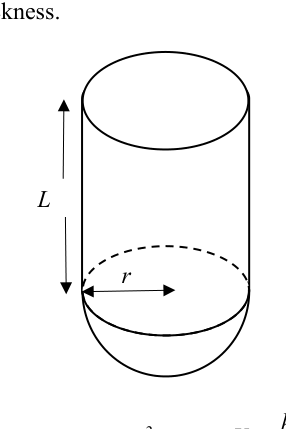
[The surface area and volume of a sphere are given by and respectively.] An aquarist who has a fixed budget of $k wants to make a goldfish sanctuary. His design of the tank consists of a circular cover, a cylinder of length cm and a hemispherical base of radius cm neatly fitted together. The costs of the material per cm used for the cover, the cylindrical surface and hemispherical base are $20, $10 and $30 respectively. Assume that the tank is made of material with negligible thickness.
- (a)
Show that the volume of the tank is cm, where .
- (b)
As varies, find the cost of the material used to make the hemispherical base in terms of when is at its maximum value. You need to show that is a maximum.
- (c)
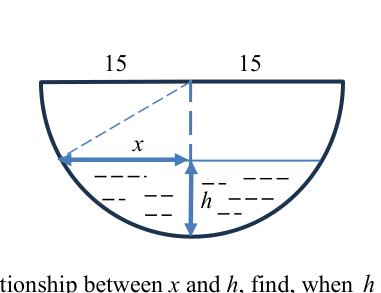
The aquarist has fixed the radius of the cylinder to be cm. Initially, there is some water in the hemispherical part of the tank. However, due to a defect in the tank, water is leaking at a constant rate of cm per minute. The depth of the water at the hemispherical bottom is denoted by cm, and the radius of the water surface is cm. The volume of water in the hemispherical bottom is given by
- (i)
By formulating a relationship between and , find, when , the rate of change of the depth of water.
- (ii)
By formulating a relationship between and , find, when , the rate of change of the radius of the water surface.
- (i)
It won't just hand you the answer — it asks where you're stuck.How the checker works
Worked solution
11(a)
1. Express the total material cost in terms of $r$ and $L$ and equate it to $k$.
Calculate the cost of each part of the tank using the given cost rates and surface area formulas:
Cost of circular cover
Cost of cylindrical surface
Cost of hemispherical base
Total cost of material
Given the fixed budget is :
2. Make $L$ the subject of the equation.
3. Set up the equation for the total volume and substitute $L$ to show the target expression.
Total volume is the sum of the volume of the cylinder and the hemisphere:
Substitute into the volume equation:
(Shown)
11(b)
1. Find the first derivative of $V$ with respect to $r$.
2. Equate the first derivative to zero to find the stationary value of $r^2$.
3. Use the second derivative to verify that this value of $r$ gives a maximum volume.
Since the radius , we have .
Therefore, is at a maximum.
4. Formulate the cost of the hemispherical base and evaluate it using the stationary value of $r^2$.
The surface area of the hemispherical base is .
Substitute into the cost equation:
$\frac{3}{10}k
11(c)(i)
1. Formulate a relationship between the radius of the water surface $x$ and the depth $h$.
Let be the centre of the hemispherical base. Since the radius of the cylinder is , the radius of the hemisphere is also .
The vertical distance from to the water surface is .
By Pythagoras' theorem on the vertical cross-section:
2. Express the volume of the water $W$ solely in terms of $h$.
Substitute into the given volume formula :
3. Differentiate $W$ with respect to $h$ and evaluate at $h=3$.
When :
4. Use the chain rule to find the rate of change of depth $\frac{dh}{dt}$.
Since water is leaking, the rate of change of volume is .
Using the chain rule:
(or )
11(c)(ii)
1. Formulate the relationship between $x$ and $h$ using Pythagoras' theorem on the hemispherical base.
From the cross-section of the hemisphere (radius cm), the distance from the centre to the water surface is cm.
Using Pythagoras' theorem on the right-angled triangle formed by the radius, the water surface, and the vertical axis:
2. Express the water volume $W$ in terms of $h$ and compute the rate of change of depth $\frac{dh}{dt}$ at $h=3$ (as determined in the preceding part c(i)).
Substitute into the volume formula:
Differentiating with respect to :
Given (since water is leaking), substitute :
3. Differentiate the geometric relationship with respect to time $t$ to link $\frac{dx}{dt}$ and $\frac{dh}{dt}$.
Differentiating implicitly with respect to :
4. Substitute $h=3$ and the known rates to evaluate the rate of change of the radius $x$.
When :
(since )
Substitute and into the differentiated equation:
(or to 3 s.f.)
AI analysis — may contain mistakes.
Worked this one out on paper? Snap your steps and Gigle's AI math checker will circle the step where it went wrong.
More questions on this topic
- 1[The volume of a cone of base radius and height is given by .] A manufacturer makes a…
- 2A sector of angle radians and radius is used to form the curved surface of a right circular co…
- 3As part of an Art Project, a student designed a lantern in the shape of an octahedron as shown in the diagram. The frame…
- 4The following diagram shows the dimensions of a trapezoidal prism with fixed volume units, with varia…
- 5[The volume of a right circular cone of radius and height is .] A student makes a printer…