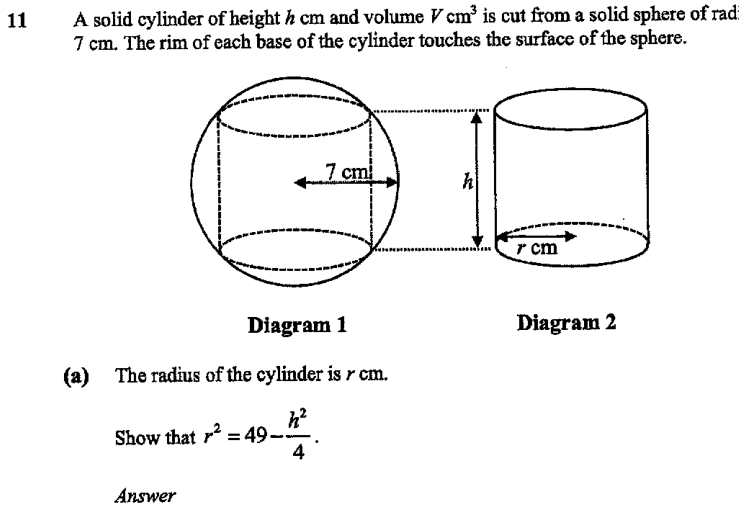
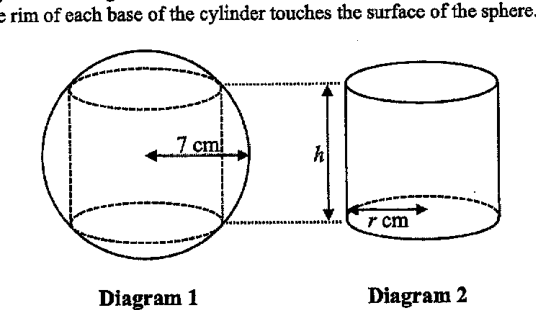
A solid cylinder of height h cm and volume V cm^3 is cut from a solid sphere of radius 7 cm. The rim of each base of the cylinder touches the surface of the sphere.
- ((a))
The radius of the cylinder is r cm.
Show that $r^2 = 49 - \frac{h^2}{4}.
Answer
- ((b))
The volume of the cylinder is given by the equation $V = \pi h \left(49 - \frac{h^2}{4}\right).
Some corresponding values of and , correct to the nearest whole number, are given in the table below.
- ((i))
Find the value of p.
Answer ...
- ((ii))
On the grid opposite, draw the graph of for .
- ((i))
- ((c))
Use your graph to find
- ((i))
the maximum volume of the cylinder,
Answer ... cm
- ((ii))
the solutions to the equation
Answer ... or ...
- ((i))
- ((d))
The line , where is a constant, is a tangent to the curve. By drawing a suitable straight line on the graph, find the value of .
Answer ...
- (b)
- ((ii))
It won't just hand you the answer — it asks where you're stuck.How the checker works
Worked solution
11((a))
1. Apply Pythagoras' theorem to the right triangle formed in the cross-section and rearrange for $r^2$.
In the cross-section, the right triangle has sides , and hypotenuse .
By Pythagoras' theorem,
11((b))((i))
1. Substitute $h=4$ into the given formula for $V$ and evaluate.
For ,
Correct to the nearest whole number,
11((b))((ii))
1. Use the completed table of values for the graph.
From the table and part (b)(i), the points to plot are
2. Plot the points accurately on the given axes.
On the grid with horizontal axis and vertical axis , plot:
Use the given axis scales: from to and marked in hundreds.
3. Draw the required curve over the interval.
Join the plotted points with a smooth curve for
The curve should rise from to a maximum between and , then fall towards .
A smooth curve of drawn for , passing through the plotted points
11((c))((i))
1. Read the maximum value of $V$ from the highest point of the graph.
From the graph of , the highest point of the curve occurs at about .
The corresponding value of is approximately
11((c))((ii))
1. Relate the given equation to the graph equation for $V$.
From the graph,
Since
then
2. Convert the given equation to a horizontal line on the graph and read the intersections.
Given
we have
So
Draw the horizontal line on the graph and read the two intersection points with the curve.
From the graph,
or
11((d))
1. Draw the suitable tangent line on the existing graph.
On the graph, mark the point on the -axis. Draw a straight line through so that it is a tangent to the curve .
From the graph, the tangent touches the curve at about
2. Find the gradient of the tangent line and identify it as $k$.
Since the line has equation
its gradient is .
Using the two points approximately and ,
Hence
AI analysis — may contain mistakes.
Worked this one out on paper? Snap your steps and Gigle's AI math checker will circle the step where it went wrong.
More questions on this topic
- 1In the diagram, there are two right-angled triangles ΔABD and ΔCEB such that AD = 12 cm, BD = 15 cm and BE = 20 cm. Find…
- 2In triangle ABC, , and . Express as a fraction in its…
- 3In the diagram, POR is a quadrant of a circle with radius 6 cm. OR and PQ are parallel. QR is an arc of a circle with ce…
- 4Triangle ABC is a right-angled triangle. Given that two of its lengths are 11 cm and 5 cm, find two possible lengths for…
- 5The diagram below shows a gift souvenir formed by joining the plane face of a solid hemisphere of radius 3 cm and a soli…