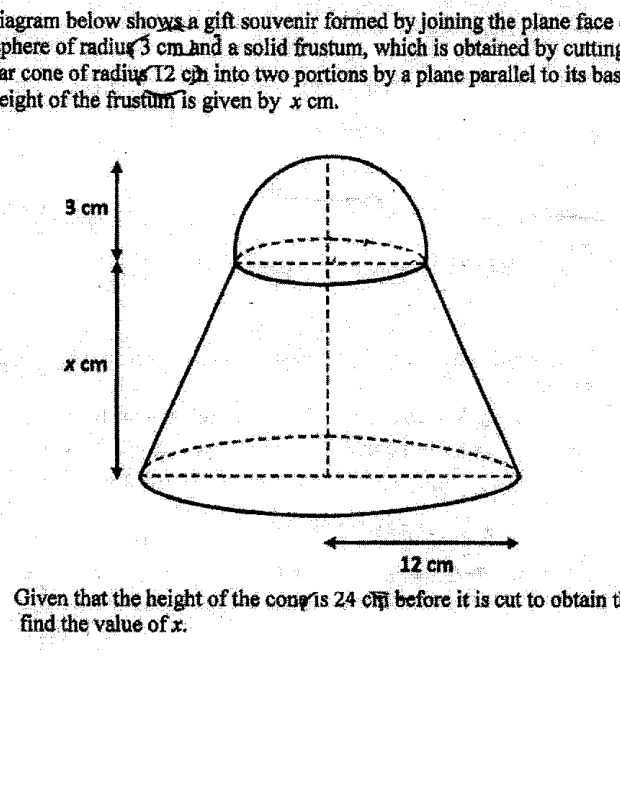
The diagram below shows a gift souvenir formed by joining the plane face of a solid hemisphere of radius 3 cm and a solid frustum, which is obtained by cutting a right circular cone of radius 12 cm into two portions by a plane parallel to its base. The height of the frustum is given by cm.
- (a)
Given that the height of the cone is 24 cm before it is cut to obtain the frustum, find the value of .
- (b)
Find the volume of the souvenir.
Answer ... cm^3
- (c)
Find the total surface area of the entire gift souvenir.
Answer ... cm^2
It won't just hand you the answer — it asks where you're stuck.How the checker works
Worked solution
12(a)
1. Find the height of the small cone cut off using similar triangles
Let the height of the small cone cut off be cm.
Since the cut is parallel to the base, the small cone is similar to the original cone.
2. Subtract the small cone height from the original cone height to find the frustum height
The height of the frustum is
12(b)
1. Find the volume of the frustum
For a frustum with height , base radius and top radius ,
2. Find the volume of the solid hemisphere
Volume of a hemisphere:
With ,
3. Add the volumes to get the volume of the souvenir
correct to 3 significant figures
12(c)
1. Find the slant height of the frustum
The frustum has height , lower radius and upper radius .
Difference in radii .
Using Pythagoras' theorem,
2. Find the curved surface area of the frustum
Curved surface area of a frustum:
where , and .
3. Find the exposed surface area of the hemisphere
Only the curved surface of the hemisphere is exposed.
Curved surface area of hemisphere:
4. Find the exposed circular base area of the frustum
The lower circular base of the frustum is exposed.
5. Add all exposed surface areas and round the answer
Correct to 3 significant figures,
correct to 3 significant figures
AI analysis — may contain mistakes.
Worked this one out on paper? Snap your steps and Gigle's AI math checker will circle the step where it went wrong.
More questions on this topic
- 1In the diagram, there are two right-angled triangles ΔABD and ΔCEB such that AD = 12 cm, BD = 15 cm and BE = 20 cm. Find…
- 2A cuboid has a volume of 250 cm^3, correct to the nearest cubic centimetre. The height of the cuboid is 8.4 cm, correct…
- 3The points A, B, C, D and E are shown in the diagram below such that ABC and AED are straight lines and BE = …
- 4In the diagram, triangle XYZ is similar to triangle UXS. Given that cm, cm and cm…
- 5The diagram shows two circles that touch at C. A, B and C are points on the small circle, centre P. C, D and E are point…