Zhao and Mei are planning their exercise routines. They record their body weights and speeds for walking and jogging.
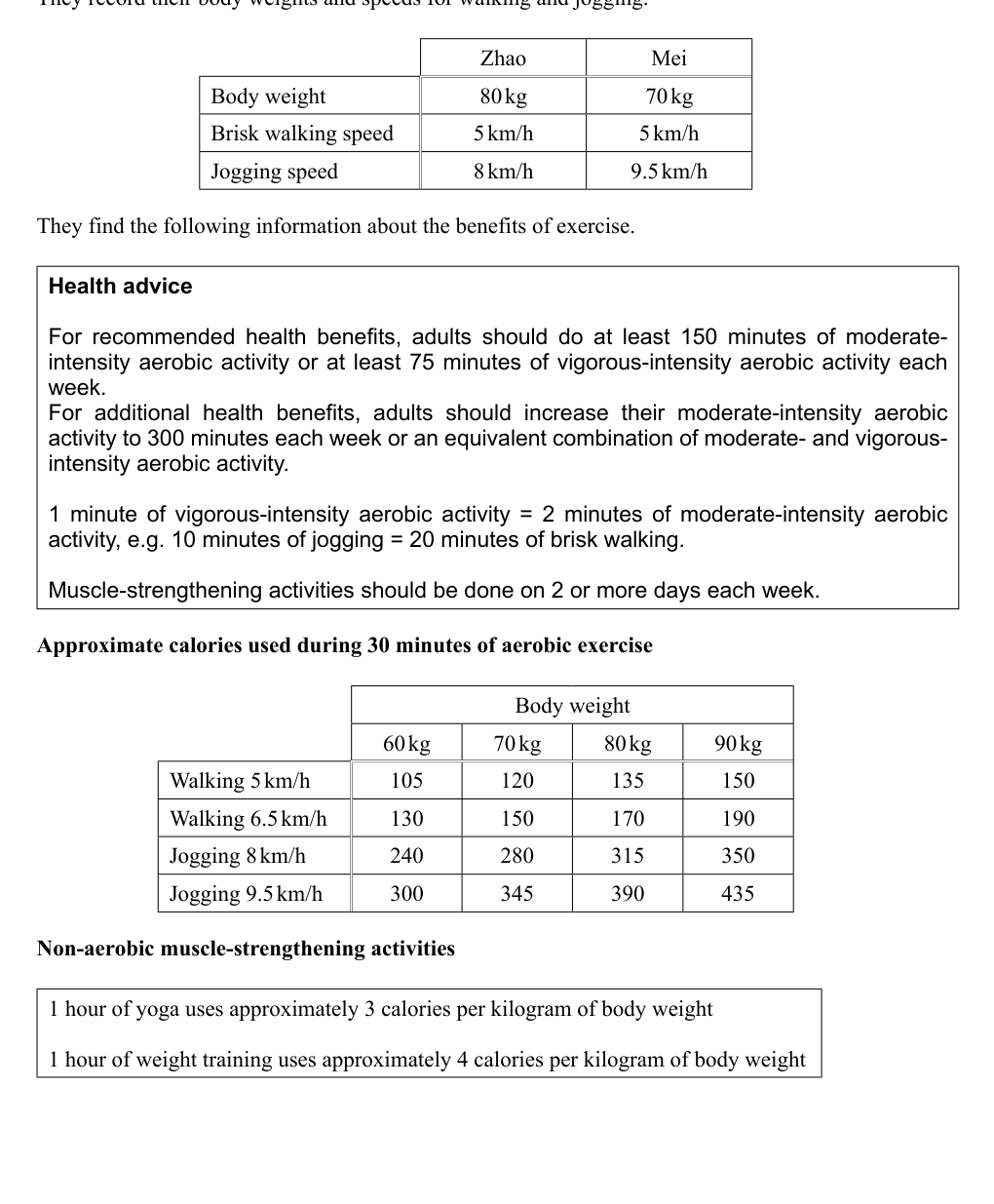
- (a)
In their first week of exercise, they each plan to go for 4 brisk walks.
They will walk the same route each time.
The four walks together meet the minimum target for the time for recommended health benefits in one week.
- (i)
Work out the distance of one of these walks.
Answer ... km
- (ii)
Work out how many more calories Zhao uses in these 4 walks than Mei does.
Answer ... calories
- (i)
- (b)
After one month they change their routines.
Zhao wants to get additional health benefits.
He decides to do a 4 km walk 3 times each week and do a 6 km jog 2 times each week.
He will also do a 45-minute yoga class 2 times each week.Mei wants to maintain recommended health benefits.
She decides to do an 8 km jog 2 times each week.
She will also do a 30-minute weight training session 2 times each week.Zhao says:
We will both meet our targets for exercise, but I will use about 50% more calories than
Mei does during our exercise each week.
Is Zhao correct?
Justify your decision with calculations.
It won't just hand you the answer — it asks where you're stuck.How the checker works
Worked solution
9(a)(i)
1. Find the time for one walk
The 4 brisk walks together meet the minimum target of minutes.
Time for one walk:
2. Use speed and time to find the distance of one walk
Brisk walking speed .
9(a)(ii)
1. Find the difference in calories used per 30 minutes and scale it to 150 minutes
From the table, for walking at for minutes:
Zhao uses calories and Mei uses calories.
Difference per minutes:
The total walking time is minutes, so
Difference for all walks:
calories
9(b)
1. Find Zhao's weekly aerobic exercise time in moderate-equivalent minutes
Zhao walks at , so time for one walk
For walks, walking time
Zhao jogs at , so time for one jog
For jogs, jogging time
Since min vigorous min moderate, Zhao's moderate-equivalent time
2. Check whether Zhao meets his target for additional health benefits
For additional health benefits, Zhao needs min moderate activity or an equivalent combination.
Since
Zhao meets his target for exercise.
3. Find Mei's weekly aerobic exercise time and check her target
Mei jogs at , so time for one jog
For jogs, jogging time
Mei needs at least min of vigorous activity for recommended health benefits.
Since
Mei meets her target for exercise.
4. Calculate Zhao's total weekly calories used
From the table, Zhao uses calories per min walking at .
Zhao walks for min, so walking calories
From the table, Zhao uses calories per min jogging at .
Zhao jogs for min, so jogging calories
Yoga uses calories per kg per hour. Zhao's body weight is , and he does two -minute classes:
Yoga calories
Total calories for Zhao
5. Calculate Mei's total weekly calories used
From the table, Mei uses calories per min jogging at .
Mei jogs for min, so jogging calories
Weight training uses calories per kg per hour. Mei's body weight is , and she does two -minute sessions:
Weight training calories
Total calories for Mei
6. Compare Zhao's calories with Mei's and decide whether Zhao's statement is correct
Percentage more calories Zhao uses than Mei
This is not about more.
Therefore, Zhao is only partly correct: both meet their exercise targets, but he does not use about more calories than Mei.
Zhao is correct that both meet their targets, but he is not correct that he uses about more calories. Zhao uses about calories per week and Mei uses about calories per week, so Zhao uses about more calories than Mei.
AI analysis — may contain mistakes.
Worked this one out on paper? Snap your steps and Gigle's AI math checker will circle the step where it went wrong.
More questions on this topic
- 1Mrs Ang runs a small tuition centre for secondary school students. The tables provide information on the cost of running…
- 2The diagram (not drawn to scale) shows the speed-time graph of a vehicle. The vehicle starts from rest and accelerates u…
- 3Hamid borrowed a sum of money for 3 years at an interest rate of 3.5% per annum simple interest to pay for his car. If t…
- 4The diagram shows the positions of a harbour, H, a lighthouse, L, and two buoys P and Q. HPQ is a straight line. The bea…
- 5The diagram below shows the speed-time graph of a bus journey. The bus accelerated from rest at 1.25 m/s^2 to a speed of…