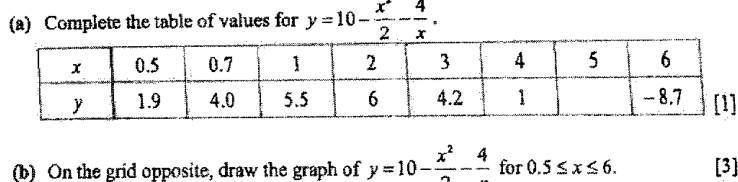
Complete the table of values for .
- ((a))
Complete the table of values for .
- ((b))
On the grid opposite, draw the graph of for .
- ((c))
By drawing a tangent, find the gradient of the curve at (2, 6).
Answer ...
- ((d))
By drawing suitable straight lines, find the x-coordinate of the point(s) on the curve at which the gradient of the tangent is 3, in the range .
Answer x = ...
- ((e))
Use your graph to find the solutions of the equation in the range .
Answer x = ... or ...
It won't just hand you the answer — it asks where you're stuck.How the checker works
Worked solution
10((a))
1. Find the missing $y$-value by substituting $x=5$ into the formula.
For ,
Missing table value: when .
10((b))
1. Use the completed table to list the coordinates to be plotted.
From the table, including the completed value from part (a), plot:
2. Plot the points accurately on the given grid.
Mark each coordinate point on the grid using the -value horizontally and the -value vertically. The graph is only required for
3. Join the plotted points with a smooth curve.
Draw a smooth curve through the plotted points, not a series of straight line segments. The curve rises from to a maximum near , then falls through the remaining points.
A smooth curve drawn for passing through the plotted points
10((c))
1. Draw the tangent at the point $(2,6)$ on the curve.
On the completed graph, draw a straight line that just touches the curve at and follows the direction of the curve at that point.
2. Find the gradient of the tangent using two points on the tangent line.
Using two well-spaced points read from the tangent line, calculate
For an accurately drawn tangent, this gives approximately
Gradient
10((d))
1. Draw a straight line with gradient 3 as a guide.
A line with gradient rises units for every unit moved to the right. For example, draw a straight guide line through two convenient points such as and .
2. Find the point on the curve where the tangent is parallel to this line.
Draw a line parallel to the gradient- guide line so that it just touches the curve. Reading the -coordinate of the point of contact from the graph gives
10((e))
1. Rewrite the cubic equation in terms of the expression used in the curve.
Given
Since in the range , divide by :
So
2. Express the equation as the intersection of the given curve and a straight line.
For the curve,
Using
we get
Therefore, draw the straight line
on the same graph.
3. Read the $x$-coordinates of the intersections from the graph.
The solutions are the -coordinates where the line
meets the curve
From the graph, the intersections occur at approximately
or
AI analysis — may contain mistakes.
Worked this one out on paper? Snap your steps and Gigle's AI math checker will circle the step where it went wrong.
More questions on this topic
- 1The sketch shows the graph of . The points A(-2, -0.75) and B(0, -3) lie on the graph. Find the values of …
- 2Sketch the graph in the spaces below. Hence, state the number of solutions for the equat…
- 3y is inversely proportional to the square of x, . If x is increased by 25%, find the percentage change in y. Answ…
- 4The variables x and y are connected by the equation . Some corresponding values of x and y are g…
- 5Complete the table of values for . Values are given to one decimal place where appropriate. Compl…