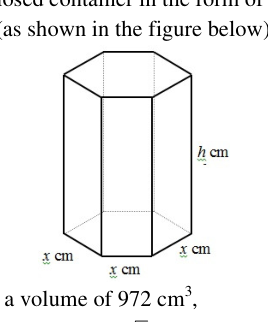
Candy is being stored in a closed container in the form of a regular hexagonal prism, with sides x cmx\text{ cm} and height h cmh\text{ cm} (as shown in the figure below). Given that the container has a volume of 972 cm3972\text{ cm}^3,

  1. (i)

    show that its base area given by 33x22 cm2\frac{3\sqrt{3}x^2}{2}\text{ cm}^2.

  2. (ii)

    Using differentiation, find the minimum area of the material, A cm2A\text{ cm}^2, that is used to make the container, leaving your answer to 2 decimal places.

  3. (iii)

    Given that the cost of the material for the packaging is $0.05 per 100 cm2100\text{ cm}^2, find the minimum cost required for the container.

Work through it with AI →

It won't just hand you the answer — it asks where you're stuck.How the checker works

Worked solution

8(i)

1. Find the area of one of the 6 constituent equilateral triangles that make up the regular hexagon.

A regular hexagon can be divided into 6 congruent equilateral triangles of side length xx cm.
Area of one equilateral triangle=12(x)(x)sin⁡60∘=12x2(32)=34x2\text{Area of one equilateral triangle} = \frac{1}{2}(x)(x)\sin 60^\circ = \frac{1}{2}x^2 \left(\frac{\sqrt{3}}{2}\right) = \frac{\sqrt{3}}{4}x^2

2. Calculate the total area of the regular hexagon.

Base area=6×34x2=33x22 cm2\text{Base area} = 6 \times \frac{\sqrt{3}}{4}x^2 = \frac{3\sqrt{3}x^2}{2}\text{ cm}^2

Answer

\frac{3\sqrt{3}x^2}{2}\text{ cm}^2

8(ii)

1. Express the height $h$ in terms of $x$ using the given volume.

V=Base Area×hV = \text{Base Area} \times h
972=(33x22)h972 = \left( \frac{3\sqrt{3}x^2}{2} \right) h
h=972×233x2=6483x2=2163x2h = \frac{972 \times 2}{3\sqrt{3}x^2} = \frac{648}{\sqrt{3}x^2} = \frac{216\sqrt{3}}{x^2}

2. Formulate the equation for the total surface area $A$ in terms of $x$.

A=2×(Base Area)+(Perimeter of Base)×hA = 2 \times (\text{Base Area}) + (\text{Perimeter of Base}) \times h
A=2(33x22)+6x(2163x2)A = 2 \left( \frac{3\sqrt{3}x^2}{2} \right) + 6x \left( \frac{216\sqrt{3}}{x^2} \right)
A=33x2+12963xA = 3\sqrt{3}x^2 + \frac{1296\sqrt{3}}{x}

3. Differentiate $A$ with respect to $x$ and equate to $0$ to find the stationary point.

dAdx=63x−12963x2\frac{\mathrm{d}A}{\mathrm{d}x} = 6\sqrt{3}x - \frac{1296\sqrt{3}}{x^2}
For minimum area, set dAdx=0\frac{\mathrm{d}A}{\mathrm{d}x} = 0:
63x−12963x2=06\sqrt{3}x - \frac{1296\sqrt{3}}{x^2} = 0
63x=12963x26\sqrt{3}x = \frac{1296\sqrt{3}}{x^2}
63x3=129636\sqrt{3}x^3 = 1296\sqrt{3}
x3=216x^3 = 216
x=6x = 6

4. Verify that the stationary point is a minimum using the second derivative test.

d2Adx2=63+25923x3\frac{\mathrm{d}^2A}{\mathrm{d}x^2} = 6\sqrt{3} + \frac{2592\sqrt{3}}{x^3}
When x=6x = 6,
d2Adx2=63+2592363=183>0\frac{\mathrm{d}^2A}{\mathrm{d}x^2} = 6\sqrt{3} + \frac{2592\sqrt{3}}{6^3} = 18\sqrt{3} > 0
Since d2Adx2>0\frac{\mathrm{d}^2A}{\mathrm{d}x^2} > 0, the surface area AA is a minimum.

5. Calculate the minimum surface area and leave the answer to 2 decimal places.

A=33(6)2+129636A = 3\sqrt{3}(6)^2 + \frac{1296\sqrt{3}}{6}
A=1083+2163A = 108\sqrt{3} + 216\sqrt{3}
A=3243≈561.184A = 324\sqrt{3} \approx 561.184
A≈561.18 cm2 (to 2 d.p.)A \approx 561.18 \text{ cm}^2 \text{ (to 2 d.p.)}

Answer

561.18561.18

8(iii)

1. Determine the minimum surface area of the container from part (ii).

From part (ii), the surface area AA is the sum of the two hexagonal bases and the 6 rectangular sides. Using the volume VV to find height hh:
V=33x22h=972  ⟹  h=6483x2V = \frac{3\sqrt{3}x^2}{2}h = 972 \implies h = \frac{648}{\sqrt{3}x^2}
A=2(33x22)+6xh=33x2+6x(6483x2)=33x2+12963xA = 2\left(\frac{3\sqrt{3}x^2}{2}\right) + 6xh = 3\sqrt{3}x^2 + 6x\left(\frac{648}{\sqrt{3}x^2}\right) = 3\sqrt{3}x^2 + \frac{1296\sqrt{3}}{x}
Differentiating to find the minimum area:
dAdx=63x−12963x2=0  ⟹  x3=216  ⟹  x=6\frac{\mathrm{d}A}{\mathrm{d}x} = 6\sqrt{3}x - \frac{1296\sqrt{3}}{x^2} = 0 \implies x^3 = 216 \implies x = 6
Minimum A=33(6)2+129636=3243≈561.184 cm2\text{Minimum } A = 3\sqrt{3}(6)^2 + \frac{1296\sqrt{3}}{6} = 324\sqrt{3} \approx 561.184\text{ cm}^2

2. Calculate the minimum cost required based on the minimum area.

The cost of the material is $0.05\char36{}0.05 per 100 cm2100\text{ cm}^2.
Cost=3243100×0.05\text{Cost} = \frac{324\sqrt{3}}{100} \times 0.05
Cost=0.28059…\text{Cost} = 0.28059\dots
Cost≈$0.28\text{Cost} \approx \text{\$}^0.28

Answer

$0.28

AI analysis — may contain mistakes.

Worked this one out on paper? Snap your steps and Gigle's AI math checker will circle the step where it went wrong.

More questions on this topic

  1. 1[The volume of a cone of base radius rr and height hh is given by V=13πr2hV = \frac{1}{3}\pi r^2 h.] A manufacturer makes a…
  2. 2A sector of angle θ\theta radians and radius 4π cm4\pi\text{ cm} is used to form the curved surface of a right circular co…
  3. 3As part of an Art Project, a student designed a lantern in the shape of an octahedron as shown in the diagram. The frame…
  4. 4The following diagram shows the dimensions of a trapezoidal prism with fixed volume 4k34k\sqrt{3} units3^{3}, with varia…
  5. 5[The volume of a right circular cone of radius rr and height hh is 13πr2h\frac{1}{3}\pi r^2 h.] A student makes a printer…