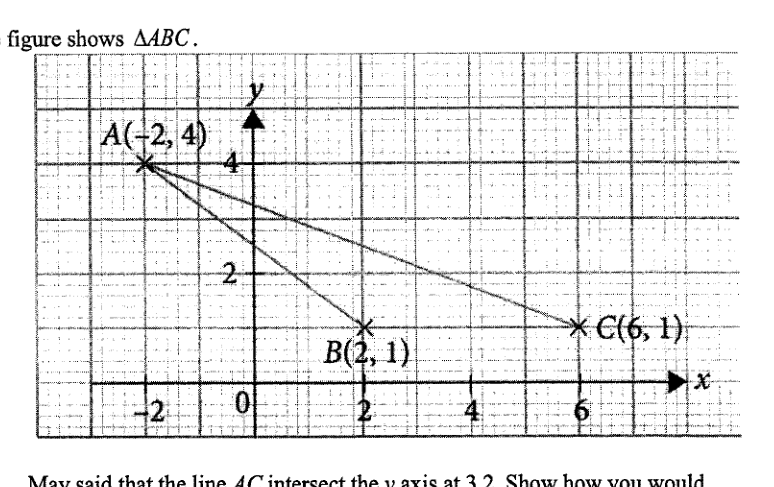
The figure shows ΔABC.
- (i)
May said that the line AC intersect the y axis at 3.2. Show how you would check if she is correct.
Answer
- (ii)
Find the length of AB.
Ans: ___ units
- (iii)
Without calculating the value of any angle, find the value of cos ÂBC.
Ans: cos ÂBC = ___
- (iv)
The point P lies on the line y = 1. Given that area of ΔABC : area of ΔAPB = 4: 3, find two possible x coordinates of P.
Ans: x = ___ or ___
It won't just hand you the answer — it asks where you're stuck.How the checker works
Worked solution
10 (a)(i)
1. Find the gradient of line AC from the two given coordinates.
For and ,
2. Find the y-intercept of AC and check May's claim.
Using and point ,
So the line intersects the -axis at .
May is incorrect, since line intersects the -axis at , not .
10 (a)(ii)
1. Find the horizontal and vertical differences between A and B.
and
Horizontal difference:
Vertical difference: , so the vertical distance is .
2. Apply the distance formula to find AB.
units
10 (a)(iii)
1. Identify the adjacent side and hypotenuse for the angle at $B$, noting that the angle is obtuse.
From to , the horizontal change is units left and the vertical change is units up, so units.
Since is horizontal to the right, is obtuse. Hence
10 (a)(iv)
1. Compare the areas using the bases on the same horizontal line.
Since , and lie on , triangles and have the same perpendicular height from .
Therefore,
Given
so
2. Find the possible positions of $P$ from the required length $BP$.
From the coordinates, and , so
Since
As lies on , it is 3 units horizontally from , whose -coordinate is 2.
Hence
or
or
AI analysis — may contain mistakes.
Worked this one out on paper? Snap your steps and Gigle's AI math checker will circle the step where it went wrong.
More questions on this topic
- 1The sketch shows the graph of . The points A(-2, -0.75) and B(0, -3) lie on the graph. Find the values of …
- 2过双曲线:的左焦点且斜率为的直线与双曲线…
- 3Solutions to this question by accurate drawing will not be accepted. The diagram below shows a triangle ABC, with …
- 4若直线为参数与直线平行,则常数 A. B. …
- 5已知圆心为的圆过点和,且圆心在直线:上. (1)求圆心为的圆的标准方程; (2)过点作圆的切线,求切线方程.