ξ = {integer xx : 0<x≤200 < x \le 20} P={perfect square}P = \{\text{perfect square}\} Q={even number which solves 3x>11}Q = \{\text{even number which solves }3x>11\} $R = {\text{multiple of 4}}

  1. (a)
    1. (i)

      List all the elements in P.

    2. (ii)

      Find n(P′∩QP' \cap Q).

    3. (iii)

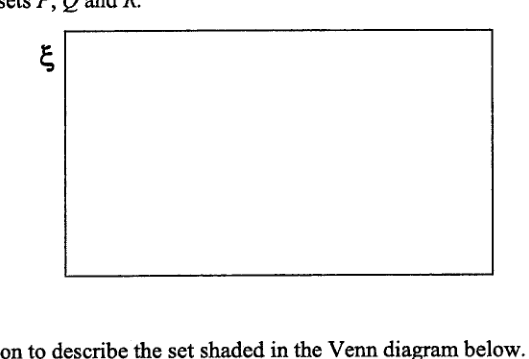
      On the answer space provided, draw the Venn diagram to illustrate the relationship between sets P, Q and R.
  2. (b)

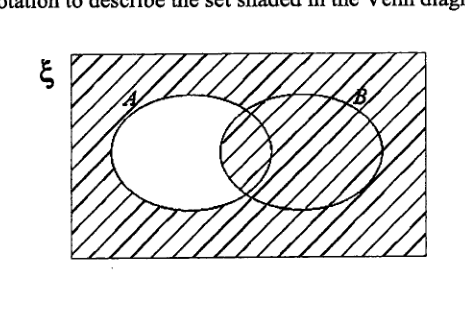
    Use set notation to describe the set shaded in the Venn diagram below.
Work through it with AI →

It won't just hand you the answer — it asks where you're stuck.How the checker works

Worked solution

17(a)(i)

1. List all perfect squares in the universal set

The universal set is
ξ={1,2,3,…,20}\xi = \{1,2,3,\ldots,20\}.

The perfect squares in this set are
12=1,22=4,32=9,42=16.1^2=1,\quad 2^2=4,\quad 3^2=9,\quad 4^2=16.

Since 52=25>205^2=25>20, there are no more perfect squares in ξ\xi.

Therefore,
P={1,4,9,16}.P=\{1,4,9,16\}.

Answer

P={1,4,9,16}P = \{1, 4, 9, 16\}

17(a)(ii)

1. Identify the elements of $Q$ and exclude those in $P$

From the definitions,

P={1,4,9,16}P=\{1,4,9,16\} and Q={4,6,8,10,12,14,16,18,20}Q=\{4,6,8,10,12,14,16,18,20\}.

P′∩QP' \cap Q means the elements in QQ that are not in PP.

So,

P′∩Q={6,8,10,12,14,18,20}P' \cap Q=\{6,8,10,12,14,18,20\}.

2. Count the number of elements

There are 77 elements in {6,8,10,12,14,18,20}\{6,8,10,12,14,18,20\}.

Hence,

n(P′∩Q)=7n(P' \cap Q)=7.

Answer

n(P′∩Q)=7n(P' \cap Q)=7

17(a)(iii)

1. Identify the relationship between the three sets

From the definitions,

P={1,4,9,16}P=\{1,4,9,16\},

Q={4,6,8,10,12,14,16,18,20}Q=\{4,6,8,10,12,14,16,18,20\},

R={4,8,12,16,20}R=\{4,8,12,16,20\}.

Every element of RR is also in QQ, so

R⊆Q.R \subseteq Q.

2. Place all elements in the correct Venn diagram regions

Draw RR completely inside QQ, and let PP overlap QQ.

Place:

P∩Q∩R={4,16},P\cap Q\cap R=\{4,16\},

P only={1,9},P\text{ only}=\{1,9\},

Q only={6,10,14,18},Q\text{ only}=\{6,10,14,18\},

Q∩R but not P={8,12,20},Q\cap R\text{ but not }P=\{8,12,20\},

and outside all three sets:

{2,3,5,7,11,13,15,17,19}.\{2,3,5,7,11,13,15,17,19\}.

Answer

Draw a rectangle for ξ\xi with circles arranged so that R⊆QR \subseteq Q and PP overlaps QQ.

Place the elements as follows:

  • P∩Q∩R={4,16}P \cap Q \cap R = \{4,16\}
  • PP only: {1,9}\{1,9\}
  • QQ only: {6,10,14,18}\{6,10,14,18\}
  • RR only: none, since R⊆QR \subseteq Q
  • outside all three sets: {2,3,5,7,11,13,15,17,19}\{2,3,5,7,11,13,15,17,19\}

17(b)

1. Describe the shaded region as elements outside both sets

The shaded region is outside circle AA and outside circle BB.

So it represents elements which are not in AA or BB, i.e. the complement of A∪BA \cup B.

Answer

(A∪B)′(A \cup B)'

AI analysis — may contain mistakes.

Worked this one out on paper? Snap your steps and Gigle's AI math checker will circle the step where it went wrong.

More questions on this topic

  1. 1On the Venn diagram, shade the region that represents A′∪BA' \cup B. Use set notation to describe the shaded region.
  2. 2It is given that ξ={x:x is polygon},\xi = \{x: x \text{ is polygon}\}, p={x:x is a parallelogram},p = \{x: x \text{ is a parallelogram}\}, q={x:x is a quadrilateral},q = \{x: x \text{ is a quadrilateral}\},…
  3. 3ξ={integers x:2<x≤12}\xi = \{\text{integers } x: 2 < x \le 12\} A={prime numbers}A = \{\text{prime numbers}\} B={factors of 12}B = \{\text{factors of 12}\} C={greater than 100}C = \{\text{greater than } \sqrt{100}\}…
  4. 4On the Venn Diagram shown in the answer space, shade the set A∩B′A \cap B'. ε=x:x is an integer and 1≤x≤100ε = {x: x \text{ is an integer and } 1 \le x \le 100}…
  5. 5ε={integer x:0<x≤12}\varepsilon = \{\text{integer } x : 0 < x \le 12\} A={prime numbers}A = \{\text{prime numbers}\} B={numbers that have at least 2 distinct factors}B = \{\text{numbers that have at least 2 distinct factors}\}…