In the diagram below, triangle ABC is congruent to triangle PNA. Given that BC = 22 cm, AP = 32 cm and angle ACB = 91°, calculate
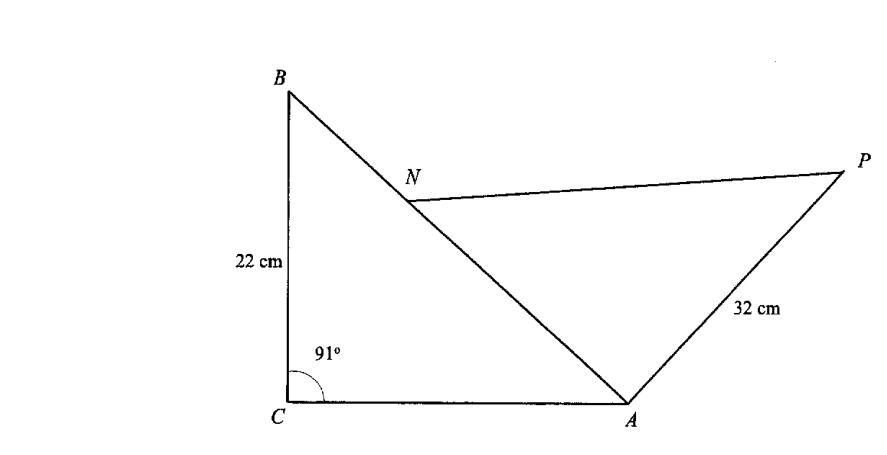
  1. (a)

    the length of BN,

    Answer ... cm

  2. (b)

    angle APN.

    Answer Angle APN = ...

Work through it with AI →

It won't just hand you the answer — it asks where you're stuck.How the checker works

Worked solution

19(a)

1. Identify the corresponding sides and included angle in triangle $PNA$.

Since △ABC≅△PNA\triangle ABC \cong \triangle PNA, the order gives
A↔PA \leftrightarrow P, B↔NB \leftrightarrow N, C↔AC \leftrightarrow A.

Hence
AC=AP=32 cmAC = AP = 32\text{ cm}, AN=BC=22 cmAN = BC = 22\text{ cm}, and
∠PAN=∠ACB=91∘\angle PAN = \angle ACB = 91^\circ.

2. Find $PN$ using the cosine rule in $\triangle APN$.

In △APN\triangle APN,
PN2=AP2+AN2−2(AP)(AN)cos⁡∠PANPN^2 = AP^2 + AN^2 - 2(AP)(AN)\cos \angle PAN
PN2=322+222−2(32)(22)cos⁡91∘PN^2 = 32^2 + 22^2 - 2(32)(22)\cos 91^\circ
PN≈39.148 cmPN \approx 39.148\text{ cm}

Since ABAB corresponds to PNPN,
AB=PN≈39.148 cm.AB = PN \approx 39.148\text{ cm}.

3. Find $BP$ and subtract $PN$ to get $BN$.

Since B,N,PB,N,P are collinear, ∠APB=∠APN\angle APB = \angle APN.

First find cos⁡∠APN\cos \angle APN from △APN\triangle APN:
cos⁡∠APN=AP2+PN2−AN22(AP)(PN)\cos \angle APN = \frac{AP^2 + PN^2 - AN^2}{2(AP)(PN)}
cos⁡∠APN=322+39.1482−2222(32)(39.148)≈0.8272\cos \angle APN = \frac{32^2 + 39.148^2 - 22^2}{2(32)(39.148)} \approx 0.8272

In △APB\triangle APB, AB=PN≈39.148 cmAB = PN \approx 39.148\text{ cm}, so
AB2=AP2+BP2−2(AP)(BP)cos⁡∠APB.AB^2 = AP^2 + BP^2 - 2(AP)(BP)\cos \angle APB.
Solving gives
BP≈61.245 cm.BP \approx 61.245\text{ cm}.

Therefore
BN=BP−PNBN = BP - PN
BN≈61.245−39.148=22.097 cmBN \approx 61.245 - 39.148 = 22.097\text{ cm}
BN≈22.1 cm.BN \approx 22.1\text{ cm}.

Answer

BN=22.1 cmBN = 22.1\text{ cm}

19(b)

1. Identify the needed sides and angle in $\triangle APN$.

Since △ABC≅△PNA\triangle ABC \cong \triangle PNA, the corresponding vertices are
A↔P,B↔N,C↔A.A \leftrightarrow P,\quad B \leftrightarrow N,\quad C \leftrightarrow A.
Hence
AN=BC=22 cmAN = BC = 22\text{ cm}
and
∠PAN=∠ACB=91∘.\angle PAN = \angle ACB = 91^\circ.
Also, AP=32 cmAP = 32\text{ cm}.

2. Calculate $\angle APN$ using the cosine rule.

First find PNPN:
PN2=322+222−2(32)(22)cos⁡91∘PN^2=32^2+22^2-2(32)(22)\cos91^\circ
PN=39.15 cmPN=39.15\text{ cm}
Now use the cosine rule for ∠APN\angle APN:
cos⁡∠APN=322+39.152−2222(32)(39.15)\cos \angle APN=\frac{32^2+39.15^2-22^2}{2(32)(39.15)}
∠APN=34.2∘ (to 1 d.p.)\angle APN=34.2^\circ\text{ }\text{(to 1 d.p.)}

Answer

∠APN=34.2∘\angle APN = 34.2^\circ

AI analysis — may contain mistakes.

Worked this one out on paper? Snap your steps and Gigle's AI math checker will circle the step where it went wrong.

More questions on this topic

  1. 1A cuboid has a volume of 250 cm^3, correct to the nearest cubic centimetre. The height of the cuboid is 8.4 cm, correct…
  2. 2In the diagram, triangle XYZ is similar to triangle UXS. Given that US=UX=9US = UX = 9 cm, XY=XZ=20XY = XZ = 20 cm and YZ=12YZ = 12 cm…
  3. 3In the diagram, P, Q, R and S are points on a circle. PR and QS meet at T. Show that triangle PTS and triangle QTR are s…
  4. 4高22米的旗杆在水平地面上的影长为33米,此时测得附近一个建筑物的影长1212米,则该建筑物的高度为()(\quad) A. 18                          18\:\:\:\:\:\:\:\:\:\:\:\:\:\:\:\:\:\:\:\:\:\:\:\:\:\: …
  5. 5Figure I shows a piece of wood is in the form of a right circular cone with a base diameter of 18 cm. The curved surface…