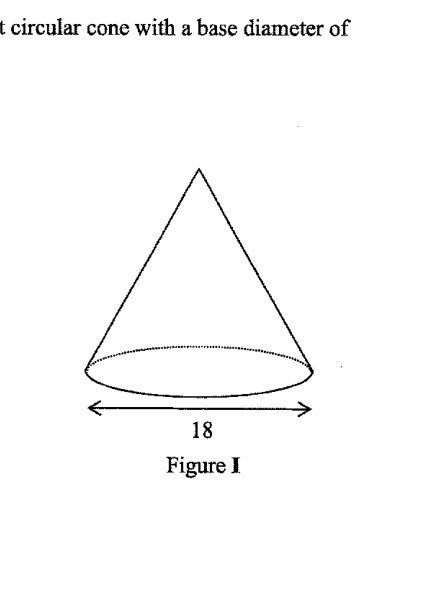
Figure I shows a piece of wood is in the form of a right circular cone with a base diameter of 18 cm.
- (a)
The curved surface area of the cone is .
Find the height of the cone.
Answer ... cm
- (b)
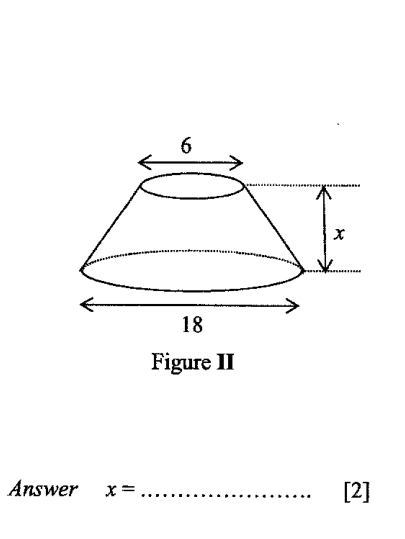
The cone in Figure I is cut into two portions by a plane parallel to its base. The upper portion is a cone of base diameter 6 cm and the lower portion, as shown in Figure II, is a frustum of height x cm.
(b) Find the value of x.
Answer x = ...
- (c)
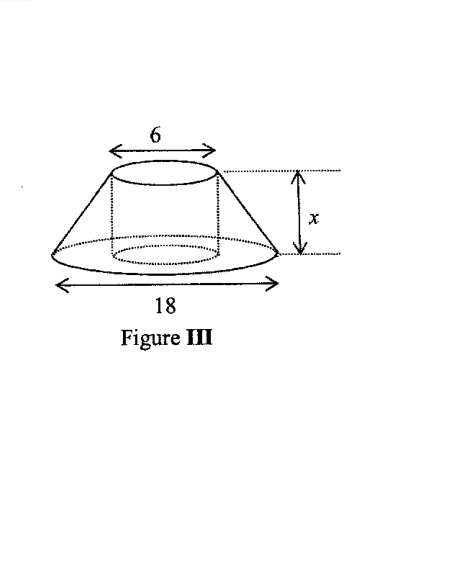
A right cylindrical hole of diameter 6 cm is drilled through the frustum as shown in Figure III.
The wood weighs 810 kg per cubic metres.
Find the mass, in grams, of the solid which remains in the frustum.Answer ... g
It won't just hand you the answer — it asks where you're stuck.How the checker works
Worked solution
7(a)
1. Find the radius from the given diameter.
The base diameter is , so
2. Use the curved surface area of a cone to find the slant height.
Curved surface area of a cone is .
3. Use Pythagoras' theorem to find the height of the cone.
In the right triangle formed by the radius, height and slant height,
7(b)
1. Find the height of the upper small cone using similar cones.
The upper cone and the original cone are similar.
Diameters are in the ratio
So their heights are also in the ratio .
Original cone height from part (a), hence
2. Subtract the upper cone height from the original cone height to find the frustum height.
The frustum height is
7(c)
1. Find the volume of the frustum using the radii and the height from part (b).
For the frustum, the height is , the larger radius is and the smaller radius is .
2. Subtract the volume of the cylindrical hole to find the remaining volume of wood.
The cylindrical hole has diameter , so its radius is and its height is .
Remaining volume:
3. Convert the density to grams per cubic centimetre and calculate the mass remaining.
Since and ,
Mass remaining:
AI analysis — may contain mistakes.
Worked this one out on paper? Snap your steps and Gigle's AI math checker will circle the step where it went wrong.
More questions on this topic
- 1A cuboid has a volume of 250 cm^3, correct to the nearest cubic centimetre. The height of the cuboid is 8.4 cm, correct…
- 2Isaiah cuts open a cardboard cube along some of its edges to form the flat shape shown on the right, which has an area o…
- 3Alex and Felicia each have cats as pets. Alex buys cat food in cylindrical cans that are in diameter and …
- 4把一个长方体正好分割成两个完全相同正方体,若分割后的正方体的棱长为4cm,则分割后比分割前表面积增加了 ,总体积增加了 .
- 5The figure below is made up of 1-cm cubes. What is the volume of the figure? Ans : ___