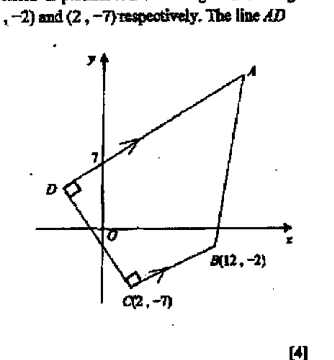
The diagram shows a trapezium in which ADAD is parallel to BCBC and angle ADC=ADC = angle BCD=90∘BCD = 90^\circ. The points BB and CC are (12,−2)(12, -2) and (2,−7)(2, -7) respectively. The line ADAD meets the y-axis at (0,7)(0, 7). Given that AB=2BCAB = 2BC, find

  1. ((i))

    the coordinates of A.

  2. ((ii))

    the coordinates of D.

  3. ((iii))

    The point P lies on BC produced such that PBAD is a parallelogram.
    find the coordinates of P.

Work through it with AI →

It won't just hand you the answer — it asks where you're stuck.How the checker works

Worked solution

7((i))

1. Find the gradient of $BC$ and hence the equation of line $AD$.

Since B=(12,−2)B=(12,-2) and C=(2,−7)C=(2,-7),
mBC=−2−(−7)12−2=510=12.m_{BC}=\frac{-2-(-7)}{12-2}=\frac{5}{10}=\frac12.
Since AD∥BCAD\parallel BC, mAD=12m_{AD}=\frac12.

Line ADAD passes through (0,7)(0,7), so
y=12x+7.y=\frac12x+7.

2. Express the coordinates of $A$ using the equation of $AD$.

Let A=(x,y)A=(x,y).

Since AA lies on ADAD,
y=12x+7.y=\frac12x+7.
So
A=(x,12x+7).A=\left(x,\frac12x+7\right).

3. Use $AB=2BC$ to form and solve an equation for $x$.

First find BCBC:
BC=(12−2)2+[−2−(−7)]2BC=\sqrt{(12-2)^2+[-2-(-7)]^2}
=102+52=125=55.=\sqrt{10^2+5^2}=\sqrt{125}=5\sqrt5.

Given AB=2BCAB=2BC,
AB=105.AB=10\sqrt5.

Using A=(x,12x+7)A=\left(x,\frac12x+7\right) and B=(12,−2)B=(12,-2),
AB2=(x−12)2+(12x+7−(−2))2.AB^2=(x-12)^2+\left(\frac12x+7-(-2)\right)^2.
So
500=(x−12)2+(12x+9)2.500=(x-12)^2+\left(\frac12x+9\right)^2.
Expanding,
500=x2−24x+144+14x2+9x+81,500=x^2-24x+144+\frac14x^2+9x+81,
500=54x2−15x+225.500=\frac54x^2-15x+225.
Hence
54x2−15x−275=0.\frac54x^2-15x-275=0.
Multiplying by 44,
5x2−60x−1100=0,5x^2-60x-1100=0,
x2−12x−220=0.x^2-12x-220=0.
Factorising,
(x−22)(x+10)=0.(x-22)(x+10)=0.
Thus
x=22orx=−10.x=22\quad \text{or}\quad x=-10.

4. Choose the correct point for $A$ and find its $y$-coordinate.

If x=22x=22,
y=12(22)+7=18,y=\frac12(22)+7=18,
so A=(22,18)A=(22,18).

If x=−10x=-10,
y=12(−10)+7=2,y=\frac12(-10)+7=2,
so the other possible point is (−10,2)(-10,2).

From the diagram, AA is the upper right vertex on line ADAD, so choose
A=(22,18).A=(22,18).

Answer

A=(22,18)A=(22,18)

7((ii))

1. Find the equation of the line $DC$.

Gradient of BCBC:
mBC=−2−(−7)12−2=510=12.m_{BC}=\frac{-2-(-7)}{12-2}=\frac{5}{10}=\frac12.
Since DC⊥BCDC\perp BC,
mDC=−2.m_{DC}=-2.
Line DCDC passes through C(2,−7)C(2,-7):
y+7=−2(x−2)y+7=-2(x-2)
y=−2x−3.y=-2x-3.

2. Find the intersection of $DC$ with $AD$.

From part (i), line ADAD has gradient 12\frac12 and passes through (0,7)(0,7), so
y=12x+7.y=\frac12x+7.
At DD, the two lines meet:
12x+7=−2x−3\frac12x+7=-2x-3
2.5x=−102.5x=-10
x=−4.x=-4.
Then
y=12(−4)+7=5.y=\frac12(-4)+7=5.

Answer

D=(−4,4)D=(-4,4)

AI analysis — may contain mistakes.

Worked this one out on paper? Snap your steps and Gigle's AI math checker will circle the step where it went wrong.

More questions on this topic

  1. 1已知圆CC:(x+1)2+(y−1)2=1(x+1)^{2}+(y-1)^{2}=1与xx轴切于AA点,与yy轴切于BB点,设劣弧A^B \hat AB的中点为MM,则过点MM的圆CC的切线方程是()() A…
  2. 2已知过点P(1,32)P(1,\dfrac{3}{2})的曲线CC的方程为(x−1)2+y2+(x+1)2+y2=2a.(Ⅰ)\sqrt{{{(x-1)}^{2}}+{{y}^{2}}}+\sqrt{{{(x+1)}^{2}}+{{y}^{2}}}=2a.(Ⅰ)求曲线CC的标准…
  3. 3ABCD is a parallelogram. A is the point (−6,−2)(-6,-2) and B is the point (−4,−7)(-4,-7). BC→=(8−2)\overrightarrow{BC} = \begin{pmatrix}8\\-2\end{pmatrix}…
  4. 4圆x2+y2−2x−5=0x^{2}+y^{2}-2x-5=0和圆x2+y2+2x−4y−4=0x^{2}+y^{2}+2x-4y-4=0的交点为AA、BB,则线段ABAB的垂直平分线方程为()(\quad) A. x+y−1=0                           x+y-1=0\:\:\:\:\:\:\:\:\:\:\:\:\:\:\:\:\:\:\:\:\:\:\:\:\:\:\: …
  5. 5Given that the coordinates of point A is (−2,11)(-2,11) and point B is (5,−11)(5,-11). Find length ABAB. Answer ... equation of th…