The diagram shows part of the curve which crosses the axes at points and .
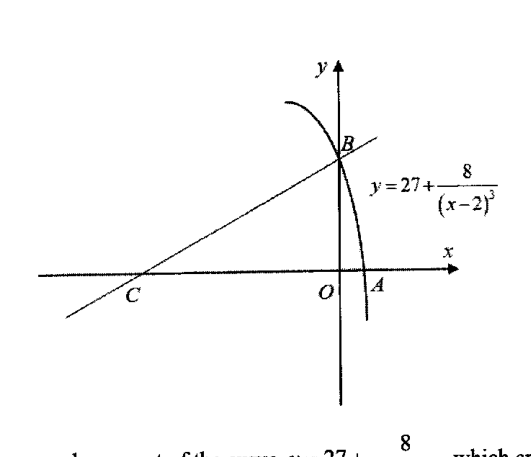
- (a)
Explain why the curve does not have a stationary point.
- (b)
Find the coordinates of and of .
- (c)
Find the equation of the normal to the curve at .
- (d)
The normal to the curve at cuts the -axis at .
Find the area of triangle .
It won't just hand you the answer — it asks where you're stuck.How the checker works
Worked solution
8(a)
1. Find the first derivative of the curve equation
2. State the condition for a stationary point and explain why it is not met
For a stationary point, .
However, has no solution because the numerator is .
Therefore, the curve does not have a stationary point.
Since for all real , the curve has no stationary point.
8(b)
1. Find the coordinates of $A$ by setting $y = 0$
At , :
Coordinates of are .
2. Find the coordinates of $B$ by setting $x = 0$
At , :
Coordinates of are .
,
8(c)
1. Find the coordinates of point $B$ (the $y$-intercept).
At , .
So is .
2. Find the derivative $\frac{dy}{dx}$ and evaluate it at $x = 0$ to find the gradient of the tangent.
At , gradient of tangent
3. Find the gradient of the normal and the equation of the normal.
Gradient of normal
Equation of normal at :
8(d)
1. Find the coordinates of $C$ using the equation of the normal from part (c)
From part (c), the equation of the normal at is .
At , the normal cuts the -axis, so .
So, is .
2. Calculate the area of triangle $BOC$
The vertices of triangle are , , and .
The base of the triangle along the -axis is units.
The perpendicular height along the -axis is units.
AI analysis — may contain mistakes.
Worked this one out on paper? Snap your steps and Gigle's AI math checker will circle the step where it went wrong.
More questions on this topic
- 1The curve has equation . Without using a calculator, find the set of values that …
- 2The diagram shows a greenhouse built on a rectangular base. of polyethene is used to build the curved r…
- 3The equation of a curve is given by for . Write down the expression for …
- 4A curve has equation where , , and are constants. The curve cuts the x…
- 5A cone of height, and radius, fits exactly inside a sphere of radius as shown below. …