Answer the whole of this question on a piece of graph paper.
The variables x and y are related by the equation .
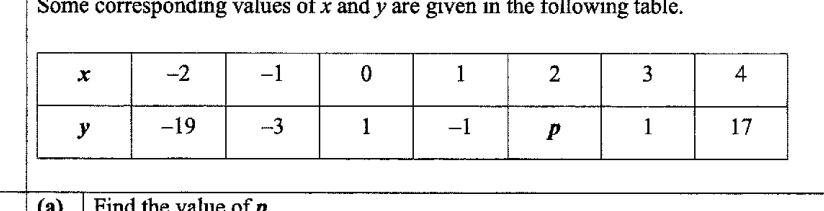
Some corresponding values of x and y are given in the following table.
x -2 -1 0 1 2 3 4 y -19 -3 1 -1 p 1 17
| x | -2 | -1 | 0 | 1 | 2 | 3 | 4 |
|---|---|---|---|---|---|---|---|
| y | -19 | -3 | 1 | -1 | p | 1 | 17 |
- (a)
Find the value of p.
Answer p = ...
- (b)
Using a scale of 2 cm to 1 unit, draw a horizontal x-axis for -2 ≤ x ≤ 4.
Using a scale of 1 cm to 2 units, draw a vertical y-axis for -20 ≤ y ≤ 20.
On your axes, plot the points given in the table and join them with a smooth curve.
- (c)
Use your graph to find the value(s) of x for which
- (i)
.
Answer x = ...
- (ii)
.
Answer x = ...
- (i)
- (d)
By drawing a suitable tangent, find the gradient of the curve at x = 3.
Draw a correct tangent line on graph
- (e)
The line , where is a constant, meets the curve at two points. Draw this line and hence find a possible value of .
Answer k = ...
It won't just hand you the answer — it asks where you're stuck.How the checker works
Worked solution
4(a)
1. Evaluate the formula when $x=2$, since $p$ is the corresponding $y$-value in the table.
For ,
4(b)
1. Set up the axes using the scales and ranges given in the question.
Draw the horizontal -axis for using the scale
.
Draw the vertical -axis for using the scale
.
Label the axes clearly as and .
2. Use the table, including the value of $p$ found earlier, to identify all points to be plotted.
From part (a), .
The points to plot are therefore
3. Plot the points accurately and join them with a smooth curve.
Plot each ordered pair accurately on the axes.
Join the plotted points with a smooth curve, not with straight line segments, since the relationship is
Axes drawn with the stated scales; points , , , , , and plotted and joined with a smooth curve.
4(c)(i)
1. Recognise that solving $x^3-3x^2+1=0$ means finding where the curve has $y=0$.
For the curve , the equation
means
So we look for the intersections of the curve with the -axis.
2. Read the $x$-coordinates of all intersections with the $x$-axis from the graph.
From the graph, the curve cuts the -axis at approximately
4(c)(ii)
1. Recognise the extra line needed so that intersections solve the equation.
The curve already drawn is
.
For
,
draw the straight line
.
The solution is the -coordinate where this line meets the curve.
2. Read the intersection point from the graph.
From the graph, the line meets the curve at about
.
4(d)
1. Identify the point on the curve where the tangent is required.
From the table/graph, when , .
So draw a tangent to the curve at the point .
2. Use two well-spaced points on the tangent to find its gradient.
Choose two clear points on the tangent line and calculate
For example, a correctly drawn tangent at has gradient about
Gradient at
4(e)
1. Identify a horizontal line that will meet the curve at two points.
From the plotted curve/table, the points and both lie on the curve.
So the horizontal line
meets the curve at two distinct points.
2. State the corresponding value of k.
Since the line is and we have chosen the line ,
AI analysis — may contain mistakes.
Worked this one out on paper? Snap your steps and Gigle's AI math checker will circle the step where it went wrong.
More questions on this topic
- 1The sketch shows the graph of . The points A(-2, -0.75) and B(0, -3) lie on the graph. Find the values of …
- 2Sketch the graph in the spaces below. Hence, state the number of solutions for the equat…
- 3y is inversely proportional to the square of x, . If x is increased by 25%, find the percentage change in y. Answ…
- 4The variables x and y are connected by the equation . Some corresponding values of x and y are g…
- 5Complete the table of values for . Values are given to one decimal place where appropriate. Compl…