The diagram below shows part of a regular 18-sided polygon, ABCDEF... The lines BC and ED are extended to meet at the point X such that XC = XD.
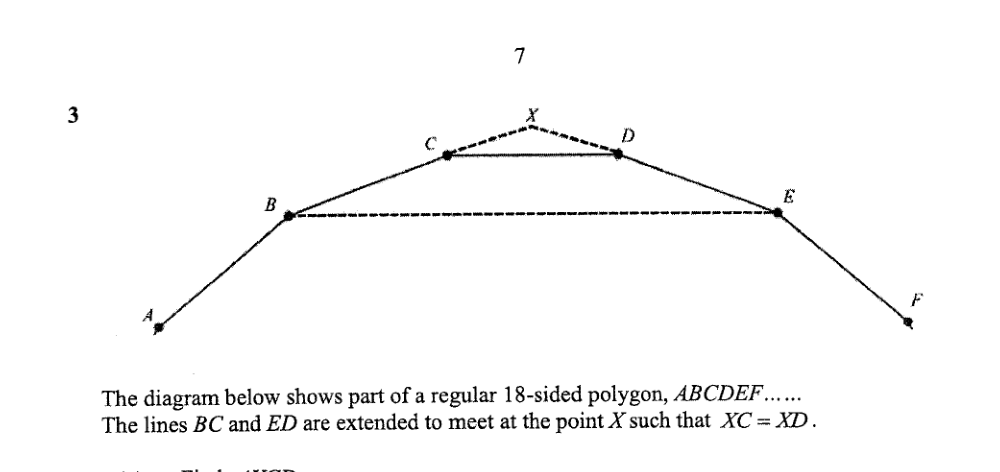
- (a)
Find ∠XCD.
Answer ...
- (b)
Find ∠CXD.
Answer ...
- (c)
Explain why BX = EX .
Answer
- (d)
Show that ΔXCD and ΔXBE are similar.
Answer
- (e)
What can we conclude about the side CD and the line BE?
Answer ...
It won't just hand you the answer — it asks where you're stuck.How the checker works
Worked solution
3(a)
1. Find the exterior angle at a vertex of the regular 18-sided polygon
For a regular 18-sided polygon,
Since is extended through to , is this exterior angle.
3(b)
1. Use the isosceles triangle property and angle sum of a triangle to find $\angle CXD$
Since , is isosceles.
So .
3(c)
1. Identify equal corresponding lengths from the regular polygon and the given condition
In a regular 18-sided polygon, all sides are equal, so
.
It is also given that
.
2. Express $BX$ and $EX$ as sums of equal parts
Since are collinear and are collinear,
and
.
As and ,
.
Since and , we have
.
Therefore, .
3(d)
1. Identify a pair of equal angles at X
Since are collinear and are collinear,
From part (b), both are .
2. Show another pair of corresponding angles are equal, then conclude similarity
Since , is isosceles, so
From part (c), , so is isosceles. Hence
Also , so
Thus
and
Therefore,
by AA similarity.
Since , is isosceles, so .
Since , is isosceles, so .
Also,
so
Thus and .
Therefore, by AA similarity.
3(e)
1. Use corresponding equal angles from the similar triangles to identify parallel lines
From part (d), .
Hence the corresponding angles are equal, so
These are corresponding angles formed by the transversal with the lines and .
Therefore,
is parallel to .
Therefore, .
AI analysis — may contain mistakes.
Worked this one out on paper? Snap your steps and Gigle's AI math checker will circle the step where it went wrong.
More questions on this topic
- 1关于长方形和平行四边形的共同特点,有如下一些说法: ①对边平行;②对边相等;③四个角的和是360°;④都是轴对称图形 以上说法正确的是( ) A. ①②和③ B. ①②和④ C. ①③和④ D. ②③和④
- 2The figure is made up of a regular pentagon ABCDE and a regular hexagon CDFGHI. Find angle BCI. Answer ... ° Determine w…
- 3下列命题是假命题的是 A. 三角形的内角和是180 ° B. 多边形的外角和都等于360° C. 五边形的内角和是900° D. 三角形的一个外角等于和它不相邻的两个内角的和
- 4从九边形的一个顶点出发可以引出___条对角线 A. B. C. D.
- 5若n边形的每个内角为150°,则这个n边形是( ) A. 九边形 B. 十边形 C. 十一边形 D. 十二边形