下图显示了 x<32x<\frac{3}{2} 时 y=f(x)y=f(x) 的图像。该图像具有驻点 (−π4,−2)(-\frac{\pi}{4}, -2) 和 (π4,−25)(\frac{\pi}{4}, -\frac{2}{5}),与坐标轴的交点为 (0,−12)(0, -\frac{1}{2}),渐近线为 y=0y=0 和 x=32x=\frac{3}{2}。 在不同的图上分别画出下列函数的图像,并清晰地标出驻点坐标、与坐标轴的交点坐标以及渐近线方程(如果适用)。
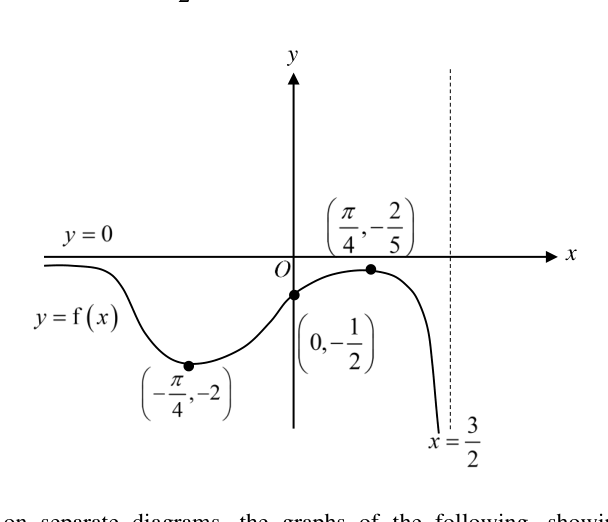
  1. ((i))

    y=1f(x)y = \frac{1}{f(x)}。

  2. ((ii))

    y=f′(x)y = f'(x)。

先不看答案,让 AI 诊断你卡在哪里?

它不会直接告诉你答案,而是问你卡在哪一步看看 AI 是怎么陪你一步步弄懂这道题的

完整解法

1((i))

1. Determine the coordinates and nature of the stationary points for $y = \frac{1}{f(x)}$.

The stationary points of y=1f(x)y = \frac{1}{f(x)} occur at the same xx-values as f(x)f(x).
At x=−π4x = -\frac{\pi}{4}, f(−π4)=−2f(-\frac{\pi}{4}) = -2. Thus, y=1−2=−12y = \frac{1}{-2} = -\frac{1}{2}. Since f(x)f(x) has a local minimum of a negative value, its reciprocal will have a local maximum. Hence, there is a local maximum at (−π4,−12)(-\frac{\pi}{4}, -\frac{1}{2}).
At x=π4x = \frac{\pi}{4}, f(π4)=−25f(\frac{\pi}{4}) = -\frac{2}{5}. Thus, y=1−2/5=−52y = \frac{1}{-2/5} = -\frac{5}{2}. Since f(x)f(x) has a local maximum of a negative value, its reciprocal will have a local minimum. Hence, there is a local minimum at (π4,−52)(\frac{\pi}{4}, -\frac{5}{2}).

2. Determine the new $y$-intercept.

The yy-intercept of f(x)f(x) is (0,−12)(0, -\frac{1}{2}).
Taking the reciprocal, the yy-intercept of y=1f(x)y = \frac{1}{f(x)} is (0,1−1/2)=(0,−2)(0, \frac{1}{-1/2}) = (0, -2).

3. Determine the end behaviours of the graph at the boundaries of its domain.

As x→−∞x \to -\infty, f(x)→0−f(x) \to 0^-, so 1f(x)→−∞\frac{1}{f(x)} \to -\infty.
As x→32−x \to \frac{3}{2}^-, f(x)→−∞f(x) \to -\infty, so 1f(x)→0−\frac{1}{f(x)} \to 0^-.
This means the graph terminates at an open (hollow) circle at (32,0)(\frac{3}{2}, 0) instead of having a vertical asymptote.

4. Describe the final sketch incorporating all features.

Draw a smooth continuous curve for x<32x < \frac{3}{2} that comes from −∞-\infty in the third quadrant, rises to a local maximum at (−π4,−12)(-\frac{\pi}{4}, -\frac{1}{2}), falls through the yy-intercept at (0,−2)(0, -2) down to a local minimum at (π4,−52)(\frac{\pi}{4}, -\frac{5}{2}), and then rises to terminate at an open circle at (32,0)(\frac{3}{2}, 0). There are no asymptotes to draw.

答案

A smooth sketch of y=1f(x)y = \frac{1}{f(x)} in the domain x<32x < \frac{3}{2} containing:

  • A local maximum at (−π4,−12)(-\frac{\pi}{4}, -\frac{1}{2})
  • A yy-intercept at (0,−2)(0, -2)
  • A local minimum at (π4,−52)(\frac{\pi}{4}, -\frac{5}{2})
  • An open circle terminating the curve at (32,0)(\frac{3}{2}, 0)
  • A left tail tending downwards to −∞-\infty as x→−∞x \to -\infty (with no asymptotes).

1((ii))

1. Determine the x-intercepts of the derived function.

The stationary points of f(x)f(x) occur at x=−π4x = -\frac{\pi}{4} and x=π4x = \frac{\pi}{4}. At these points, the gradient is zero.
Thus, the xx-intercepts of y=f′(x)y = f'(x) are (−π4,0)(-\frac{\pi}{4}, 0) and (π4,0)(\frac{\pi}{4}, 0).

2. Determine the intervals where the derivative is positive or negative.

By observing the gradient of f(x)f(x):

  • For x<−π4x < -\frac{\pi}{4}, f(x)f(x) is decreasing, so the gradient is negative (f′(x)<0f'(x) < 0).
  • For −π4<x<π4-\frac{\pi}{4} < x < \frac{\pi}{4}, f(x)f(x) is increasing, so the gradient is positive (f′(x)>0f'(x) > 0).
  • For π4<x<32\frac{\pi}{4} < x < \frac{3}{2}, f(x)f(x) is decreasing, so the gradient is negative (f′(x)<0f'(x) < 0).

3. Determine the asymptotes of the derived function.

As x→−∞x \to -\infty, f(x)f(x) approaches the horizontal asymptote y=0y=0 flattening out, meaning its gradient approaches 0. Thus, y=0y = 0 is a horizontal asymptote for f′(x)f'(x).
As x→(32)−x \to \left(\frac{3}{2}\right)^-, the curve of f(x)→−∞f(x) \to -\infty and gets increasingly steep downwards, meaning the gradient f′(x)→−∞f'(x) \to -\infty. Thus, x=32x = \frac{3}{2} is a vertical asymptote.

答案

A sketched curve of y=f′(x)y=f'(x) with the following features:

  • xx-intercepts at (−π4,0)(-\frac{\pi}{4}, 0) and (π4,0)(\frac{\pi}{4}, 0).
  • Horizontal asymptote y=0y=0 as x→−∞x \to -\infty.
  • Vertical asymptote x=32x=\frac{3}{2} as f′(x)→−∞f'(x) \to -\infty.
  • Curve is below the xx-axis for x<−π4x < -\frac{\pi}{4}, with a local minimum.
  • Curve is above the xx-axis for −π4<x<π4-\frac{\pi}{4} < x < \frac{\pi}{4}, passing through the positive yy-axis with a local maximum.
  • Curve is below the xx-axis for π4<x<32\frac{\pi}{4} < x < \frac{3}{2}.

AI 分析,可能出错

用 AI 批改,圈出写错的那一步,并自动将你的薄弱点存入错题本,形成你的错因库。

同一知识点的其他题

  1. 15 (a) 求解下列积分。 ∫1−2x3+2x−x2 dx.\displaystyle\int \frac{1-2x}{\sqrt{3+2x-x^2}}\,\mathrm{d}x. ∫xln⁡(2−x2) dx\displaystyle\int x\ln\left(2-x^2\right)\,\mathrm{d}x…
  2. 2在同一幅图中,画出 y=∣2x+3∣y = |2x + 3| 和 y=−2x2−8x−3y = -2x^2 - 8x - 3 的图像。 (你不需要标出任何轴交点和驻点。) 精确求解不等式 ∣2x+3∣>−2x2−8x−3|2x + 3| > -2x^2 - 8x - 3。
  3. 3图中给出了 y=f(∣x∣)y = \mathrm{f}(|x|) 和 y=f′(x)y = \mathrm{f}'(x) 的图像。 y=f(∣x∣)y = \mathrm{f}(|x|) 的图像在 (−3,4)(-3, 4) 和 (3,4)(3, 4) 处有转折点,交 xx 轴于 (−2,0)(-2, 0)…
  4. 4函数 y=f(x)y = \text{f}(x) 的图像在 (2,3)(2,3) 处有一个极大值转折点,且经过原点。直线 x=−1x = -1 和 y=2y = 2 是该图像的渐近线,如下图所示。 求使 y=1f(x)y = \frac{1}{\text{f}(x)}…
  5. 5在同一个图上,画出满足下列条件的 y=∣2x−p∣y = |2x - p| 和 y=qxy = qx 的图像草图,标出轴交点。 * pp 和 qq 是常数,p>1p > 1 且 q>0q > 0,以及 * 图像仅有一个交点。 写出 qq 的最小值。 解不…