下图显示了 的图像。该曲线与 轴相交于点 ,其极大值点为 ,极小值点为 。渐近线方程为 、 和 。 在不同的图上,分别画出下列函数的图像,并在必要时标出对应的驻点、坐标轴交点以及渐近线。
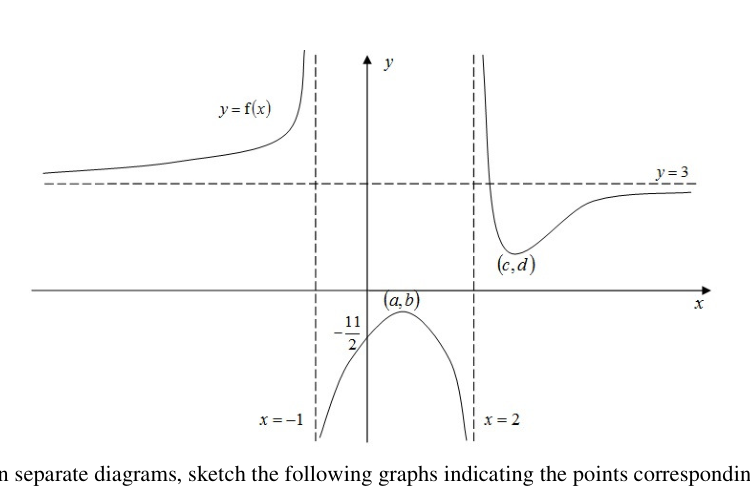
- (i)
- (ii)
- (iii)
它不会直接告诉你答案,而是问你卡在哪一步看看 AI 是怎么陪你一步步弄懂这道题的
完整解法
6(i)
1. Identify the geometrical transformation for $y = \mathrm{f}(|x|)$.
The graph of is obtained by retaining the part of the curve for , and discarding the part for . The retained portion is then reflected across the -axis to produce the graph for .
2. Determine the new features (asymptotes, intercepts, stationary points) and sketch the graph.
- Asymptotes: The portion for has a vertical asymptote and a horizontal asymptote . Reflecting across the -axis gives an additional vertical asymptote . The horizontal asymptote extends to both and .
- Stationary points: The existing stationary points for are the maximum and minimum . Reflecting them across the -axis gives additional stationary points at and .
- Axial intercepts: The -intercept is at . Because it lies on the axis of reflection, it remains unchanged and acts as a sharp minimum (kink) connecting the two symmetric halves. There are no -intercepts.
The resulting sketch is drawn with bilateral symmetry across the -axis.
A sketched graph symmetric about the -axis.
- For , the graph matches .
- For , it is the reflection of the portion across the -axis.
- Stationary points: , , , .
- Axial intercept: .
- Asymptotes: , , .
6(ii)
1. Determine the new asymptotes and $x$-intercepts for $y = \frac{1}{\text{f}(x)}$.
As , , so . The horizontal asymptote is .
As and , , so . This gives -intercepts at and .
2. Determine the $y$-intercept and map the stationary points.
The -intercept maps from to .
For stationary points, the nature is inverted. The maximum point where maps to a local minimum point .
The minimum point where maps to a local maximum point .
3. Determine the overall shape and sketch the graph.
For : The curve approaches from above as and decreases smoothly to .
For : The curve starts at , drops through , reaches a minimum at , and then rises to .
For : The curve rises from to a maximum at . Since approaches from below as , we know , meaning . The curve then decreases from this maximum, approaching from above.
A sketch of with the following features:
- -intercepts: and
- -intercept:
- Horizontal asymptote:
- Stationary points: Minimum at and Maximum at
- Shape:
- : Decreases from (as ) down to .
- : Drops from to a minimum at (passing through the -intercept ), then rises to .
- : Rises from to a maximum at (which is above ), then decreases towards as .
6(iii)
1. Determine the asymptotes of the derivative graph
As , the curve approaches the horizontal line . This means the gradient approaches . Hence, the horizontal asymptote for is .
At and , has vertical asymptotes and the curve becomes infinitely steep. Therefore, and remain vertical asymptotes for .
2. Determine the $x$-intercepts corresponding to the stationary points
The function has a maximum point at and a minimum point at . At these stationary points, the gradient is zero.
Thus, and . The -intercepts of are and .
3. Analyze the sign of the gradient in each region to sketch the shape
- For : increases from to . The gradient is positive (), approaching as and as .
- For : increases from to the maximum at , then decreases to . The gradient is positive for , zero at , and negative for . The curve goes from , crosses , and goes to .
- For : decreases from to the minimum at , then increases to approach . The gradient is negative for , zero at , and positive for . Since it approaches a constant as , the gradient must peak and then return to .
A sketch of with the following features:
- Horizontal Asymptote: (the -axis).
- Vertical Asymptotes: and .
- -intercepts: and .
- Shape for : Curve is entirely above the -axis, starting from as and approaching going upwards to .
- Shape for : Curve starts from at , goes downwards, crosses the -axis at a positive value, crosses the -axis at , and approaches going downwards to .
- Shape for : Curve starts from at , goes upwards, crosses the -axis at , reaches a local maximum (positive value), and then decreases to approach the -axis () from above as .
AI 分析,可能出错
用 AI 批改,圈出写错的那一步,并自动将你的薄弱点存入错题本,形成你的错因库。