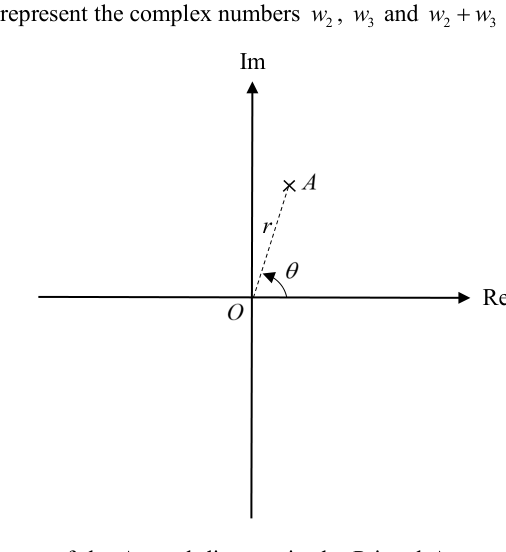
下方阿冈德图上的点 A 表示模为 rr、辐角为 θ\theta 的复数 w1w_1。已知复数 w2w_2 和 w3w_3 满足方程 w2=−w1w_2 = -w_1 且 w3=iw2w_3 = i w_2。 设 B、C 和 D 分别表示复数 w2w_2、w3w_3 和 w2+w3w_2 + w_3。

  1. (a)

    在答题卡给出的阿冈德图副本上,标出点 B、C 和 D,并清晰指出 w2w_2 和 w3w_3 的模和辐角。

  2. (b)

    用弧度表示角 BOC。

  3. (c)

    通过考虑四边形 OBDC,求用 rr 表示的 ∣w2+w3∣|w_2 + w_3| 以及用 θ\theta 表示的 arg⁡(w2+w3)\arg(w_2 + w_3)。

先不看答案,让 AI 诊断你卡在哪里?

它不会直接告诉你答案,而是问你卡在哪一步看看 AI 是怎么陪你一步步弄懂这道题的

完整解法

3(a)

1. Determine the position, modulus, and argument for point B representing $w_2$.

Given w2=−w1w_2 = -w_1.
Multiplying a complex number by −1-1 is equivalent to a 180∘180^\circ (π\pi radians) rotation about the origin.
∣w2∣=∣−w1∣=∣−1∣∣w1∣=r|w_2| = |-w_1| = |-1| |w_1| = r
arg⁡(w2)=arg⁡(−1)+arg⁡(w1)=π+θ\arg(w_2) = \arg(-1) + \arg(w_1) = \pi + \theta
Plot point B such that O is the midpoint of AB. Label the length of OB as rr and the angle from the positive real axis as θ+π\theta + \pi (or θ−π\theta - \pi).

2. Determine the position, modulus, and argument for point C representing $w_3$.

Given w3=iw2w_3 = iw_2.
Multiplying by ii rotates a complex number by 90∘90^\circ (π2\frac{\pi}{2} radians) anti-clockwise about the origin.
∣w3∣=∣i∣∣w2∣=(1)(r)=r|w_3| = |i||w_2| = (1)(r) = r
arg⁡(w3)=arg⁡(i)+arg⁡(w2)=π2+(θ+π)=θ+3π2 (or θ−π2)\arg(w_3) = \arg(i) + \arg(w_2) = \frac{\pi}{2} + (\theta + \pi) = \theta + \frac{3\pi}{2} \text{ (or } \theta - \frac{\pi}{2})
Plot point C by rotating OB anti-clockwise by 90∘90^\circ. Label the length of OC as rr and the angle from the positive real axis as θ+3π2\theta + \frac{3\pi}{2} (or θ−π2\theta - \frac{\pi}{2}).

3. Determine the position of point D representing the sum $w_2 + w_3$.

Addition of complex numbers follows the parallelogram law of vector addition.
Since OD→=OB→+OC→\overrightarrow{OD} = \overrightarrow{OB} + \overrightarrow{OC}, point D forms a parallelogram OBDCOBDC with OB and OC.
As ∣w2∣=∣w3∣=r|w_2| = |w_3| = r and they are perpendicular, OBDCOBDC is specifically a square of side rr. Plot D at the fourth vertex of this square.

答案

Argand Diagram Description:

  • Point B: Plotted on the line segment extending AO through O, such that OB=rOB = r. An arc from the positive Re axis to OB is labelled with angle θ+π\theta + \pi (or θ−π\theta - \pi). The length rr is indicated on segment OB.
  • Point C: Plotted such that OC=rOC = r and ∠BOC=90∘\angle BOC = 90^{\circ} (CC is rotated anti-clockwise from BB). An arc from the positive Re axis to OC is labelled with angle θ+3π2\theta + \frac{3\pi}{2} (or θ−π2\theta - \frac{\pi}{2}). The length rr is indicated on segment OC.
  • Point D: Plotted to complete the square OBDCOBDC, meaning vectorially OD→=OB→+OC→\overrightarrow{OD} = \overrightarrow{OB} + \overrightarrow{OC}.

3(b)

1. State the angle BOC based on the geometrical effect of multiplying by $i$

Since w3=iw2w_3 = i w_2, the position vector OC→\overrightarrow{OC} is obtained by rotating the position vector OB→\overrightarrow{OB} counter-clockwise by π2\frac{\pi}{2} radians about the origin. Thus, the angle between the two vectors is π2\frac{\pi}{2}.

∴∠BOC=π2\therefore \angle BOC = \frac{\pi}{2}

答案

π2\frac{\pi}{2}

3(c)

1. Identify the geometrical shape of quadrilateral OBDC to find the modulus of $w_2 + w_3$.

Since w3=iw2w_3 = iw_2, multiplying by ii represents a π2\frac{\pi}{2} anticlockwise rotation. Thus, OC=OB=rOC = OB = r and ∠BOC=π2\angle BOC = \frac{\pi}{2}.
Since DD represents w2+w3w_2 + w_3, OD→=OB→+OC→\overrightarrow{OD} = \overrightarrow{OB} + \overrightarrow{OC}.
Therefore, the quadrilateral OBDC is a parallelogram. Given adjacent equal sides and a 90∘90^\circ included angle, OBDC is a square.
Using Pythagoras' theorem on △OBD\triangle OBD:
∣w2+w3∣=OD=r2+r2=r2|w_2 + w_3| = OD = \sqrt{r^2 + r^2} = r\sqrt{2}

2. Find the argument of $w_2 + w_3$ by considering the angle of the diagonal OD.

The diagonal OD bisects ∠BOC\angle BOC, so the angle between OB and OD is π4\frac{\pi}{4} radians anticlockwise.
The point B represents w2=−w1w_2 = -w_1, so its argument is diametrically opposite to w1w_1:
arg⁡(w2)=θ+π\arg(w_2) = \theta + \pi (or θ−π\theta - \pi)
The argument of w2+w3w_2 + w_3 is the angle of OD from the positive real axis:
arg⁡(w2+w3)=arg⁡(w2)+π4=(θ+π)+π4=θ+5π4\arg(w_2 + w_3) = \arg(w_2) + \frac{\pi}{4} = (\theta + \pi) + \frac{\pi}{4} = \theta + \frac{5\pi}{4}
Subtracting 2π2\pi to give a standard principal value form, this can also be written as θ−3π4\theta - \frac{3\pi}{4}.

答案

∣w2+w3∣=r2|w_2 + w_3| = r\sqrt{2}
arg⁡(w2+w3)=θ−3π4\arg(w_2 + w_3) = \theta - \frac{3\pi}{4} (or θ+5π4\theta + \frac{5\pi}{4})

AI 分析,可能出错

用 AI 批改,圈出写错的那一步,并自动将你的薄弱点存入错题本,形成你的错因库。

同一知识点的其他题

  1. 1解方程 iz5=−32i z^5 = -32,将根写成 reiθre^{i\theta} 的形式,其中 r>0r>0 且 −π<θ≤π-\pi<\theta\le\pi。在阿甘特图上描绘出代表这些根的点 P1,P2,P3,P4P_1, P_2, P_3, P_4 和 P5P_5,其…
  2. 2解方程 iz5=−32iz^5=-32,求出其根并表示为 reiθre^{i\theta} 的形式,其中 r>0r>0 且 −π<θ≤π-\pi<\theta\le\pi。在阿甘图上描绘出代表这些根的点 P1,P2,P3,P4P_1, P_2, P_3, P_4 和 P5P_5,其…
  3. 3复数 zz 满足方程 2 z3=1+22a−1 i,\sqrt{2}\,z^{3} = 1 + \dfrac{2}{2a - 1}\,i , 其中 aa 是实数。 已知 arg⁡(z3)=−π4\arg\bigl(z^{3}\bigr) = -\dfrac{\pi}{4}。 证…
  4. 4复数 aa 的模为 rr,辐角为 θ\theta,其中 r∈R+r \in \mathbb{R}^+ 且 0<θ<π20 < \theta < \frac{\pi}{2}。复数 bb 满足 b=−2iab = -2ia,复数 cc 为纯虚数且虚部为负…
  5. 5点 A 表示一个固定的复数 aa,满足 −π2<arg⁡a<0-\dfrac{\pi}{2}<\arg a<0。复数 iaia 和 a+iaa+ia 分别由点 B 和 C 表示。在清晰标注的阿甘图(Argand diagram)上,画出点 A、B、C 以及表示…