The point A on the Argand diagram below represents the complex number with modulus and argument . It is given that the complex numbers and satisfy the equations and . Let B, C and D represent the complex numbers , and respectively.
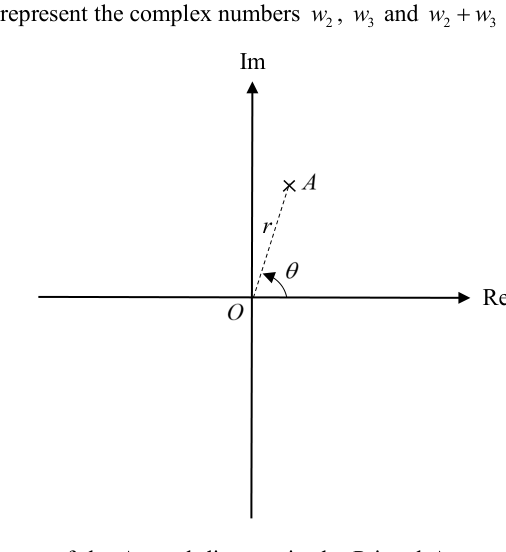
- (a)
On the copy of the Argand diagram in the Printed Answer Book, plot the points B, C and D, indicating clearly the modulus and argument of and .
- (b)
State, in radians, the angle BOC.
- (c)
By considering the quadrilateral OBDC, find in terms of and in terms of .
It won't just hand you the answer — it asks where you're stuck.How the checker works
Worked solution
3(a)
1. Determine the position, modulus, and argument for point B representing $w_2$.
Given .
Multiplying a complex number by is equivalent to a ( radians) rotation about the origin.
Plot point B such that O is the midpoint of AB. Label the length of OB as and the angle from the positive real axis as (or ).
2. Determine the position, modulus, and argument for point C representing $w_3$.
Given .
Multiplying by rotates a complex number by ( radians) anti-clockwise about the origin.
Plot point C by rotating OB anti-clockwise by . Label the length of OC as and the angle from the positive real axis as (or ).
3. Determine the position of point D representing the sum $w_2 + w_3$.
Addition of complex numbers follows the parallelogram law of vector addition.
Since , point D forms a parallelogram with OB and OC.
As and they are perpendicular, is specifically a square of side . Plot D at the fourth vertex of this square.
Argand Diagram Description:
- Point B: Plotted on the line segment extending AO through O, such that . An arc from the positive Re axis to OB is labelled with angle (or ). The length is indicated on segment OB.
- Point C: Plotted such that and ( is rotated anti-clockwise from ). An arc from the positive Re axis to OC is labelled with angle (or ). The length is indicated on segment OC.
- Point D: Plotted to complete the square , meaning vectorially .
3(b)
1. State the angle BOC based on the geometrical effect of multiplying by $i$
Since , the position vector is obtained by rotating the position vector counter-clockwise by radians about the origin. Thus, the angle between the two vectors is .
3(c)
1. Identify the geometrical shape of quadrilateral OBDC to find the modulus of $w_2 + w_3$.
Since , multiplying by represents a anticlockwise rotation. Thus, and .
Since represents , .
Therefore, the quadrilateral OBDC is a parallelogram. Given adjacent equal sides and a included angle, OBDC is a square.
Using Pythagoras' theorem on :
2. Find the argument of $w_2 + w_3$ by considering the angle of the diagonal OD.
The diagonal OD bisects , so the angle between OB and OD is radians anticlockwise.
The point B represents , so its argument is diametrically opposite to :
(or )
The argument of is the angle of OD from the positive real axis:
Subtracting to give a standard principal value form, this can also be written as .
(or )
AI analysis — may contain mistakes.
Worked this one out on paper? Snap your steps and Gigle's AI math checker will circle the step where it went wrong.
More questions on this topic
- 1Solve the equation , giving your roots in the form , where and . Ske…
- 2Solve the equation , giving your roots in the form , where and . Sketch…
- 3The complex number satisfies the equation where is a real numbe…
- 4The complex number has modulus and argument , where and …
- 5The point A represents a fixed complex number a such that . The complex numbers and …