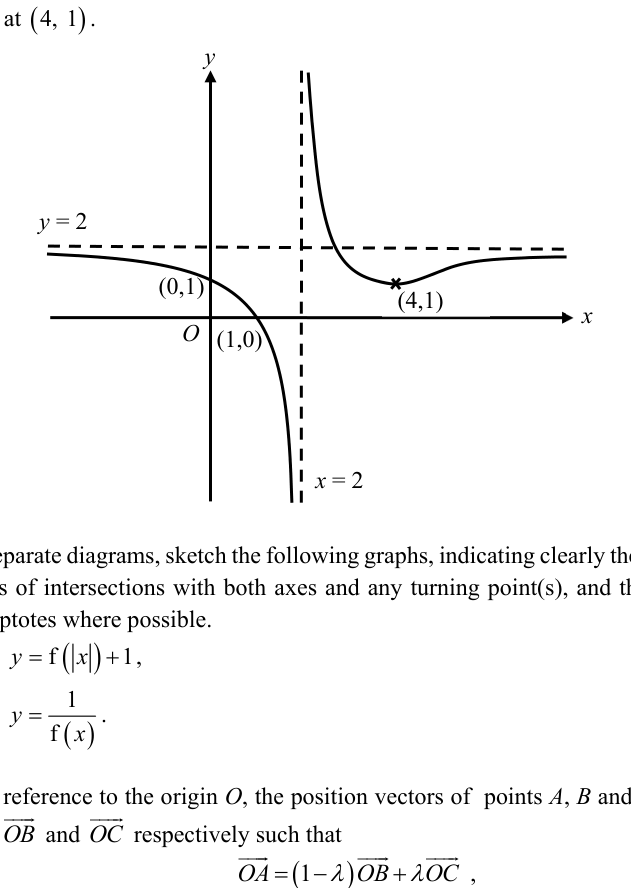
下图显示了 的图象。该图象的渐近线为 和 。图象与 轴交于 ,与 轴交于 ,且有一个转折点 。 在不同的图上分别画出下列函数的图象,清晰地标出与两坐标轴的任何交点的坐标、任何转折点,以及任何渐近线的方程(如果可能)。
- (i)
、
- (ii)
。
它不会直接告诉你答案,而是问你卡在哪一步看看 AI 是怎么陪你一步步弄懂这道题的
完整解法
4(i)
1. Determine the effect of the $|x|$ transformation on the key features of the graph.
The transformation means we keep the part of the graph where , and reflect it in the -axis to generate the part for .
- The portion for of the original graph is discarded.
- -intercept: Remains at .
- Turning point: is retained, and its reflection is added.
- Vertical asymptote: is retained, and its reflection is added.
- Horizontal asymptote: is retained (now approached as both and ).
2. Apply the vertical translation to find the final key features for the sketch.
The translates the graph of vertically upwards by unit.
- -intercept: . Because the graph for is decreasing from , reflecting it creates a sharp peak (local maximum) at .
- Minimum turning points: and .
- Vertical asymptotes: Remain at and .
- Horizontal asymptote: .
- -intercepts: The original graph passed through , which translates to . The new graph crosses the -axis closer to the vertical asymptotes (between and , and between and ), but their exact coordinates cannot be algebraically determined so they do not need to be labelled.
答案
A sketch of the even function showing:
- Vertical asymptotes: and
- Horizontal asymptote:
- -intercept / Local maximum: (a sharp peak)
- Minimum turning points: and
- The curve crosses the -axis between and , and between and (exact coordinates not required as they cannot be found).
- The outer branches approach from below as .
4(ii)
1. Determine the equations of the new asymptotes.
- The -intercept of is at . As , , so . This gives a new vertical asymptote at .
- The horizontal asymptote of is . As , , so . This gives a new horizontal asymptote at .
2. Determine the new intercepts and turning point.
- The vertical asymptote of is . As , , so . This gives an -intercept at .
- The -intercept of is , so . The -intercept remains at .
- The local minimum of is at . Taking the reciprocal of the -coordinate gives a local maximum at .
3. Sketch the graph using the deduced features.
- For : The curve approaches from above as , increases through , and goes to as .
- For : The curve comes from as , crosses the -axis at , reaches a local maximum at , and decreases asymptotically to from above as .
答案
A sketched graph consisting of two branches separated by a vertical asymptote at :
- Left branch (): increasing from horizontal asymptote , passing through -intercept , approaching as .
- Right branch (): coming from as , passing through -intercept , reaching a local maximum at , and then decreasing towards horizontal asymptote as .
AI 分析,可能出错
用 AI 批改,圈出写错的那一步,并自动将你的薄弱点存入错题本,形成你的错因库。