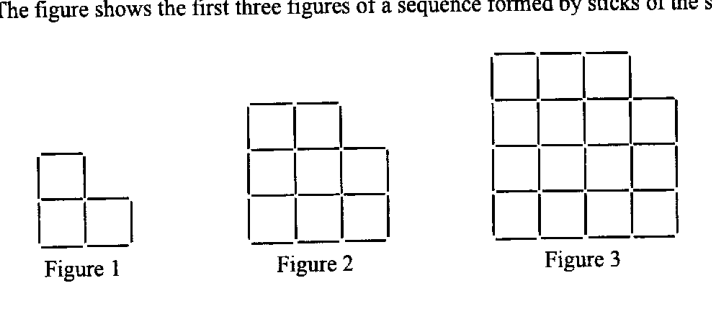
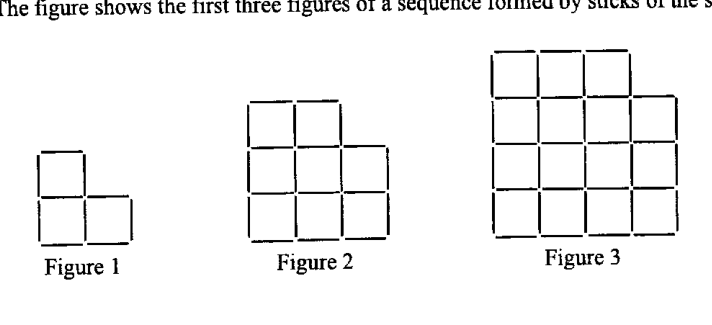
该图展示了由相同大小的木棒组成的图案序列的前三个图案。
- (i)
求图 5 中形成的小正方形的个数。
答案 ...
- (ii)
求一个关于 的表达式,表示图 中正方形的个数。
答案 ...
- (iii)
解释为什么两个连续图案中的正方形个数之和总是奇数。
答案
- (8)
- (b)
下表显示了 4 个序列的第 项。
对于每个序列,序列中的数是总是 7 的倍数、有时是 7 的倍数,还是绝不是 7 的倍数?
写下字母 'A'、'S' 或 'N' 来代表你的答案。
A 总是 7 的倍数
S 有时是 7 的倍数
N 绝不是 7 的倍数
- (Sequence 1)
序列 1 ...
- (Sequence 2)
序列 2 ...
- (Sequence 3)
序列 3 ...
- (Sequence 4)
序列 4 ...
- (Sequence 1)
- (b)
它不会直接告诉你答案,而是问你卡在哪一步看看 AI 是怎么陪你一步步弄懂这道题的
完整解法
8 (a)(i)
1. Substitute the figure number into the given pattern and evaluate.
For Figure 5,
8 (a)(ii)
1. Generalise the given pattern by replacing the figure number with $n$.
From the table,
Figure :
Figure :
Figure :
So for Figure , the number of squares is
8 (a)(iii)
1. Write expressions for the number of squares in two consecutive figures.
From part (ii), the number of squares in Figure is
So the number of squares in Figure is
2. Add the two expressions and show the sum is odd.
Sum of the number of squares:
This is of the form , so it is always odd.
For consecutive figures and ,
Since is even, the sum is always odd.
8 (a)(8)(b)(Sequence 1)
1. Decide whether $4n+3$ can be a multiple of 7.
For Sequence 1, the term is .
Test values of :
When ,
which is a multiple of 7.
When ,
which is not a multiple of 7.
So the terms are multiples of 7 only for some values of .
S
8 (a)(8)(b)(Sequence 2)
1. Determine whether $7n+1$ is ever a multiple of 7.
is always a multiple of .
So is always more than a multiple of , and hence is never a multiple of .
N
8 (a)(8)(b)(Sequence 3)
1. Identify that the nth term is a multiple of 7 for every positive integer value of $n$.
Sequence 3 has nth term
Since is divisible by for all values of , the sequence is always made up of multiples of .
A
8 (a)(8)(b)(Sequence 4)
1. Rewrite the nth term to identify when it is a multiple of 7.
For Sequence 4,
This is a multiple of 7 when is a multiple of 7, for example when
2. Decide the correct classification.
For example:
which is a multiple of 7.
But
which is not a multiple of 7.
So the terms are sometimes multiples of 7.
S
AI 分析,可能出错
用 AI 批改,圈出写错的那一步,并自动将你的薄弱点存入错题本,形成你的错因库。
同一知识点的其他题
- 1求数列 10, 11, 13, 16, 20,... 的第 8 项。 答案
- 2一列数的前四项为 其中 是常数。 求该数列第 项关于 和 的表达式。 答案 ... 给出关于 的两个条件,使得 39…
- 3图 1 显示了一个边长为 1 个单位的等边三角形。去掉一个边长为 1/2 个单位的倒置白色等边三角形,得到图 2。然后从图 2 中去掉三个边长为 1/4 个单位的倒置白色等边三角形,得到图 3。此过程以此类推。 求一个关于 的表达式…
- 4研究以下规律。 写出图 11 中 、 和 的值。 答: = ... = ... = ... 用关于 的代数式表示图 中的 。 答: = ... 解释为什么对于所有整数值…
- 5下面给出了一个数列的前四项。 求 。 答 ... 求用 n 表示 的表达式。 答 ... 计算前十项的和,。 答 ...