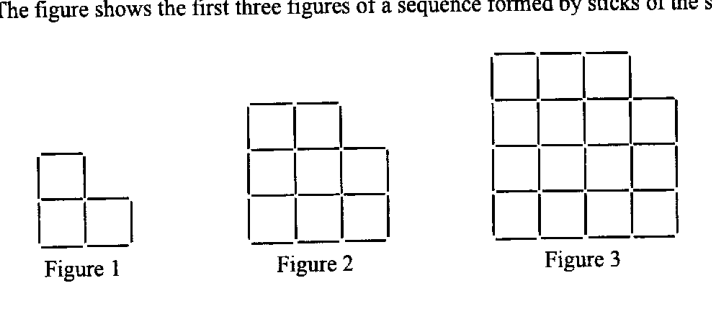
The figure shows the first three figures of a sequence formed by sticks of the same size.
- (i)
Find the number of small squares formed in Figure 5.
Answer ...
- (ii)
Find, in terms of n, an expression for the number of squares in Figure n.
Answer ...
- (iii)
Explain why the sum of the number of squares in two consecutive figures is always odd.
Answer
- (8)
- (b)
The table below shows the terms of 4 sequences.
For each sequence, are the numbers in the sequence always multiples of 7, sometimes multiples of 7 or never multiples of 7?
Write down the letter 'A', 'S' or 'N' to represent your answer.
A Always multiples of 7
S Sometimes multiples of 7
N Never multiples of 7
- (Sequence 1)
Sequence 1 ...
- (Sequence 2)
Sequence 2 ...
- (Sequence 3)
Sequence 3 ...
- (Sequence 4)
Sequence 4 ...
- (Sequence 1)
- (b)
It won't just hand you the answer — it asks where you're stuck.How the checker works
Worked solution
8 (a)(i)
1. Substitute the figure number into the given pattern and evaluate.
For Figure 5,
8 (a)(ii)
1. Generalise the given pattern by replacing the figure number with $n$.
From the table,
Figure :
Figure :
Figure :
So for Figure , the number of squares is
8 (a)(iii)
1. Write expressions for the number of squares in two consecutive figures.
From part (ii), the number of squares in Figure is
So the number of squares in Figure is
2. Add the two expressions and show the sum is odd.
Sum of the number of squares:
This is of the form , so it is always odd.
For consecutive figures and ,
Since is even, the sum is always odd.
8 (a)(8)(b)(Sequence 1)
1. Decide whether $4n+3$ can be a multiple of 7.
For Sequence 1, the term is .
Test values of :
When ,
which is a multiple of 7.
When ,
which is not a multiple of 7.
So the terms are multiples of 7 only for some values of .
S
8 (a)(8)(b)(Sequence 2)
1. Determine whether $7n+1$ is ever a multiple of 7.
is always a multiple of .
So is always more than a multiple of , and hence is never a multiple of .
N
8 (a)(8)(b)(Sequence 3)
1. Identify that the nth term is a multiple of 7 for every positive integer value of $n$.
Sequence 3 has nth term
Since is divisible by for all values of , the sequence is always made up of multiples of .
A
8 (a)(8)(b)(Sequence 4)
1. Rewrite the nth term to identify when it is a multiple of 7.
For Sequence 4,
This is a multiple of 7 when is a multiple of 7, for example when
2. Decide the correct classification.
For example:
which is a multiple of 7.
But
which is not a multiple of 7.
So the terms are sometimes multiples of 7.
S
AI analysis — may contain mistakes.
Worked this one out on paper? Snap your steps and Gigle's AI math checker will circle the step where it went wrong.
More questions on this topic
- 1Find the 8th term of the sequence 10, 11, 13, 16, 20,..., Answer
- 2The first four terms in a sequence of numbers are where is a constant. Fin…
- 3Diagram 1 shows an equilateral triangle with sides of length 1 unit. An inverted white equilateral triangle with sides o…
- 4Study the pattern below. Write down the values of , and in Figure 11. Answer = ... = ... = ... Wr…
- 5The first four terms in a sequence of numbers are given below. Find . Answer ... Find an expression, in terms of n,…