Study the pattern below.
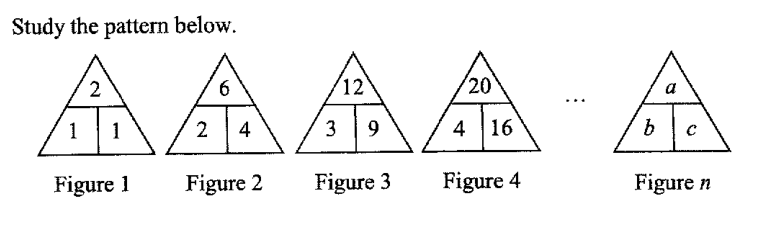
- (a)
Write down the values of , and in Figure 11.
Answer = ...
= ...
= ...
- (b)
Write down an expression, in terms of , for in Figure .
Answer = ...
- (c)
Explain why the value of is even for all integer values of .
Answer ...
...
It won't just hand you the answer — it asks where you're stuck.How the checker works
Worked solution
18(a)
1. Recognise the pattern for the bottom two cells.
From Figures 1 to 4,
bottom-left values are , so in Figure ,
bottom-right values are , so these are squares:
2. Recognise the pattern for the top cell and find its value in Figure 11.
Top values are .
Each is the figure number multiplied by one more than itself:
So in Figure ,
18(b)
1. Identify the rule for the top cell in Figure $n$.
The top values are
These can be written as
So for Figure ,
18(c)
1. Use the expression for $a$ from the pattern.
From part (b),
This means is the product of two consecutive integers, and .
2. Explain why the product is always even.
For any integer value of , one of the two consecutive integers and must be even.
Therefore, is divisible by , so is even.
Since , is the product of two consecutive integers.
For any integer , one of and is even, so their product is even.
Hence is even for all integer values of .
AI analysis — may contain mistakes.
Worked this one out on paper? Snap your steps and Gigle's AI math checker will circle the step where it went wrong.
More questions on this topic
- 1Find the 8th term of the sequence 10, 11, 13, 16, 20,..., Answer
- 2The first four terms in a sequence of numbers are where is a constant. Fin…
- 3Diagram 1 shows an equilateral triangle with sides of length 1 unit. An inverted white equilateral triangle with sides o…
- 4The first four terms in a sequence of numbers are given below. Find . Answer ... Find an expression, in terms of n,…
- 5Here are the first four terms of a sequence. …