Diagram 1 shows an equilateral triangle with sides of length 1 unit. An inverted white equilateral triangle with sides of length 1/2 unit is removed to form Diagram 2. Three inverted white equilateral triangles with sides of length 1/4 unit is then removed from Diagram 2 to form Diagram 3. The process continues in this way.
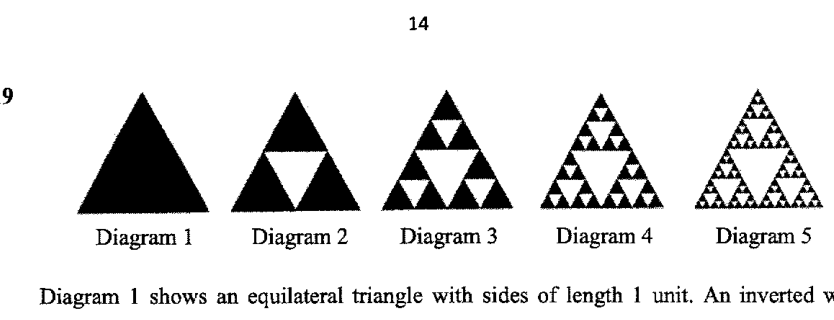
- (a)
Find an expression, in terms of , for the total number of black triangles in Diagram .
Answer ... ,
- (b)
Taking the area of Diagram 1 to be units, find an expression, in terms of and , for the total area of black triangles in Diagram .
Answer ... units
It won't just hand you the answer — it asks where you're stuck.How the checker works
Worked solution
19(a)
1. Identify the pattern in the number of black triangles
Diagram 1 has black triangle.
Diagram 2 has black triangles.
Diagram 3 has black triangles.
So the number of black triangles follows
with each term multiplied by .
2. Write the general expression for Diagram $n$
Since Diagram 1 corresponds to , Diagram 2 to , and Diagram 3 to , Diagram corresponds to
19(b)
1. Find the scale factor for total black area from one diagram to the next
From one diagram to the next, each black triangle is replaced by smaller black triangles.
Each smaller triangle has side length half of the previous one, so its area is
of the previous black triangle.
So the total black area is multiplied by
2. Write the general expression for the total black area in Diagram $n$
Diagram 1 has black area .
There are stages from Diagram 1 to Diagram , so
units
AI analysis — may contain mistakes.
Worked this one out on paper? Snap your steps and Gigle's AI math checker will circle the step where it went wrong.
More questions on this topic
- 1Find the 8th term of the sequence 10, 11, 13, 16, 20,..., Answer
- 2The first four terms in a sequence of numbers are where is a constant. Fin…
- 3Study the pattern below. Write down the values of , and in Figure 11. Answer = ... = ... = ... Wr…
- 4The first four terms in a sequence of numbers are given below. Find . Answer ... Find an expression, in terms of n,…
- 5Here are the first four terms of a sequence. …