[It is given that the surface area and the volume of a sphere of radius is and respectively.]
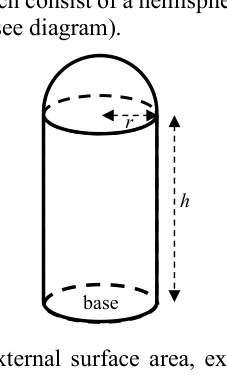
A manufacturer produces barriers which consist of a hemisphere of radius joined to a cylinder of base radius and height (see diagram).
The manufacturer decides that the external surface area, excluding the base, of each barrier is .
Using differentiation, find the exact value of the maximum volume of a barrier.
It won't just hand you the answer — it asks where you're stuck.How the checker works
Worked solution
5
1. Formulate an equation for the external surface area excluding the base.
The external surface area consists of the curved surface area of the cylinder and the curved surface area of the hemisphere.
2. Express the height $h$ in terms of $r$.
3. Formulate an equation for the volume of the barrier in terms of $r$ and $h$.
The volume is the sum of the volumes of the cylinder and the hemisphere:
4. Express the volume $V$ entirely in terms of $r$.
5. Differentiate $V$ with respect to $r$.
6. Equate the derivative to zero to find the stationary value of $r$.
For maximum volume, :
7. Verify that this value of $r$ gives a maximum volume using the second derivative test.
When , .
Since the second derivative is negative, the volume is maximized.
8. Calculate the exact maximum volume.
AI analysis — may contain mistakes.
Worked this one out on paper? Snap your steps and Gigle's AI math checker will circle the step where it went wrong.
More questions on this topic
- 1[The volume of a cone of base radius and height is given by .] A manufacturer makes a…
- 2A sector of angle radians and radius is used to form the curved surface of a right circular co…
- 3As part of an Art Project, a student designed a lantern in the shape of an octahedron as shown in the diagram. The frame…
- 4The following diagram shows the dimensions of a trapezoidal prism with fixed volume units, with varia…
- 5[The volume of a right circular cone of radius and height is .] A student makes a printer…