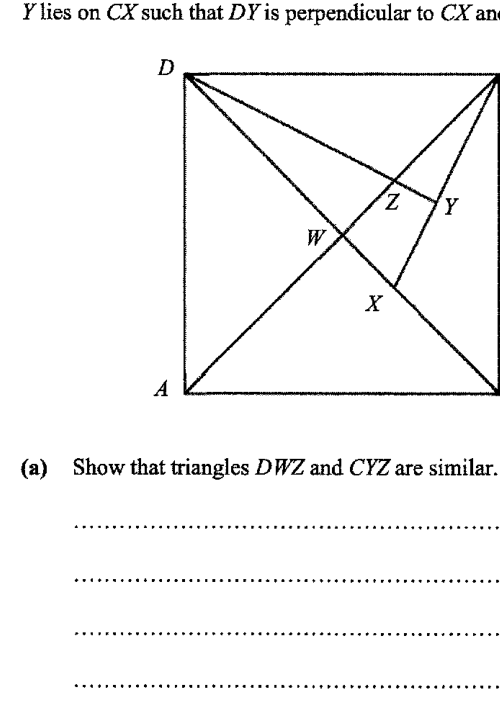
The diagram shows a square ABCD. The diagonals of the square intersect at W and X is a point on the diagonal BD. Y lies on CX such that DY is perpendicular to CX and DY meets AC at Z.
  1. (a)

    Show that triangles DWZ and CYZ are similar.

  2. (b)

    Write down another pair of triangles that are similar but not congruent.

    Answer Δ... and Δ...

  3. (c)

    Prove that triangle BCX and triangle CDZ have the same area.

  4. (d)

    It is given that YZ : WZ = √2 : √5 and 3CZ = 2CW.

    1. (i)

      Find area of ΔCYZ\Delta CYZ / area of ΔDWZ\Delta DWZ.

      Answer ...

    2. (ii)

      Calculate the area of the square ABCD if the area of triangle CYZ is 3 cm^2.

      Answer ... cm^2

Work through it with AI →

It won't just hand you the answer — it asks where you're stuck.How the checker works

Worked solution

9(a)

1. Show one pair of corresponding angles are equal right angles.

In a square, the diagonals are perpendicular.

Since DWDW lies on diagonal BDBD and WZWZ lies on diagonal ACAC,

∠DWZ=90∘\angle DWZ = 90^\circ.

Also, DY⊥CXDY \perp CX is given. Since YZYZ lies on DYDY and CYCY lies on CXCX,

∠CYZ=90∘\angle CYZ = 90^\circ.

Hence,

∠DWZ=∠CYZ\angle DWZ = \angle CYZ.

2. Show a second pair of corresponding angles are equal and conclude similarity.

At ZZ, the straight lines ACAC and DYDY intersect.

Therefore,

∠DZW=∠CZY(vertically opposite angles)\angle DZW = \angle CZY \quad \text{(vertically opposite angles)}.

Since two pairs of corresponding angles are equal,

△DWZ∼△CYZ(AA similarity)\triangle DWZ \sim \triangle CYZ \quad \text{(AA similarity)}.

Answer

∠DWZ=∠CYZ=90∘\angle DWZ = \angle CYZ = 90^\circ

∠DZW=∠CZY(vertically opposite angles)\angle DZW = \angle CZY \quad \text{(vertically opposite angles)}

Therefore, by AA similarity,

△DWZ∼△CYZ.\triangle DWZ \sim \triangle CYZ.

9(b)

1. Write down a valid pair of similar but not congruent triangles.

Since WXWX lies on BDBD and WZWZ lies on ACAC, ∠XWZ=90∘\angle XWZ=90^\circ.

Also, ZYZY lies on DYDY and YXYX lies on CXCX, with DY⊥CXDY\perp CX, so ∠ZYX=90∘\angle ZYX=90^\circ.

Thus a valid pair is

△WXZ\triangle WXZ and △YZX\triangle YZX.

Answer

△WXZ\triangle WXZ and △YZX\triangle YZX

9(c)

1. Set up a coordinate system for the square and represent point X on diagonal BD.

Let the square have side length aa.

Take

A(0,0),B(a,0),C(a,a),D(0,a).A(0,0),\quad B(a,0),\quad C(a,a),\quad D(0,a).

Since XX lies on diagonal BDBD, whose equation is

x+y=a,x+y=a,

let

X=(t,a−t).X=(t,a-t).

2. Find the coordinates of Z using perpendicular gradients and the fact that Z lies on AC.

Gradient of CXCX is

(a−t)−at−a=−tt−a=ta−t.\frac{(a-t)-a}{t-a}=\frac{-t}{t-a}=\frac{t}{a-t}.

Since DY⊥CXDY \perp CX, the gradient of DYDY is

−a−tt.-\frac{a-t}{t}.

Line DYDY passes through D(0,a)D(0,a), so

y=a−a−ttx.y=a-\frac{a-t}{t}x.

Since ZZ lies on diagonal ACAC, y=xy=x. Thus

x=a−a−ttx.x=a-\frac{a-t}{t}x.

Multiplying by tt,

tx=at−(a−t)x.tx=at-(a-t)x.

So

ax=atax=at

and hence

x=t.x=t.

Therefore

Z=(t,t).Z=(t,t).

3. Compare the two triangle areas using base and perpendicular height.

For △BCX\triangle BCX, take base BC=aBC=a.

The perpendicular distance from XX to BCBC is the horizontal distance from XX to the line x=ax=a:

a−t.a-t.

So

Area of △BCX=12(a)(a−t).\text{Area of }\triangle BCX=\frac12(a)(a-t).

For △CDZ\triangle CDZ, take base CD=aCD=a.

The perpendicular distance from ZZ to CDCD is the vertical distance from ZZ to the line y=ay=a:

a−t.a-t.

So

Area of △CDZ=12(a)(a−t).\text{Area of }\triangle CDZ=\frac12(a)(a-t).

Hence

Area of △BCX=Area of △CDZ.\text{Area of }\triangle BCX=\text{Area of }\triangle CDZ.
Answer

Let the square have side length aa, with D(0,a)D(0,a), C(a,a)C(a,a), B(a,0)B(a,0) and A(0,0)A(0,0).

Since XX lies on BDBD, let X=(t,a−t)X=(t,a-t).

As DY⊥CXDY \perp CX, the line through DD perpendicular to CXCX meets ACAC at Z=(t,t)Z=(t,t).

Hence

Area of △BCX=12(a)(a−t)\text{Area of }\triangle BCX=\frac12(a)(a-t)

and

Area of △CDZ=12(a)(a−t).\text{Area of }\triangle CDZ=\frac12(a)(a-t).

Therefore,

Area of △BCX=Area of △CDZ.\boxed{\text{Area of }\triangle BCX=\text{Area of }\triangle CDZ.}

9(d)(i)

1. Use the given corresponding length ratio to find the area ratio of the similar triangles.

From part (a), △DWZ∼△CYZ\triangle DWZ \sim \triangle CYZ.

Since YZYZ corresponds to WZWZ,
area of △CYZarea of △DWZ=(YZWZ)2\frac{\text{area of }\triangle CYZ}{\text{area of }\triangle DWZ}=\left(\frac{YZ}{WZ}\right)^2

Given YZ:WZ=2:5YZ:WZ=\sqrt{2}:\sqrt{5},
area of △CYZarea of △DWZ=(25)2=25.\frac{\text{area of }\triangle CYZ}{\text{area of }\triangle DWZ}=\left(\frac{\sqrt{2}}{\sqrt{5}}\right)^2=\frac{2}{5}.

Answer

area of △CYZarea of △DWZ=25\frac{\text{area of }\triangle CYZ}{\text{area of }\triangle DWZ}=\frac{2}{5}

9(d)(ii)

1. Find the area of $\triangle DWZ$ and hence the area of $\triangle CDZ$.

From part (d)(i),
area of △CYZarea of △DWZ=25.\frac{\text{area of }\triangle CYZ}{\text{area of }\triangle DWZ}=\frac{2}{5}.
Given area of △CYZ=3 cm2\text{area of }\triangle CYZ=3\text{ cm}^2,
3area of △DWZ=25\frac{3}{\text{area of }\triangle DWZ}=\frac{2}{5}
area of △DWZ=3×52=7.5 cm2.\text{area of }\triangle DWZ=\frac{3\times 5}{2}=7.5\text{ cm}^2.

Since 3CZ=2CW3CZ=2CW,
CZ:CW=2:3.CZ:CW=2:3.
As ZZ lies on CWCW,
CZ:ZW=2:1.CZ:ZW=2:1.
Triangles CDZCDZ and DWZDWZ have bases CZCZ and ZWZW on the same straight line ACAC, and the same perpendicular height from DD to ACAC. Hence
area of △CDZarea of △DWZ=CZZW=2.\frac{\text{area of }\triangle CDZ}{\text{area of }\triangle DWZ}=\frac{CZ}{ZW}=2.
So
area of △CDZ=2(7.5)=15 cm2.\text{area of }\triangle CDZ=2(7.5)=15\text{ cm}^2.

2. Relate $\triangle CDZ$ to the square and calculate the square area.

Since CZ:CW=2:3CZ:CW=2:3, triangles CDZCDZ and CDWCDW have the same perpendicular height from DD to ACAC, so
area of △CDZarea of △CDW=CZCW=23.\frac{\text{area of }\triangle CDZ}{\text{area of }\triangle CDW}=\frac{CZ}{CW}=\frac{2}{3}.
Thus
area of △CDW=15×32=22.5 cm2.\text{area of }\triangle CDW=15\times \frac{3}{2}=22.5\text{ cm}^2.

The diagonals of a square divide it into 44 equal triangles, so
area of square ABCD=4(22.5)=90 cm2.\text{area of square }ABCD=4(22.5)=90\text{ cm}^2.

Answer

90 cm290\text{ cm}^2

AI analysis — may contain mistakes.

Worked this one out on paper? Snap your steps and Gigle's AI math checker will circle the step where it went wrong.

More questions on this topic

  1. 1In the diagram, there are two right-angled triangles ΔABD and ΔCEB such that AD = 12 cm, BD = 15 cm and BE = 20 cm. Find…
  2. 2A cuboid has a volume of 250 cm^3, correct to the nearest cubic centimetre. The height of the cuboid is 8.4 cm, correct…
  3. 3The points A, B, C, D and E are shown in the diagram below such that ABC and AED are straight lines and BE = 8\sqrt{8}…
  4. 4In the diagram, triangle XYZ is similar to triangle UXS. Given that US=UX=9US = UX = 9 cm, XY=XZ=20XY = XZ = 20 cm and YZ=12YZ = 12 cm…
  5. 5The diagram below shows a gift souvenir formed by joining the plane face of a solid hemisphere of radius 3 cm and a soli…