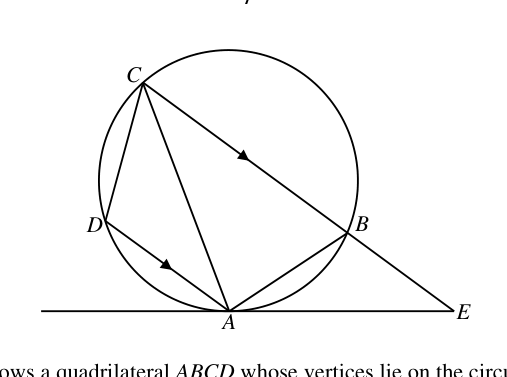
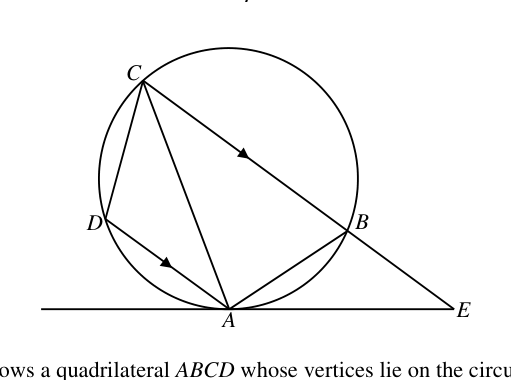
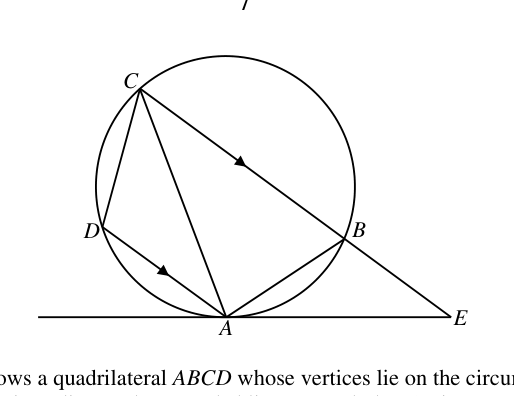
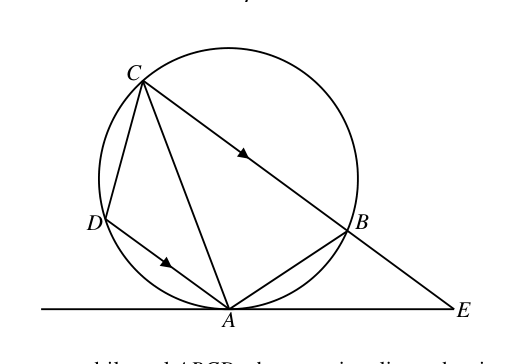
The diagram shows a quadrilateral ABCD whose vertices lie on the circumference of the circle. The point E lies on the extended line CB such that AE is a tangent to the circle. CE and DA are parallel lines.
- (i)
Explain why angle BAE = angle CAD.
- (ii)
Show that triangles BAE and DAC are similar.
- (iii)
Given that AB = BE, explain why the line AC bisects the angle BCD.
It won't just hand you the answer — it asks where you're stuck.How the checker works
Worked solution
7(i)
1. Relate angle BAE to an angle inside the circle using the tangent.
(Alternate Segment Theorem)
2. Relate angle ACB to angle CAD using parallel lines and conclude.
Since ,
(Alternate angles)
Therefore, .
(shown)
7(ii)
1. State the first pair of equal angles from part (i)
From (i), .
2. Identify a second pair of equal angles using parallel lines and cyclic quadrilateral properties
Since , (alternate angles).
Also, (angles in the alternate segment, since is a tangent and is a chord).
Therefore, .
3. Conclude similarity
Since two pairs of corresponding angles are equal ( and ), is similar to (AA similarity).
Triangles BAE and DAC are similar (AA similarity).
7(iii)
1. Use the given side equality to find equal angles in triangle ABE.
Given , is an isosceles triangle.
Therefore, .
2. Use the similar triangles from part (ii) to relate angles in triangle DAC.
From (ii), and are similar.
Corresponding angles are equal, so .
Since (from part i) and , it follows that .
3. Use parallel lines to show the two parts of angle BCD are equal.
Given , alternate angles are equal, so .
Substituting from the previous step gives .
Hence, the line bisects .
Since , the line bisects .
AI analysis — may contain mistakes.
Worked this one out on paper? Snap your steps and Gigle's AI math checker will circle the step where it went wrong.
More questions on this topic
- 1The triangle ABC is such that its area is , the length of AB is …
- 2如果三角形的两条边分别为4和6,那么连结该三角形三边中点所得的周长可能是下列数据中的【 】 A. 6 B. 8 C. 10 D. 12
- 3In , , is a right angle, radians and is the…
- 4The diagram shows a quadrilateral whose vertices lie on the circumference of a circle. The point lies on the…
- 5The equation of a circle is . Find the radius of the circle and the coordinates of its ce…